
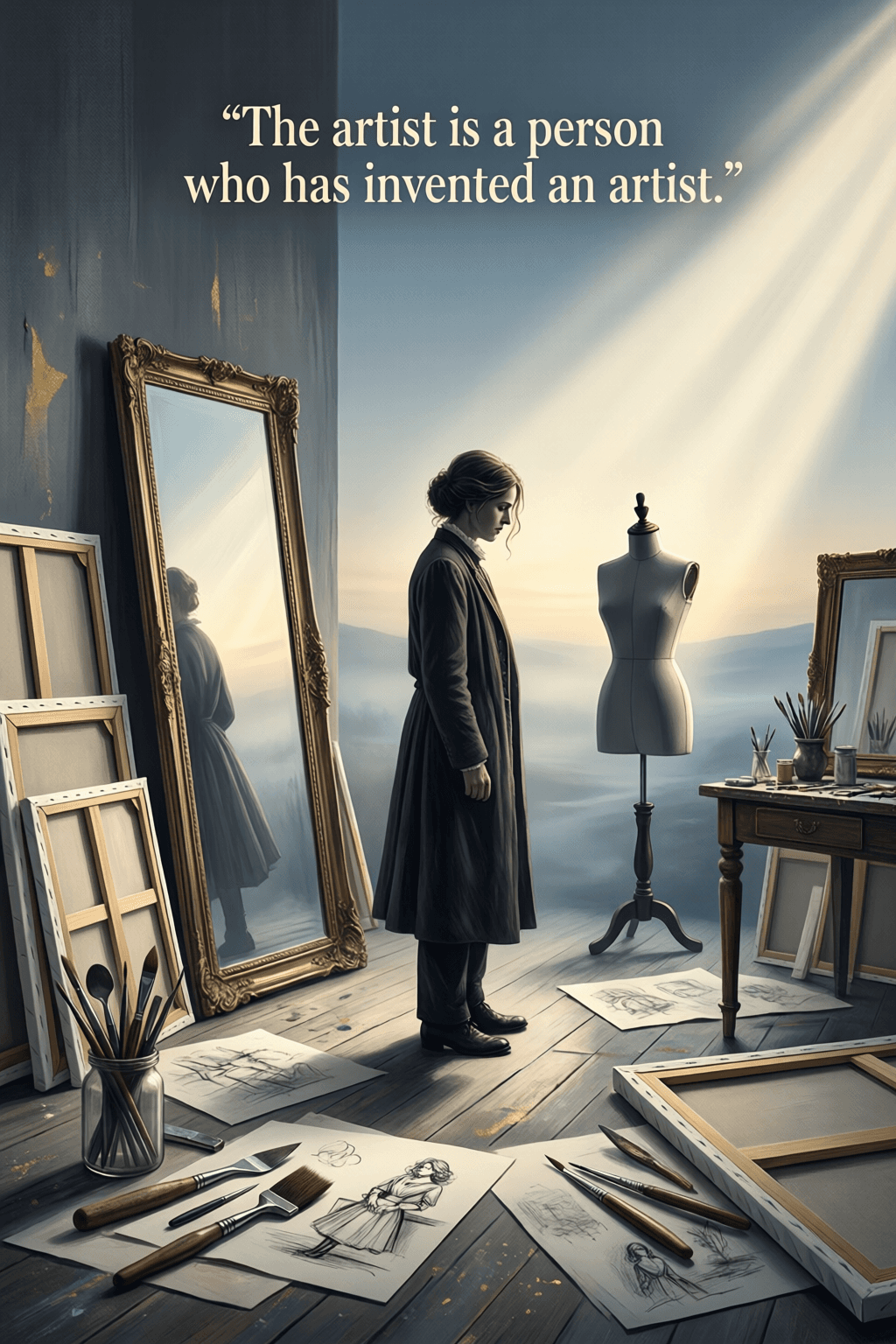
The artist is a person who has invented an artist. — Marcel Duchamp
—What lingers after this line?
Identity as Artistic Construction
At first glance, Duchamp’s remark sounds playful, yet it carries a radical idea: an artist is not simply born with a fixed essence but actively constructs the figure the world comes to recognize as “the artist.” In this view, making art and making oneself are inseparable acts. The painter, sculptor, or provocateur invents a style, a posture, a public voice—and that composite becomes part of the work. This idea fits Duchamp’s broader career, especially his challenge to traditional definitions of art through works like Fountain (1917). By presenting an ordinary urinal as art, he did more than redefine objects; he also redefined the role of the artist as someone who frames meaning rather than merely crafts it by hand. Thus, the artist becomes an authored persona as much as a producer of artifacts.
From Creator to Character
Building on that thought, Duchamp implies that every artist eventually becomes a kind of character in a larger cultural story. The public rarely encounters a pure private self; instead, it meets a curated identity shaped through statements, choices, scandals, and signatures. In that sense, the “artist” is partly a performance, consciously assembled over time. Duchamp himself demonstrated this with his female alter ego, Rrose Sélavy, introduced in the 1920s. Through this persona, he blurred distinctions between author and mask, suggesting that artistic identity could be fluid, ironic, and staged. Consequently, the artist is not only the one who produces images or objects, but also the one who designs the role from which those works emerge.
Modernism and the Reinvention of Authorship
Seen in a wider historical context, Duchamp’s statement marks a turning point in modern art, where authorship became as important as technique. Earlier traditions often emphasized mastery of materials, but modernism increasingly valued the artist’s conceptual stance. Pablo Picasso’s shifting identities across Blue Period melancholy, Cubist experiment, and celebrity genius reveal a similar pattern: the artist continually re-authors himself through reinvention. As a result, artistic identity becomes dynamic rather than stable. This helps explain why modern and contemporary audiences often follow an artist’s biography almost as closely as the works themselves. The invented artist is not a deception, then, but a vehicle through which new forms of meaning can be made visible.
Psychology of the Invented Self
Furthermore, Duchamp’s insight resonates beyond art history because it reflects a broader psychological truth: identity is often shaped through narrative. Thinkers such as Erving Goffman in The Presentation of Self in Everyday Life (1956) argued that people perform roles depending on social context. Duchamp sharpens this idea by showing that artists may do so with unusual deliberateness, turning self-fashioning into part of their creative practice. An anecdotal parallel appears in Salvador Dalí, who cultivated his flamboyant mustache, theatrical interviews, and extravagant behavior as extensions of his surrealist imagination. The spectacle was not incidental; it amplified the art. Therefore, Duchamp’s aphorism suggests that the artist’s persona can function like another medium—no less crafted than paint, marble, or film.
A Challenge to Authenticity
Yet this perspective also raises an unsettling question: if the artist is invented, what becomes of authenticity? Duchamp seems to suggest that authenticity does not require raw transparency or an untouched inner core. Instead, it may arise through conscious construction, when a person deliberately shapes an identity that truthfully expresses their vision, however stylized it may be. This tension appears in Cindy Sherman’s Untitled Film Stills (1977–1980), where she photographs herself in fabricated roles that never reveal a stable “real” self. Even so, the work feels deeply authentic in its exploration of gender, image, and performance. In this light, Duchamp invites us to abandon simplistic oppositions between genuine and artificial; invention itself can be a sincere artistic act.
Why the Quote Still Matters
Finally, Duchamp’s observation feels especially contemporary in an age of branding, social media, and curated public identities. Today, musicians, writers, and visual artists often build recognizable personas across platforms, turning biography, image, and attitude into part of their creative output. What Duchamp anticipated is now nearly unavoidable: the artist is expected not only to make work, but also to make a self that the audience can read. Even so, his quote remains more than a comment on publicity. It reminds us that art does not emerge from a neutral human source; it comes through identities that are shaped, edited, and imagined. For that reason, the artist’s greatest invention may not be a single masterpiece, but the creative self from which all masterpieces become possible.
One-minute reflection
What does this quote ask you to notice today?
Related Quotes
2 selectedThe artist performs only one part of the creative process. The onlooker completes it, and it is the onlooker who has the last word. — Marcel Duchamp
Marcel Duchamp
At first glance, Duchamp’s statement seems to reduce the artist’s authority, yet it actually expands the meaning of art itself. He argues that making an artwork is not a closed act completed in the studio; rather, it rem...
Read full interpretation →You are the artist of your own life. Don't hand the paintbrush to anyone else. — Unknown
Unknown
This quote emphasizes the importance of personal autonomy, encouraging individuals to take control of their own lives and decisions rather than allowing others to dictate their path.
Read full interpretation →More From Author
More from Marcel Duchamp →