
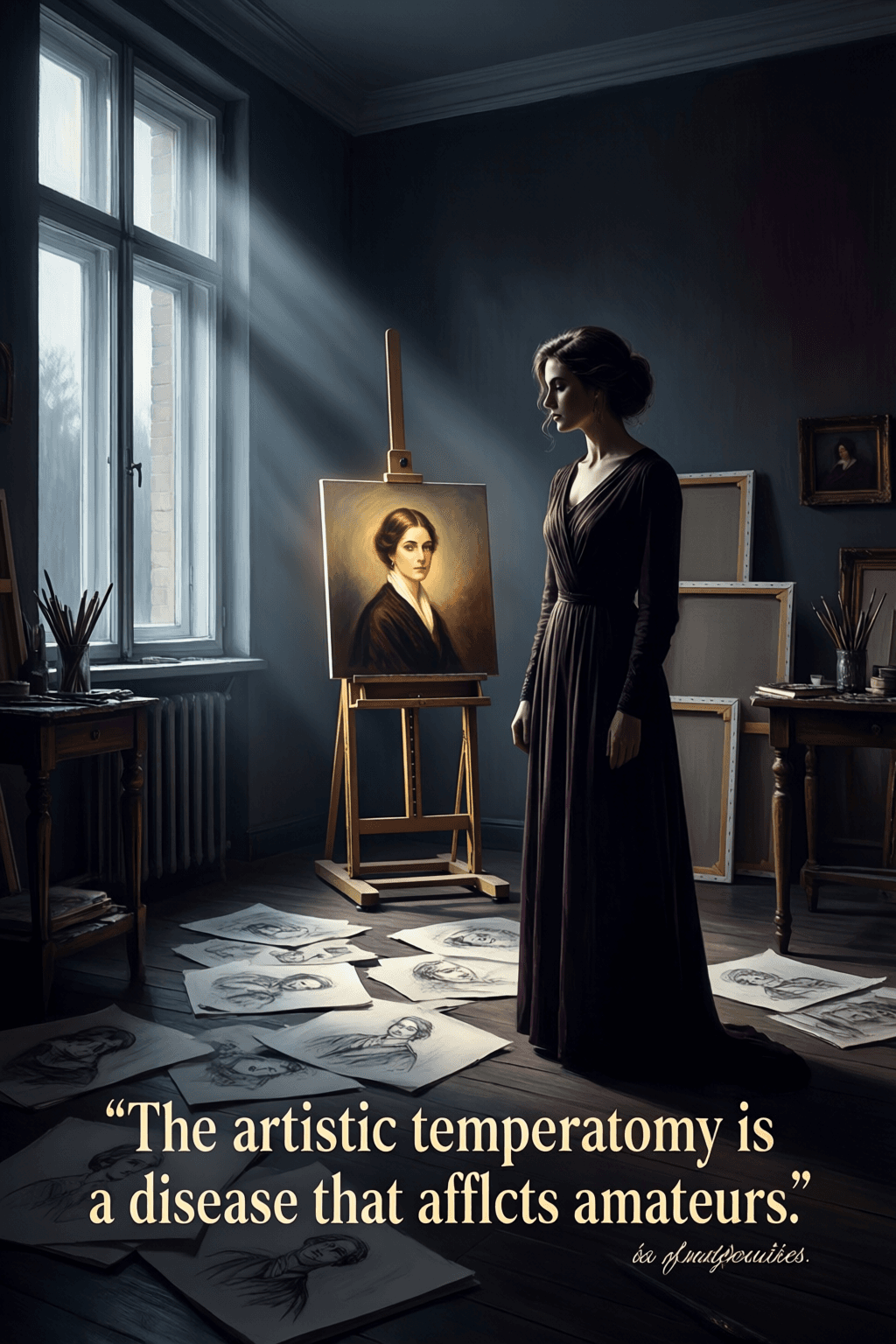
The artistic temperament is a disease that afflicts amateurs. — G. K. Chesterton
—What lingers after this line?
A Provocation About Artistic Identity
At first glance, Chesterton’s remark sounds almost cruel, yet its sharpness is deliberate. By calling the artistic temperament a “disease,” he mocks the habit of treating artistic sensitivity as a grand personal affliction. In his usual paradoxical style, he shifts attention away from art itself and toward the self-dramatizing posture that can gather around it. This opening jab matters because Chesterton is not dismissing creativity; rather, he is challenging the vanity that sometimes masquerades as creativity. The quote suggests that what truly afflicts amateurs is not their love of art, but their obsession with feeling like artists.
Why Amateurs Are the Target
From there, the word “amateurs” becomes crucial. Chesterton often distrusted pretension more than incompetence, and here he implies that beginners are especially vulnerable to romantic myths about suffering, moodiness, and exceptionalism. Instead of learning craft, they may become attached to the image of themselves as misunderstood creators. In this sense, the amateur’s problem is psychological before it is technical. A professional, by contrast, usually has deadlines, revisions, and practical constraints. Those demands leave less room for cultivating a theatrical temperament and more room for simply doing the work.
Craft Versus Self-Consciousness
Consequently, the quote draws a line between making art and performing the role of artist. Chesterton hints that genuine artistic labor is often disciplined, repetitive, and even humble. Painters mix pigments, writers revise sentences, and musicians practice scales; none of this depends on maintaining a glamorous aura of torment. This contrast appears across artistic history. Gustave Flaubert’s letters, for example, show relentless devotion to style through labor rather than mere temperament, while Igor Stravinsky argued in his Poetics of Music (1942) that discipline, not emotional indulgence, makes artistic freedom possible. Chesterton’s wit therefore exposes self-consciousness as a distraction from mastery.
The Satire of Romantic Suffering
At the same time, Chesterton is pushing back against a long cultural tradition that links art with illness, melancholy, and instability. Nineteenth-century Romanticism often elevated the suffering genius into a near-sacred figure, and later bohemian culture turned that image into a lifestyle. Chesterton punctures this myth by implying that affectation, not inspiration, is what often spreads. There is a comic truth in this. Anyone who has met a novice poet who mistakes gloom for depth or a young painter who confuses eccentricity with originality has encountered the pattern Chesterton describes. His aphorism works because it satirizes a recognizable temptation: to cultivate symptoms instead of substance.
A Defense of Ordinary Health
Yet beneath the joke lies a positive ideal. Chesterton frequently celebrated sanity, gratitude, and ordinary life, believing that wonder arises not from cultivated neurosis but from seeing the familiar world clearly. In that broader context, this quote becomes a defense of health—mental, moral, and artistic. Accordingly, real art need not depend on fragility as a badge of honor. One can be serious without being solemn, imaginative without being unstable, and original without being afflicted. Chesterton’s deeper point is that art flourishes best when ego recedes and attention returns to reality.
Why the Saying Still Resonates
Finally, the line remains relevant because modern culture still rewards artistic persona as much as artistic achievement. Social media, in particular, can encourage creators to curate an identity of exquisite sensitivity before they have developed a body of work. Chesterton’s old epigram cuts through that temptation with startling efficiency. What survives, then, is not merely a joke about amateurs but a durable warning about self-mythology. If the artistic temperament becomes something one displays instead of something one disciplines, it stops serving art. In that sense, Chesterton’s provocation still invites creators to exchange theatrical suffering for honest practice.
Recommended Reading
As an Amazon Associate, we earn from qualifying purchases.
One-minute reflection
What feeling does this quote bring up for you?
Related Quotes
6 selectedIf seeds in the black earth can turn into such beautiful roses, what might not the heart of man become in its long journey toward the stars? — G.K. Chesterton
G. K. Chesterton
Chesterton begins with a striking contrast: black earth, dark and ordinary, somehow gives rise to roses of astonishing beauty. From that image, he invites us to see human nature in the same light.
Read full interpretation →I would maintain that thanks are the highest form of thought, and that gratitude is happiness doubled by wonder. — G. K. Chesterton
G. K. Chesterton
Chesterton’s remark begins by elevating gratitude beyond manners and placing it within the life of the mind. To say that thanks are the highest form of thought is to suggest that real intelligence does not end in analysi...
Read full interpretation →Gratitude is not a passive observation of good things; it is a deliberate, daily refusal to be consumed by what is missing. — G.K. Chesterton
G. K. Chesterton
Chesterton’s statement immediately shifts gratitude from a soft emotion to an active discipline. He argues that thankfulness is not simply noticing pleasant moments as they pass; rather, it is a conscious choice to direc...
Read full interpretation →Humility is the mother of all virtues. — G.K. Chesterton
G. K. Chesterton
Chesterton’s statement presents humility not as one virtue among many, but as the source from which the rest arise. In calling it the “mother of all virtues,” he suggests that courage, justice, patience, and charity beco...
Read full interpretation →It is the main earthly business of a human being to make his home, and the immediate surroundings of his home, as symbolic and significant to his own imagination as he can. — G. K. Chesterton
G. K. Chesterton
Chesterton begins with a striking claim: making a home is not a secondary chore but one of our central earthly tasks. By calling it our “main earthly business,” he elevates domestic life into something almost moral and a...
Read full interpretation →An inconvenience is only an adventure wrongly considered. — G. K. Chesterton
G. K. Chesterton
G. K.
Read full interpretation →More From Author
More from G. K. Chesterton →If seeds in the black earth can turn into such beautiful roses, what might not the heart of man become in its long journey toward the stars? — G.K. Chesterton
Chesterton begins with a striking contrast: black earth, dark and ordinary, somehow gives rise to roses of astonishing beauty. From that image, he invites us to see human nature in the same light.
Read full interpretation →I would maintain that thanks are the highest form of thought, and that gratitude is happiness doubled by wonder. — G. K. Chesterton
Chesterton’s remark begins by elevating gratitude beyond manners and placing it within the life of the mind. To say that thanks are the highest form of thought is to suggest that real intelligence does not end in analysi...
Read full interpretation →Gratitude is not a passive observation of good things; it is a deliberate, daily refusal to be consumed by what is missing. — G.K. Chesterton
Chesterton’s statement immediately shifts gratitude from a soft emotion to an active discipline. He argues that thankfulness is not simply noticing pleasant moments as they pass; rather, it is a conscious choice to direc...
Read full interpretation →Humility is the mother of all virtues. — G.K. Chesterton
Chesterton’s statement presents humility not as one virtue among many, but as the source from which the rest arise. In calling it the “mother of all virtues,” he suggests that courage, justice, patience, and charity beco...
Read full interpretation →