
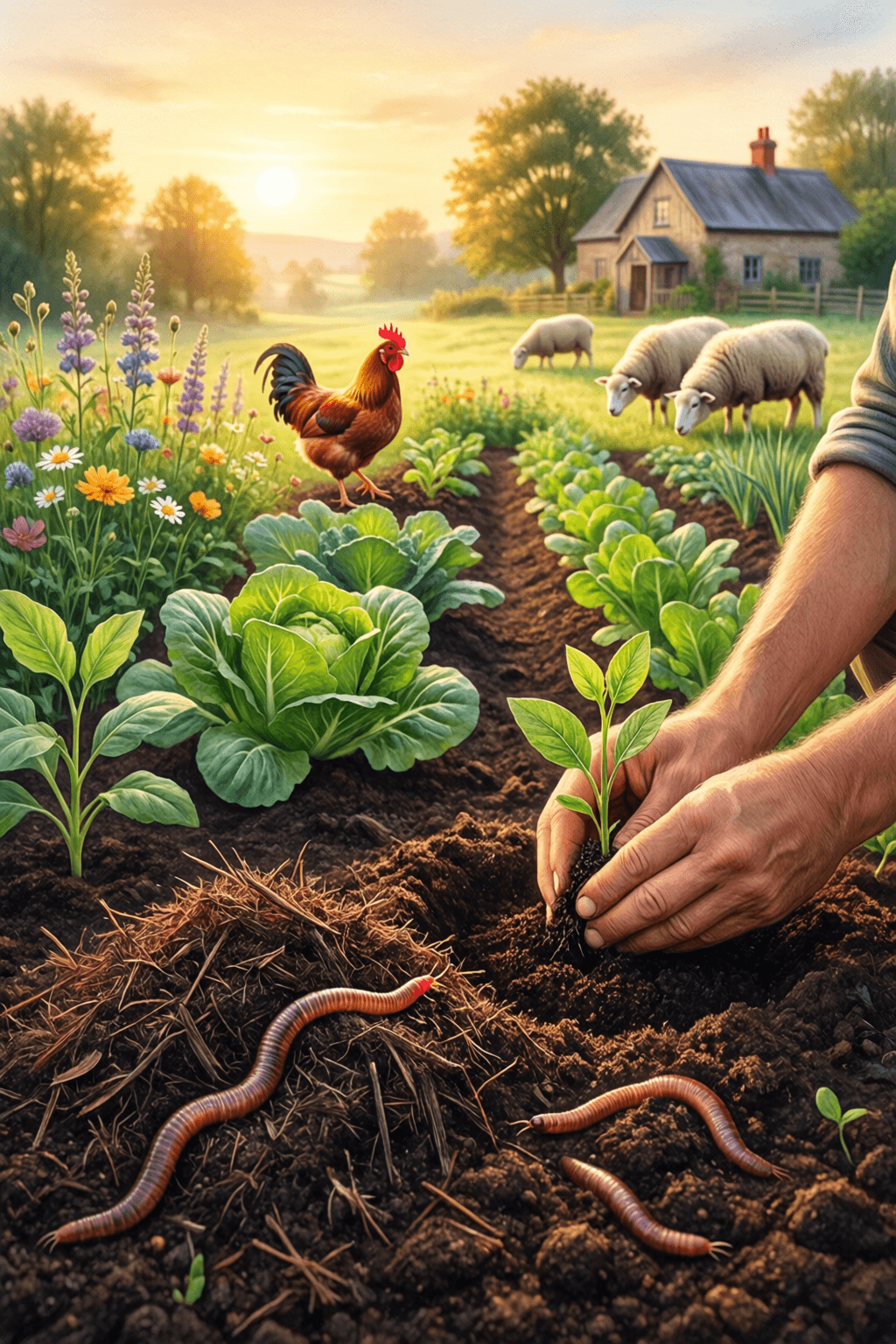
The health of soil, plant, animal and man is one and indivisible. — Albert Howard
—What lingers after this line?
A Unified View of Living Systems
Albert Howard’s statement begins with a radical simplicity: the well-being of soil, plants, animals, and humans cannot be separated into neat compartments. Rather than treating health as a series of isolated problems, he frames it as one continuous living process. In this view, the ground beneath our feet is not merely a resource but the first link in a chain that reaches our bodies and societies. This idea was central to Howard’s agricultural philosophy in works such as An Agricultural Testament (1940), where he argued that fertile soil is the foundation of durable civilization. Thus, the quote does more than praise nature’s harmony; it insists that every act of cultivation, feeding, and healing participates in a single biological order.
Why Soil Comes First
From that broader vision, Howard directs our attention to soil as the hidden origin of health. Soil is not inert dirt but a living community of minerals, fungi, bacteria, insects, and decaying organic matter. When this community is balanced, it nourishes crops with resilience as well as nutrients; when it is exhausted, the weakness often travels upward through the food chain. In practical terms, this means degraded land can produce abundant-looking harvests that are nonetheless less vital. Howard’s compost-centered methods, developed in part from observations in India during the early 20th century, reflected this conviction: feed the soil first, and the rest of the system will follow. Consequently, human health begins long before the meal reaches the plate.
Plants as the Living Middle Link
Once soil is understood as living, plants appear not as isolated products but as translators between earth and animal life. They absorb what the soil offers and convert it into forms that sustain herbivores, omnivores, and ultimately human communities. In this sense, the condition of a plant reveals the condition of the world beneath it. Moreover, healthy plants are typically better able to resist pests and disease, a point long emphasized in ecological farming. Howard believed that weakness in crops was often a symptom of deeper imbalance rather than merely an external attack. Therefore, instead of focusing only on curing the plant, his philosophy asks us to trace symptoms back to the larger system that produced them.
Animals Reflect the Land They Depend On
The chain continues naturally from plants to animals. Livestock raised on nourishing forage from biologically rich land often show stronger growth, fertility, and resistance than animals fed from depleted systems. Howard’s insight suggests that animal health is not solely a matter of veterinary intervention; it is also an agricultural and ecological outcome. This perspective has echoed through later movements in pasture-based farming and holistic grazing, which argue that the quality of feed, habitat, and soil life affects the vitality of the herd. In other words, the animal becomes a visible measure of invisible land conditions. As a result, sickness in livestock can be read not only as an individual problem but as a sign that something earlier in the chain has been neglected.
Human Health Is Ecological, Not Isolated
By the time Howard reaches “man,” the quote acquires its deepest moral force: human health cannot be divorced from the ecological processes that sustain it. Modern societies often treat medicine, agriculture, and environmental care as separate fields, yet Howard collapses those boundaries. The food people eat, the air and water they rely on, and the resilience of the land all shape bodily health long before a doctor enters the picture. In this way, the statement anticipates later frameworks such as “One Health,” which links human, animal, and environmental well-being, and even aspects of public health nutrition. Therefore, Howard’s line reads not as rustic idealism but as a systemic warning: damage the natural basis of life, and human health will eventually register the cost.
An Ethical Lesson for Agriculture
Finally, the quote carries an ethical challenge. If the health of soil, plant, animal, and human is truly indivisible, then exploitative farming is not merely inefficient; it is self-destructive. To strip soil for short-term yield is also to weaken crops, burden animals, and compromise the people who depend on them. Howard’s thought turns stewardship from a sentimental virtue into a practical necessity. Accordingly, his message remains urgent in debates over industrial agriculture, biodiversity loss, and regenerative farming. It asks us to replace fragmentary thinking with responsibility for the whole. In the end, Howard’s sentence endures because it expresses a truth both scientific and civilizational: life flourishes together, or it declines together.
Recommended Reading
As an Amazon Associate, we earn from qualifying purchases.
One-minute reflection
What does this quote ask you to notice today?
More From Author
More from Albert Howard →