
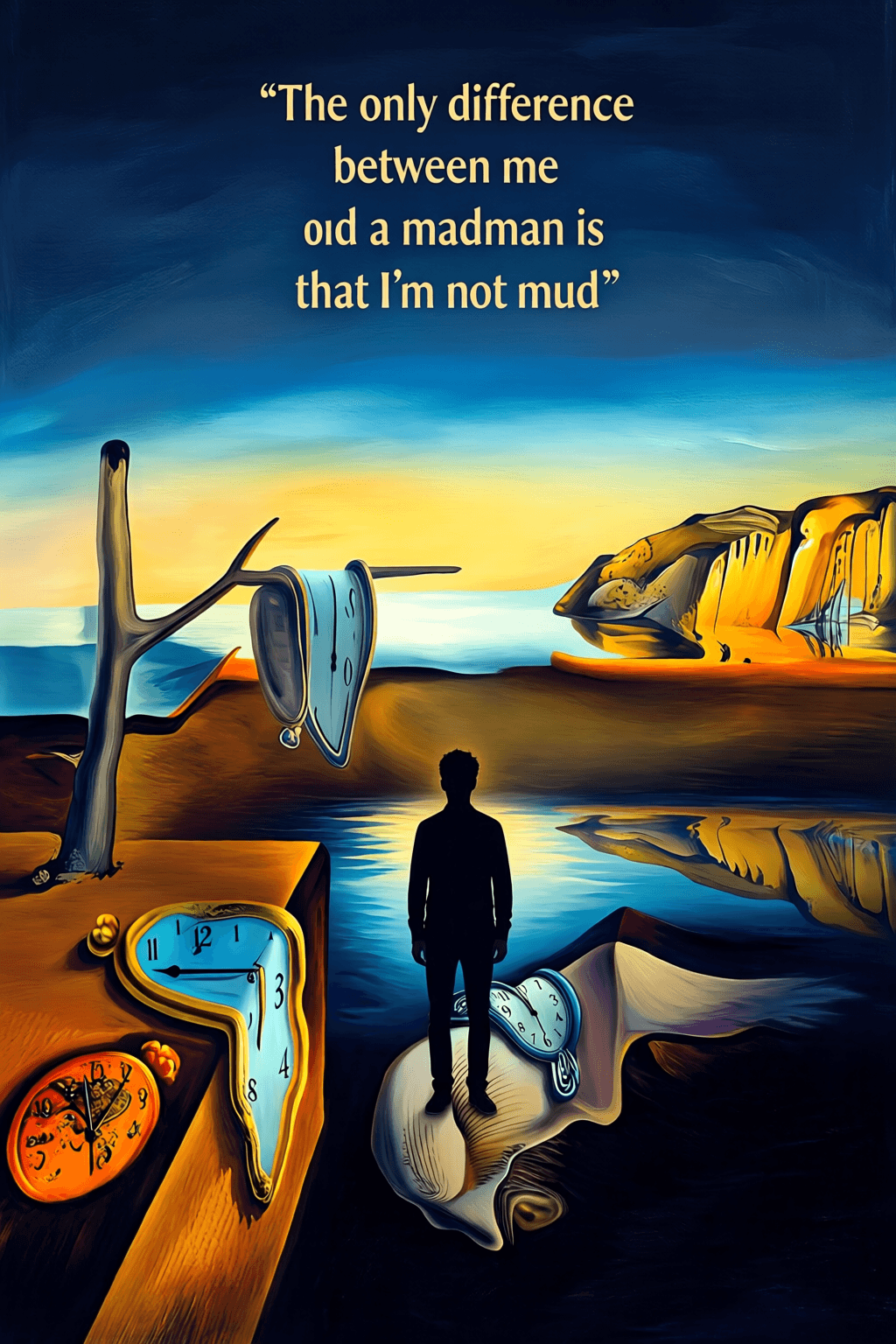
The only difference between me and a madman is that I'm not mad. — Salvador Dalí
—What lingers after this line?
A Provocation Disguised as a Joke
At first glance, Dalí’s line sounds like a clever contradiction: he claims closeness to a madman while insisting on a decisive difference. Yet that tension is precisely the point. Salvador Dalí, famous for turning shock into art, uses humor to unsettle the listener and blur the boundary between eccentricity and illness. In this way, the remark becomes more than a punchline. It invites us to ask who gets labeled irrational and why. By framing himself as nearly indistinguishable from a madman, Dalí suggests that unusual behavior may look chaotic from the outside while still being guided by intention within.
The Persona Behind the Statement
Seen in the context of Dalí’s public life, the quote also reflects a deliberately crafted persona. With his theatrical mustache, extravagant interviews, and dreamlike paintings such as The Persistence of Memory (1931), he cultivated an image that hovered between genius and absurdity. Consequently, the statement works as self-mythology as much as self-description. Rather than denying his strangeness, Dalí amplified it. However, he also wanted control over how that strangeness was interpreted. The line therefore draws a careful distinction: he may appear wild, but he remains self-aware. That difference, subtle yet crucial, separates performance from breakdown.
Surrealism and the Edge of Reason
From there, the quote connects naturally to Surrealism, the movement that prized dreams, irrational juxtapositions, and the liberation of the unconscious. André Breton’s Surrealist Manifesto (1924) called for an art that could bypass ordinary logic, and Dalí became one of its most recognizable practitioners. His images often resemble hallucinations, but they are meticulously composed. Thus, Dalí’s apparent madness is not accidental confusion; it is disciplined imagination. He approaches the irrational as material to shape, not as a force that overwhelms him. The statement captures that paradox beautifully: he ventures to the edge of reason in order to create, yet he insists he has not fallen off.
The Thin Line Between Genius and Madness
Moreover, Dalí’s remark belongs to a long cultural tradition linking brilliance with instability. Plato’s Phaedrus (c. 370 BC) speaks of divine madness as a source of poetic inspiration, and later writers often romanticized the suffering artist. By echoing that tradition, Dalí positions himself among creators whose visions seem too intense for ordinary categories. Still, the quote resists complete romanticization. It does not simply say madness and genius are the same; instead, it depends on a distinction between them. Dalí implies that creativity may resemble madness in form—its bold leaps, strange images, and defiance of convention—while differing in one essential respect: the artist can return and explain the journey.
A Psychological Reading of Self-Awareness
Psychologically, the line turns on the idea of insight. In many forms of severe mental disturbance, one hallmark can be the inability to recognize one’s altered condition. Dalí’s joke rests on the opposite premise: he knows exactly how he appears and comments on it with theatrical precision. That self-observation becomes his proof of sanity. At the same time, the quote exposes how unstable such proof can feel. After all, many people who defy social norms are casually called mad when they are simply unconventional. Dalí exploits that ambiguity, reminding us that society often confuses nonconformity with pathology, especially when confidence and oddity appear together.
Why the Quote Still Resonates
Finally, the statement endures because it speaks to a modern fear and fascination: the possibility that originality always risks being misunderstood. In creative fields especially, people often walk a narrow path between visionary thinking and social suspicion. Dalí turns that anxiety into a memorable line, one that is both comic and defensive. For contemporary readers, the quote remains compelling because it captures an everyday truth in exaggerated form. Many of us have felt that our inner logic made perfect sense even when others found it bizarre. Dalí dramatizes that experience brilliantly, leaving us with a paradox that is amusing on the surface and deeply revealing underneath.
One-minute reflection
What feeling does this quote bring up for you?
Related Quotes
6 selectedI am not a glitch in the system; I am the system evolving. — Octavia Butler
Octavia Butler
At first glance, Octavia Butler’s line transforms a defensive statement into a declaration of power. To say “I am not a glitch in the system” rejects the idea of being an error, an anomaly, or an inconvenience to the est...
Read full interpretation →Confidence is knowing who you are and not changing it a bit because someone's version of your reality is not their reality. — Shannon L. Alder
Shannon L. Alder
At its core, Shannon L. Alder’s quote defines confidence not as loudness or display, but as a steady knowledge of one’s own identity.
Read full interpretation →Your personal boundaries protect the inner core of your identity and your right to choices. — Gerard Manley Hopkins
Gerard Manley Hopkins
At its heart, Hopkins’s statement presents personal boundaries as more than social preferences; they are safeguards around the deepest parts of the self. The “inner core” suggests identity, dignity, and private convictio...
Read full interpretation →You walk in the rain and you feel the rain, but, importantly, you are not the rain. — Matt Haig
Matt Haig
Matt Haig’s line begins with an ordinary scene—walking in the rain—then pivots into a psychological distinction: sensation is real, but identity is separate. You can be soaked, cold, and uncomfortable, and none of that c...
Read full interpretation →Healing is not a return to who you were before, but a becoming of who you are now. — Gabor Maté
Gabor Maté
Gabor Maté reframes healing as forward movement rather than restoration. Instead of treating recovery as a rewind to a pre-injury, pre-trauma, or pre-illness “original,” he suggests that healing creates someone new—someo...
Read full interpretation →You are under no obligation to be the person you were five minutes ago. — Alan Watts
Alan Watts
Alan Watts’s line opens with a startling kind of relief: you don’t owe continuity to anyone—not even to yourself. Rather than treating identity as a contract signed in the past, he frames it as something closer to a livi...
Read full interpretation →More From Author
More from Salvador Dalí →Challenge the expected by practicing the unexpected with confidence. — Salvador Dalí
Dalí’s injunction turns disruption from a lucky accident into a discipline: challenge the expected by repeatedly rehearsing the unexpected. Rather than waiting for inspiration, he implies a method—treat surprise as a ski...
Read full interpretation →He who wishes to interest others must provoke them. - Salvador Dalí
This quote by Salvador Dalí suggests that to capture and maintain the interest of others, one must evoke strong emotions or reactions. Simple or bland content often fails to capture attention, whereas provocative ideas s...
Read full interpretation →He who wants to interest others must provoke them. - Salvador Dalí
This quote suggests that to capture people's attention and engage them meaningfully, one must challenge their thoughts, beliefs, or emotions. Provocation serves as a catalyst for deeper interest and dialogue.
Read full interpretation →He who wishes to interest others must provoke them. - Salvador Dalí
This quote suggests that to capture and hold the attention of others, one must challenge their ideas, beliefs, or emotions. Provocation stirs curiosity and engagement.
Read full interpretation →