
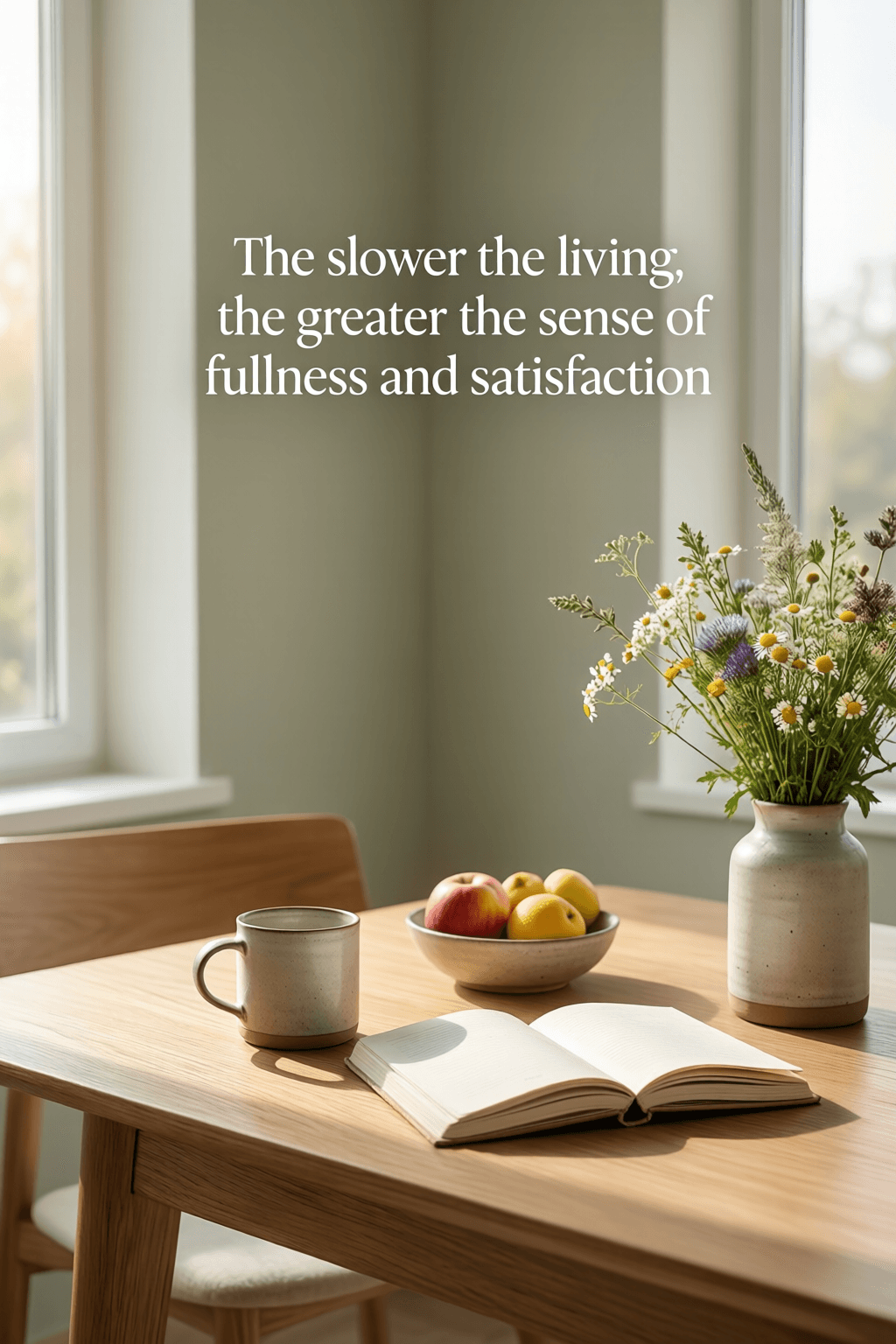
The slower the living, the greater the sense of fullness and satisfaction. — Ann Voskamp
—What lingers after this line?
A Different Measure of a Good Life
Ann Voskamp’s line proposes a quiet reversal of modern values: instead of equating a full life with a crowded schedule, she links fullness to slowness. At first glance, this seems countercultural, even impractical, because contemporary life often rewards speed, productivity, and constant availability. Yet her insight suggests that satisfaction does not necessarily grow from doing more, but from noticing more. In that sense, slowness becomes less about inactivity and more about attention. A day felt deeply—through conversation, reflection, or simple presence—can seem richer than one packed with accomplishments but blurred by haste. Thus, Voskamp invites us to reconsider whether abundance is measured by quantity or by depth of experience.
Why Hurry Empties Experience
From there, the quote points to a familiar paradox: the faster we move, the less we often feel. When life is driven by urgency, moments are consumed before they are truly inhabited. Meals become fuel, walks become errands, and even relationships risk becoming administrative exchanges rather than encounters of care. Modern psychology often supports this intuition. Studies on mindfulness, such as Jon Kabat-Zinn’s work beginning in the late 1970s, show that deliberate attention can reduce stress and increase well-being. In other words, slowing down does not merely change pace; it changes perception. What seemed ordinary under pressure may reveal texture, gratitude, and meaning once we stop rushing past it.
Fullness Through Attention and Gratitude
Consequently, Voskamp’s idea aligns closely with traditions that treat gratitude as a path to abundance. Her own writing in One Thousand Gifts (2010) emphasizes that naming small blessings transforms one’s experience of life. A cup of tea, late afternoon light, or a child’s laughter may appear insignificant in a hurried frame, yet under a slower gaze they become sources of genuine satisfaction. This is why slowness often feels full rather than empty. It creates room for appreciation, and appreciation enlarges experience from within. Rather than chasing extraordinary moments, a person begins to discover that the ordinary is already rich when it is received with care.
An Old Wisdom Across Traditions
Seen more broadly, Voskamp’s insight belongs to a long lineage of thought. Henry David Thoreau’s Walden (1854) famously praises simplicity and deliberate living, arguing that people often overcomplicate life in pursuit of what does not truly nourish them. Likewise, Buddhist teachings on mindful awareness encourage an unhurried presence that allows one to encounter reality without grasping or distraction. Although these traditions differ in language and worldview, they converge on a similar lesson: inner satisfaction is rarely produced by acceleration. Instead, it emerges when life is lived with intention. In this way, Voskamp’s brief statement echoes an enduring human suspicion that speed can make us efficient, but not necessarily fulfilled.
Slowness as Resistance and Renewal
At the same time, slowing down is not simply a lifestyle preference; it can also be an act of resistance. In cultures shaped by metrics, notifications, and perpetual comparison, choosing a slower rhythm declares that a human being is more than output. It protects space for rest, relationships, and interior life—those dimensions that cannot be optimized without being diminished. A simple anecdote illustrates this well: many people report that a phone-free dinner feels longer, warmer, and more memorable than an evening spent half-scrolling. The clock may show the same hour, but the lived experience is fuller. Therefore, slowness renews not only our energy but our ability to belong to the moment we are in.
Living Slowly Without Escaping Life
Finally, Voskamp’s quote should not be mistaken for a rejection of responsibility or ambition. Slower living does not require abandoning work, family duties, or goals; rather, it asks for a different quality of engagement with them. One can act diligently while resisting franticness, just as one can be productive without surrendering every moment to pressure. The deeper promise of the quote, then, is balance. A slower life is not necessarily a smaller life, but a more inhabited one. By moving with greater deliberateness, people often recover what busyness conceals: a sense of enoughness, a clearer awareness of beauty, and the quiet satisfaction of having truly lived the moments they were given.
Recommended Reading
As an Amazon Associate, we earn from qualifying purchases.
One-minute reflection
Why might this line matter today, not tomorrow?
Related Quotes
6 selectedTo be fully alive is to allow yourself the grace of slowing down. — Thich Nhat Hanh
Thich Nhat Hanh
Thich Nhat Hanh’s words begin with a gentle challenge to modern life: we often mistake speed for vitality, as though being busy proves that we are truly living. Yet his insight reverses that assumption.
Read full interpretation →Rest for you could look like moving slower as you clean the house or being mindful while you make a meal. It probably means being nicer to yourself. — Jeff Brown
Jeff Brown
At first glance, Jeff Brown’s reflection challenges the common idea that rest only happens when all activity stops. Instead, he suggests that rest can exist inside ordinary moments: in the pace we choose, the attention w...
Read full interpretation →I will get there, but now I'm here, and here is wonderful. — Jenny Offill
Jenny Offill
Jenny Offill’s line gently overturns the modern obsession with destinations. At first, “I will get there” acknowledges ambition and movement, yet the sentence immediately returns us to the present: “but now I’m here.” In...
Read full interpretation →Don't go expecting perfection; be satisfied with even the smallest progress. — Marcus Aurelius
Marcus Aurelius
Marcus Aurelius advises against the exhausting demand for flawlessness and redirects attention toward modest improvement. In the spirit of Stoic thought, especially in his Meditations (c.
Read full interpretation →A crust eaten in peace is better than a banquet partaken in anxiety. — Aesop
Aesop
At first glance, Aesop’s saying contrasts two meals, yet its real subject is the quality of life surrounding them. A dry crust seems poor beside a banquet, but once peace enters the comparison, the values reverse.
Read full interpretation →Your worth is not a spreadsheet. You are not a project to be completed, but a life to be experienced. Stop measuring and start breathing. — Anne Lamott
Anne Lamott
Anne Lamott’s quote begins by confronting a habit many people barely notice: treating human value as if it could be tabulated. A spreadsheet symbolizes order, productivity, and comparison, yet it also reduces complexity...
Read full interpretation →More From Author
More from Ann Voskamp →