
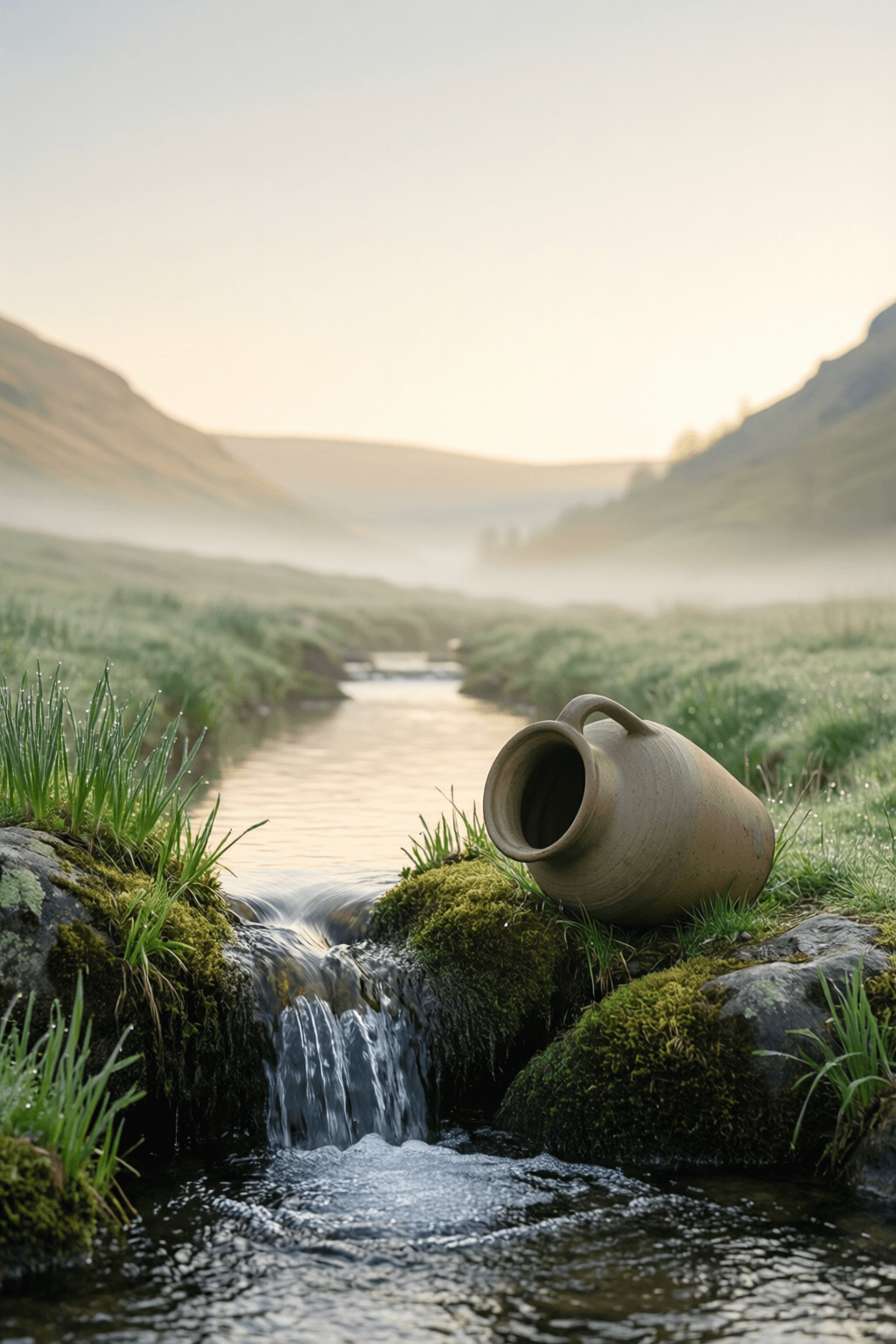
The spring that keeps running is more valuable than the jug which bottoms out each day. — Charlotte Joko Beck
—What lingers after this line?
A Metaphor of Lasting Abundance
At first glance, Charlotte Joko Beck’s image contrasts two simple things: a living spring and a finite jug. The spring matters more because it renews itself, while the jug, however useful, eventually runs dry. In that contrast, Beck points to a deeper truth about value: what continually gives life, energy, or clarity is more precious than what merely stores a temporary reserve. From there, the quote invites us to look beyond appearances. A jug can seem convenient because it is visible and graspable, yet the spring represents something more fundamental—the source itself. In Zen teaching, as seen throughout Beck’s Everyday Zen (1989), attention often shifts from possessions and surface solutions to the underlying conditions that sustain us.
Zen Attention to the Source
Seen through Beck’s Zen perspective, the saying is not just about resources but about awareness. Zen repeatedly asks us to return to what is direct, alive, and present rather than clinging to what is fixed and limited. Thus, the running spring can symbolize an inner steadiness that keeps replenishing itself when we meet life honestly, moment by moment. In that sense, the jug resembles the habits by which we try to secure ourselves—status, routines, even fixed opinions. Those containers can help for a time, yet they cannot replace living contact with reality. Beck’s teaching, influenced by Zen masters such as Shunryu Suzuki in Zen Mind, Beginner’s Mind (1970), similarly emphasizes freshness over accumulation.
The Difference Between Means and Source
Moreover, the quote distinguishes between a means of carrying something and the origin of what is carried. A jug is useful only because water first exists elsewhere; without the spring, the vessel has no purpose. This shifts our thinking from managing outputs to protecting origins, whether we are speaking of creativity, health, trust, or spiritual depth. That insight appears in many traditions. For example, the Gospel of John 4:14 describes ‘a well of water springing up into everlasting life,’ using flowing water as an image of inexhaustible renewal. Likewise, Beck’s phrasing reminds us that systems, tools, and possessions matter less than the living forces that make them possible.
A Lesson for Daily Living
Applied to ordinary life, the quote suggests that sustainable practices are wiser than frantic replenishment. Rest is more valuable than constant recovery from burnout; meaningful friendship is more valuable than occasional comfort; a disciplined mind is more valuable than repeated rescue from chaos. In each case, the spring is whatever keeps nourishing us before depletion occurs. Consequently, Beck’s words challenge modern habits of emergency living. Many people spend their days emptying the jug—using up attention, patience, or energy—and only then scrambling to refill it. Her image gently proposes another path: cultivate the source, and the need for desperate replenishment begins to fade.
An Ethical and Emotional Reading
At the same time, the metaphor carries an ethical dimension. A person who gives from a deep, renewed center can offer care more consistently than someone operating from exhaustion. This does not mean constant self-sacrifice; rather, it means recognizing that generosity rooted in inner balance lasts longer than generosity fueled by pressure alone. Therefore, the spring may also represent compassion that arises naturally, not performatively. Beck often wrote about observing the self without drama, and that kind of grounded awareness becomes a renewable well for patience and kindness. By contrast, the emptied jug evokes emotional depletion—the point at which even good intentions cannot sustain us.
Why the Quote Endures
Finally, the enduring power of Beck’s sentence lies in its quiet practicality. It does not romanticize scarcity or celebrate mere endurance; instead, it asks us to prize what keeps flowing. That lesson applies to institutions, relationships, creative work, and inner life alike: if we neglect the source, every container eventually fails. In the end, the quote leaves us with a simple but demanding question: are we protecting the jug, or are we tending the spring? By framing value in terms of renewal rather than possession, Beck offers a calm corrective to a culture obsessed with short-term supply instead of lasting nourishment.
Recommended Reading
As an Amazon Associate, we earn from qualifying purchases.
One-minute reflection
What's one small action this suggests?
Related Quotes
6 selectedThe art of living well is knowing when to hold your focus and when to let the world fall away. True resilience is found in the stillness of a mind that knows its own direction. — Marcus Aurelius
Marcus Aurelius
At its core, this reflection presents living well as an act of disciplined attention. To ‘hold your focus’ is not merely to concentrate harder; rather, it means choosing what deserves the mind’s energy and refusing to be...
Read full interpretation →Your home should be the place where the day softens around the edges. — Unknown (removed per constraints) -> Let's use: "Home is not a place; it is a feeling of being able to handle whatever the world throws at you." — Cheryl Richardson
Cheryl Richardson
At first glance, Cheryl Richardson’s quote shifts the meaning of home away from geography and architecture. Home is no longer merely a house, apartment, or hometown; instead, it becomes an emotional condition—a steady in...
Read full interpretation →Only to the extent that we expose ourselves over and over to annihilation can that which is indestructible in us be found. — Pema Chödrön
Pema Chödrön
Pema Chödrön’s line hinges on an unsettling premise: what lasts in us is not discovered by protecting ourselves, but by repeatedly meeting what feels like our end. “Annihilation” here is less a literal destruction than t...
Read full interpretation →Cultivate a private garden of resolve that flowers in quiet storms. — Emily Dickinson
Emily Dickinson
Emily Dickinson’s line invites us first to imagine the self as a walled garden, hidden from public view. In her poetry and letters, she often retreated to private spaces—her room, her Amherst home—as sites of intense inn...
Read full interpretation →In the depth of winter, I finally learned that within me there lay an invincible summer. - Albert Camus
Albert Camus
This quote highlights the idea of an inner strength that persists even during the most challenging times. No matter how tough the external circumstances (the 'winter') may be, there is an enduring, powerful force ('summe...
Read full interpretation →Embrace the glorious mess that you are; it's in the chaos that you find your true beauty and strength. — Brene Brown, USA.
Brene Brown, USA.
This quote highlights the importance of accepting one's flaws and imperfections. By embracing our 'messiness,' we can appreciate our uniqueness and authenticity.
Read full interpretation →More From Author
More from Charlotte Joko Beck →