
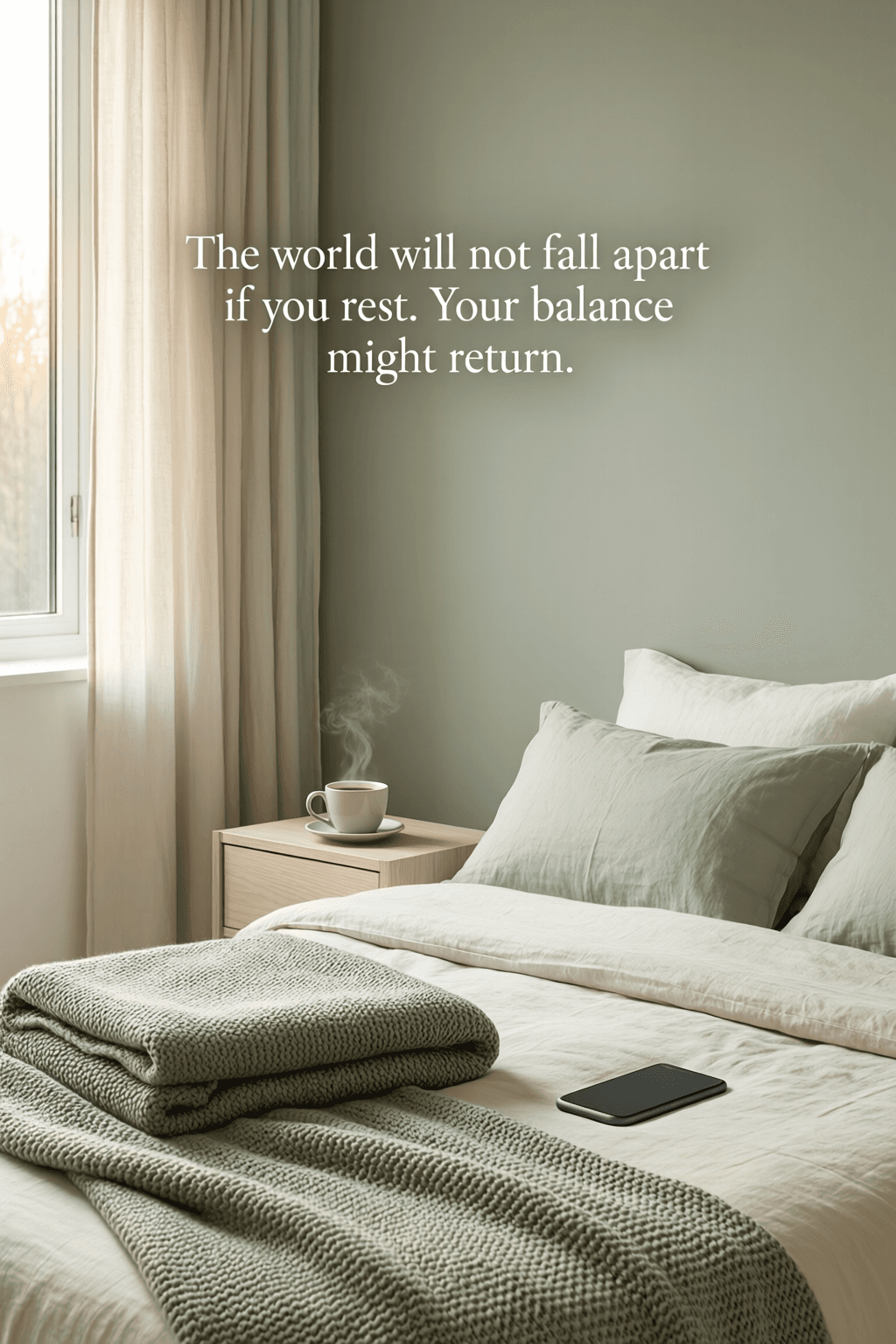
The world will not fall apart if you rest. Your balance might return. — Tessa Romero
—What lingers after this line?
A Gentle Challenge to Urgency
At first glance, Tessa Romero’s line confronts a fear many people quietly carry: that if they stop, everything around them will collapse. By saying the world will not fall apart if you rest, she gently exposes how often exhaustion disguises itself as responsibility. The quote does not dismiss duty; rather, it questions the belief that constant motion is the only thing holding life together. From there, the second sentence shifts the focus inward. Instead of imagining disaster outside us, Romero asks us to consider what might be restored within us. Rest is no longer laziness or retreat, but a condition in which balance can return.
Rest as Restoration, Not Escape
Importantly, the quotation frames rest not as avoidance but as repair. In a culture that often prizes endurance above wellbeing, stepping back can feel like failure. Yet Romero reverses that logic: the pause itself may be what allows clarity, steadiness, and emotional proportion to reappear. This idea has deep roots. As the biblical Sabbath tradition in Exodus 20 presents, rest is built into the rhythm of life rather than added after all work is done. In that sense, Romero’s words echo an older wisdom: renewal is not the opposite of meaningful effort, but one of its necessary foundations.
The Myth of Indispensability
Moreover, the quote quietly dismantles the comforting but dangerous illusion of indispensability. People under pressure often act as though every task, message, or obligation depends entirely on their uninterrupted attention. Romero’s first sentence punctures that belief with unusual tenderness. The world, she implies, is more resilient than our anxiety suggests. That insight appears in modern burnout research as well. The World Health Organization’s 2019 description of burnout as a workplace syndrome linked to chronic unmanaged stress suggests that overextension is not proof of commitment, but evidence of imbalance. Seen this way, rest becomes less a personal indulgence and more a practical correction to distorted self-expectation.
Balance as a Return, Not an Achievement
Just as striking is Romero’s use of the word return. She does not say balance must be invented, earned, or mastered from scratch; she suggests it can come back. That subtle phrasing carries hope. It implies that beneath fatigue, irritability, and mental clutter, a steadier self still exists and can be recovered. In this light, rest becomes a path of reconnection. Much like Virginia Woolf’s reflections in A Room of One’s Own (1929), where space and quiet are shown to nourish thought, Romero’s line proposes that inner order often emerges when pressure recedes. Balance is not always built through more effort; sometimes it reappears when effort loosens.
A More Humane Measure of Strength
Finally, the quote offers a broader redefinition of strength. Many people are taught to equate resilience with pushing through at all costs, but Romero presents another model: the wisdom to stop before depletion becomes collapse. Under this view, strength includes self-preservation, discernment, and trust that life can continue while one recovers. That is why the quote feels both comforting and corrective. It gives permission to rest without apology, while also reminding us that rest has consequences beyond comfort. When we pause, we do not betray our responsibilities; we often become more capable of meeting them. In the end, Romero’s message is simple but profound: rest is not what interrupts balance, but what restores it.
Recommended Reading
As an Amazon Associate, we earn from qualifying purchases.
One-minute reflection
Why might this line matter today, not tomorrow?
Related Quotes
6 selectedAnything that is living must have a rest. If it does not rest, it will lose its strength. — Lao Tzu
Lao Tzu
Lao Tzu’s insight begins with a simple observation: all living things move in cycles, not in endless exertion. By saying that anything alive must rest, he frames rest not as laziness but as a biological and spiritual nec...
Read full interpretation →Rest is a form of resistance against a world that demands your exhaustion. — Tricia Hersey
Tricia Hersey
Tricia Hersey’s line begins by flipping a familiar moral script: instead of praising constant output, it frames rest as a deliberate refusal. In a culture that often treats busyness as proof of worth, exhaustion becomes...
Read full interpretation →There is a time for many words, and there is also a time for sleep. — Homer
Homer
Homer’s line turns on a simple but profound contrast: there is a season for speaking at length, and there is another for surrendering to sleep. At once, he suggests that wisdom is not merely knowing what matters, but kno...
Read full interpretation →Exhaustion is not the only proof that you are trying. You are allowed to pause, even if everything feels urgent. — Annie Wright
Annie Wright
At first glance, Annie Wright’s quote challenges a deeply ingrained belief: that visible exhaustion is the clearest sign of seriousness. Many people have learned to equate being drained with being dedicated, as if fatigu...
Read full interpretation →Recovery begins to change when rest stops being something you must earn and starts becoming something your system is allowed to need. — Tessa
Tessa, Psychologist
At the heart of Tessa’s statement is a quiet but radical shift: recovery deepens when rest is no longer treated as a prize for productivity. In many cultures, people are taught to pause only after proving their worth, ye...
Read full interpretation →You are allowed to pause, even if everything feels urgent. — Emily Nagoski
Emily Nagoski
At its core, Emily Nagoski’s line offers something many people rarely grant themselves: permission. In a culture that equates constant motion with worth, the reminder that you may pause—even when everything feels urgent—...
Read full interpretation →More From Author
More from Tessa Romero →