
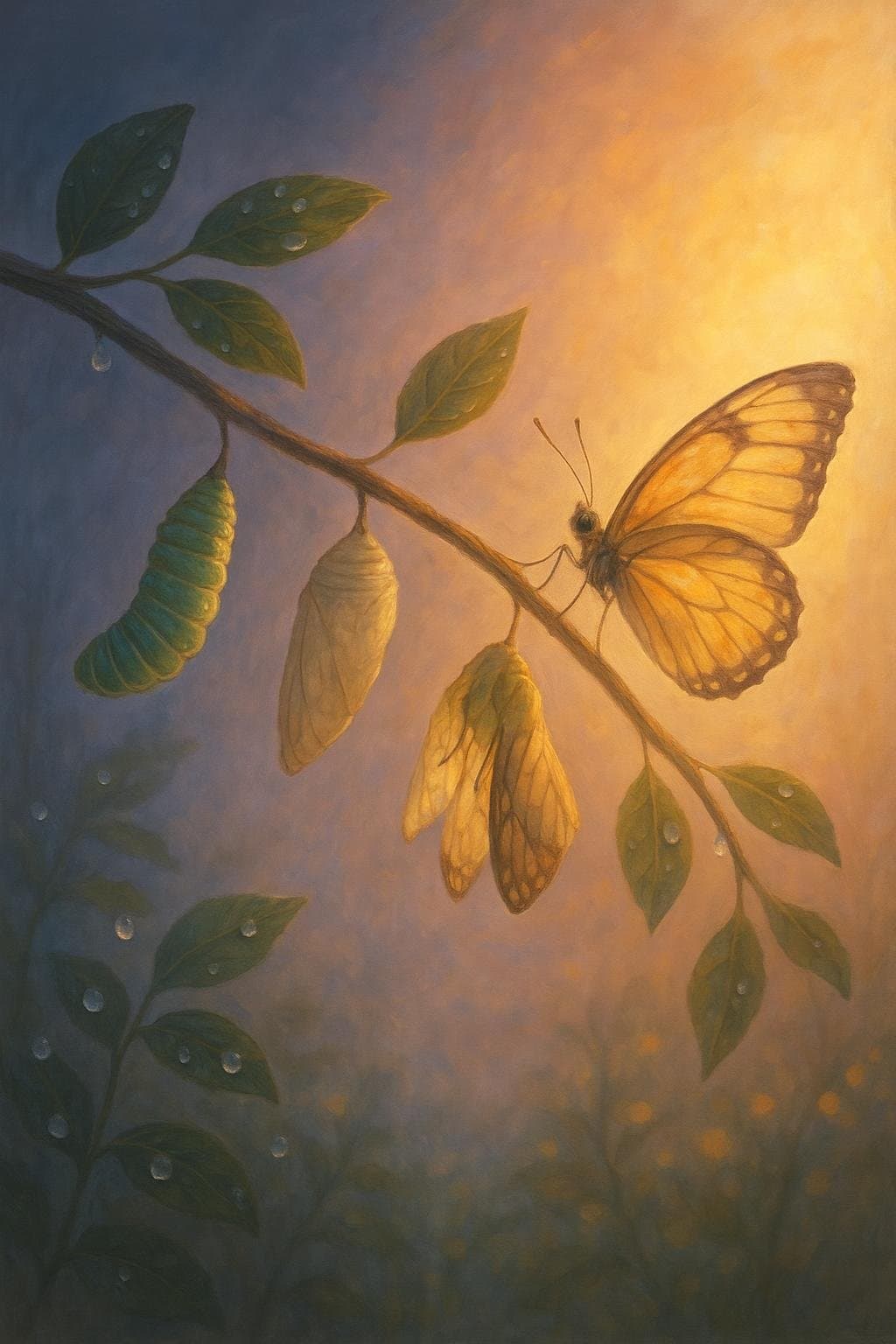
To live is to be slowly born. — Antoine de Saint-Exupéry
—What lingers after this line?
Understanding Life as Gradual Becoming
Saint-Exupéry’s words invite us to see life not as a finished product but as an ongoing process of emergence and evolution. Rather than viewing birth as a single, dramatic event, he reframes it as a slow, continual unfolding—an idea that aligns with philosophical notions of becoming, such as those found in Heraclitus’s saying that 'everything flows,' suggesting constancy in transformation.
Childhood and the Seeds of Identity
Building on this theme, early childhood serves as fertile ground for the seeds of identity. Just as a tree grows imperceptibly, each new experience—whether joyful or painful—shapes the contours of who we are. In *The Little Prince*, Saint-Exupéry himself illustrates how innocence and curiosity guide a person’s gradual emergence into the world, emphasizing that growth cannot be rushed.
Transformation Through Learning
With time, learning becomes a catalyst for our rebirth. Every challenge, lesson, or relationship leaves a trace, quietly altering our perspective. Jean Piaget’s developmental psychology, for instance, describes how children slowly construct understanding through lived experience, underscoring that true growth happens in increments. Thus, to live is to accept and embrace this ceaseless reconstruction of self.
Facing Adversity: Essential to Growth
Adversity, meanwhile, acts as the fire that tempers and reveals the essence of our character. Viktor Frankl, writing from the crucible of the Holocaust, observed in *Man's Search for Meaning* (1946) how enduring hardship deepens one’s sense of purpose. Through setbacks, we are forced to re-examine, adapt, and ultimately, to be reborn in resilience—a vital stage in being 'slowly born.'
Embracing Continuous Becoming
Ultimately, Saint-Exupéry's metaphor reminds us that life is not a static state but a ceaseless act of becoming. As we age, each day refines and reveals new aspects of our potential. Accepting this slow, beautiful process fosters patience and humility, allowing us to honor every tentative step as part of the mystery and miracle of our own unfolding.
One-minute reflection
Where does this idea show up in your life right now?
Related Quotes
6 selectedLearning to love yourself is like learning to walk – essential, life-changing, and the only way to stand tall. — Vironika Tugaleva
Vironika Tugaleva
Vironika Tugaleva’s comparison begins with a simple but powerful truth: self-love is not a luxury, but a basic human necessity. Just as walking allows a child to move through the world with growing independence, learning...
Read full interpretation →The most gifted members of the human species are at their creative best when they cannot have their way, and must compensate for what they miss by realizing and cultivating their capacities. — Bryant H. McGill
Bryant H. McGill
Bryant H. McGill’s observation begins with a striking reversal: gifted people may not reach their highest potential when everything comes easily, but when something blocks their path.
Read full interpretation →A mind grows by staying with difficulty long enough for the experience to change it. — Mary Catherine Bateson
Mary Catherine Bateson
Mary Catherine Bateson’s observation begins with a quiet but demanding truth: the mind does not grow merely by encountering difficulty, but by remaining with it. Challenge becomes transformative only when we resist the u...
Read full interpretation →Consistency is a superpower. — Ryan Holiday
Ryan Holiday
Ryan Holiday’s line begins with a deceptively simple idea: greatness is rarely built through dramatic gestures. More often, it emerges from repeated actions that seem ordinary in isolation but become extraordinary over t...
Read full interpretation →Confidence is silent. Insecurities are loud. — Unknown (Wait—skip/replace with: True nobility is being superior to your former self. — Ernest Hemingway)
Ernest Hemingway
At its core, Hemingway’s line redefines nobility as an inward achievement rather than a social rank. Instead of measuring worth by wealth, pedigree, or dominance over others, it points to a quieter standard: becoming bet...
Read full interpretation →You are under no obligation to be consistent with the person you were yesterday. — James McCrae
James McCrae
At its core, James McCrae’s line challenges the quiet pressure to remain legible to others. Many people feel bound to opinions, habits, or identities simply because they once claimed them, as though consistency were a mo...
Read full interpretation →More From Author
More from Exupéry →A rock pile ceases to be a rock pile the moment a single man contemplates it, bearing within him the image of a cathedral. — Antoine de Saint-Exupéry
At first glance, Saint-Exupéry’s line seems to describe an ordinary heap of stones. Yet the moment someone looks at it while carrying the image of a cathedral within, the pile is transformed in meaning.
Read full interpretation →Perfection is achieved, not when there is nothing more to add, but when there is nothing left to take away. — Antoine de Saint-Exupéry
Saint-Exupéry reframes perfection as an endpoint reached by removal rather than accumulation. Instead of chasing the next enhancement, he invites us to question what is truly necessary and what is merely decorative.
Read full interpretation →Let curiosity guide your flight and persistence steady the wings. — Antoine de Saint-Exupéry
Saint-Exupéry frames personal growth as a kind of aviation: curiosity is the impulse to take off, while persistence is the disciplined skill that keeps you in the air. The line feels especially fitting from someone who l...
Read full interpretation →Curiosity paired with courage writes the maps others fear to follow. — Antoine de Saint-Exupéry
Curiosity is the quiet spark behind every new path. In Antoine de Saint-Exupéry’s line, it functions as the inner question that refuses to be silenced: What lies beyond what I already know?
Read full interpretation →