
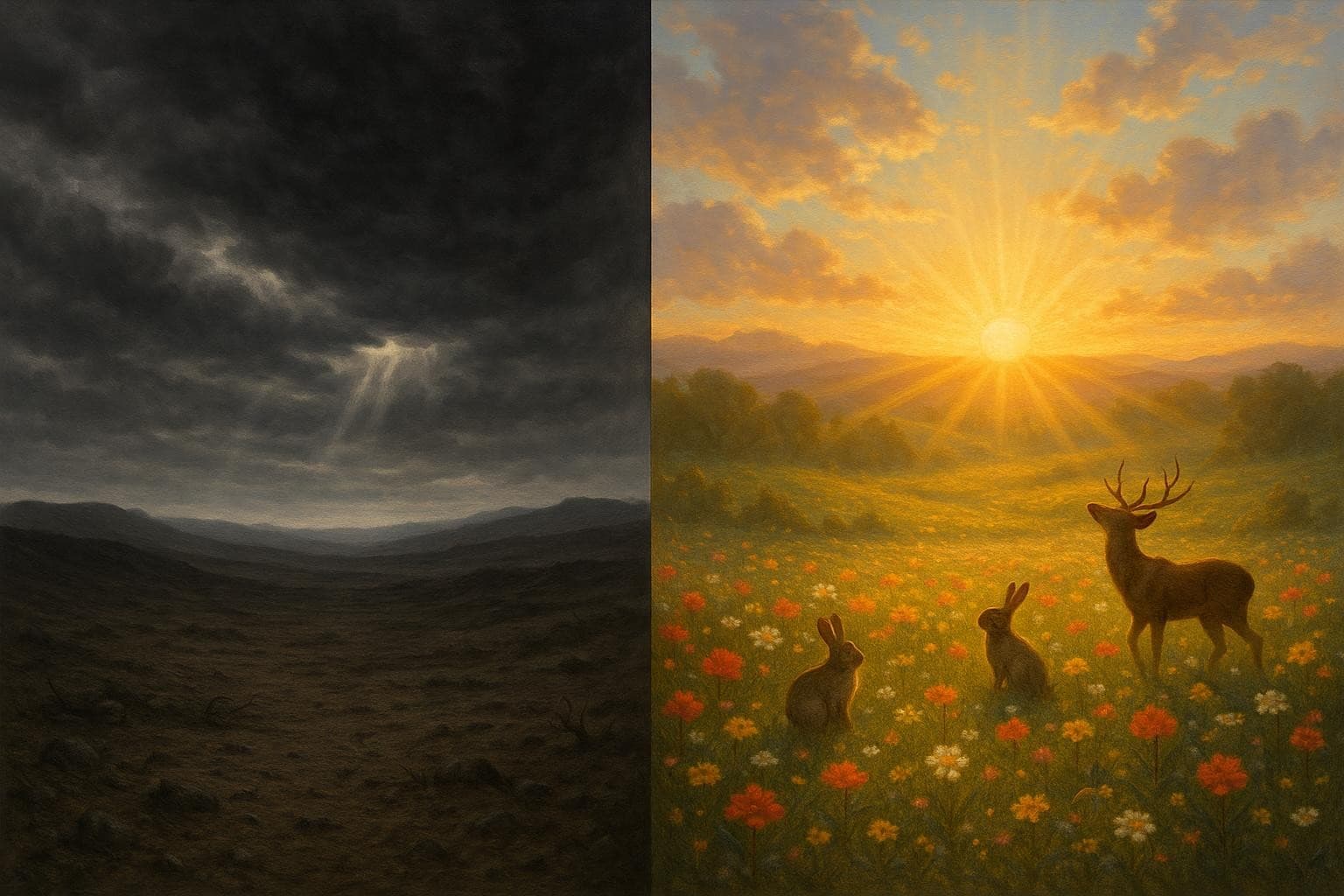
To seek is to suffer; to find is to experience joy. — Rumi
—What lingers after this line?
Rumi’s View on the Human Search
Rumi’s words immediately strike at the heart of the human condition: the act of seeking inherently brings suffering, while the moment of finding bestows joy. This duality echoes throughout his poetry, where longing and fulfillment are inextricably linked. By drawing this contrast, Rumi frames the journey of life as a process marked by both hardship and transcendence, setting the stage for a deeper exploration of desire and attainment.
Suffering as a Catalyst for Growth
Extending Rumi’s insight, the suffering experienced during the search can serve as a catalyst for personal transformation. Much like the trials faced by Siddhartha in Hermann Hesse’s novel—where constant seeking leads to wisdom—adversity refines and shapes character. It is through enduring the discomfort of longing that individuals develop resilience, empathy, and a heightened appreciation for the eventual moments of joy.
The Elusive Nature of Joy
Transitioning from suffering, the joy of finding is often fleeting but profoundly impactful. In Plato’s ‘Republic’ (c. 375 BC), the allegory of the cave represents enlightenment as a sudden illumination after a long, painful struggle. Similarly, Rumi sees moments of discovery not merely as endpoints, but as bursts of happiness that derive their value from the hardships preceding them. This ephemerality encourages us to cherish brief triumphs all the more.
The Interdependence of Seeking and Finding
Furthermore, Rumi implies that suffering and joy are mutually dependent; the meaning of one is enriched by the presence of the other. This notion resonates with the Taoist yin-yang, where opposites coexist to create harmony. As we seek, our anticipation heightens, intensifying the joy found upon discovery—suggesting that one cannot exist fully without the other, and that both are necessary components of a fulfilled life.
Embracing the Journey’s Full Spectrum
Ultimately, Rumi invites readers to embrace both suffering and joy as essential experiences. This holistic approach appears in many spiritual traditions, where the journey itself—not just the destination—holds intrinsic value. By acknowledging the pain of seeking and the bliss of finding, individuals can adopt a more compassionate outlook toward themselves and others on similar paths. In this way, Rumi’s wisdom continues to inspire a balanced, open-hearted approach to life’s perpetual quest.
One-minute reflection
Where does this idea show up in your life right now?
Related Quotes
6 selectedDo not seek to follow in the footsteps of the ancients; seek what they sought. — Matsuo Bashō
Bashō
Bashō’s counsel draws a sharp line between copying a master’s outward style and inheriting a master’s inward purpose. “Footsteps” implies visible technique—preferred subjects, established forms, and recognizable manneris...
Read full interpretation →Set your life on fire. Seek those who fan your flames. — Rumi
Rumi
This quote encourages individuals to live passionately and pursue their dreams and ambitions zealously. Setting one's life on fire symbolizes embracing one's passions fully.
Read full interpretation →Everything that happens is a form of instruction if you choose to listen. — Rumi
Rumi
At its core, Rumi’s line reframes ordinary experience as a living classroom. Nothing is merely random noise if one approaches it with attention; instead, each success, disappointment, encounter, or delay carries the poss...
Read full interpretation →Do not mistake movement for progress; a spinning top stays in one place, while a seed grows by staying rooted in the dark. — Rumi
Rumi
Rumi’s image draws an immediate contrast between busyness and true development. A spinning top dazzles with speed and motion, yet it remains fixed in essentially the same place.
Read full interpretation →You don't need to escape the chaos to find peace—it's already inside you, waiting to be remembered. — Rumi
Rumi
At first glance, Rumi’s line overturns a common assumption: that peace must be found by fleeing noise, conflict, or uncertainty. Instead, he suggests that peace is not an external destination but an inner condition alrea...
Read full interpretation →Confidence is silent. Insecurities are loud. Do not feel the need to broadcast your worth to a world that doesn't understand your path. — Rumi
Rumi
At its core, this saying contrasts two very different emotional states: confidence, which rests quietly within, and insecurity, which seeks constant outward expression. The point is not that confident people never speak,...
Read full interpretation →More From Author
More from Rumi →Everything that happens is a form of instruction if you choose to listen. — Rumi
At its core, Rumi’s line reframes ordinary experience as a living classroom. Nothing is merely random noise if one approaches it with attention; instead, each success, disappointment, encounter, or delay carries the poss...
Read full interpretation →Do not mistake movement for progress; a spinning top stays in one place, while a seed grows by staying rooted in the dark. — Rumi
Rumi’s image draws an immediate contrast between busyness and true development. A spinning top dazzles with speed and motion, yet it remains fixed in essentially the same place.
Read full interpretation →You don't need to escape the chaos to find peace—it's already inside you, waiting to be remembered. — Rumi
At first glance, Rumi’s line overturns a common assumption: that peace must be found by fleeing noise, conflict, or uncertainty. Instead, he suggests that peace is not an external destination but an inner condition alrea...
Read full interpretation →Confidence is silent. Insecurities are loud. Do not feel the need to broadcast your worth to a world that doesn't understand your path. — Rumi
At its core, this saying contrasts two very different emotional states: confidence, which rests quietly within, and insecurity, which seeks constant outward expression. The point is not that confident people never speak,...
Read full interpretation →