
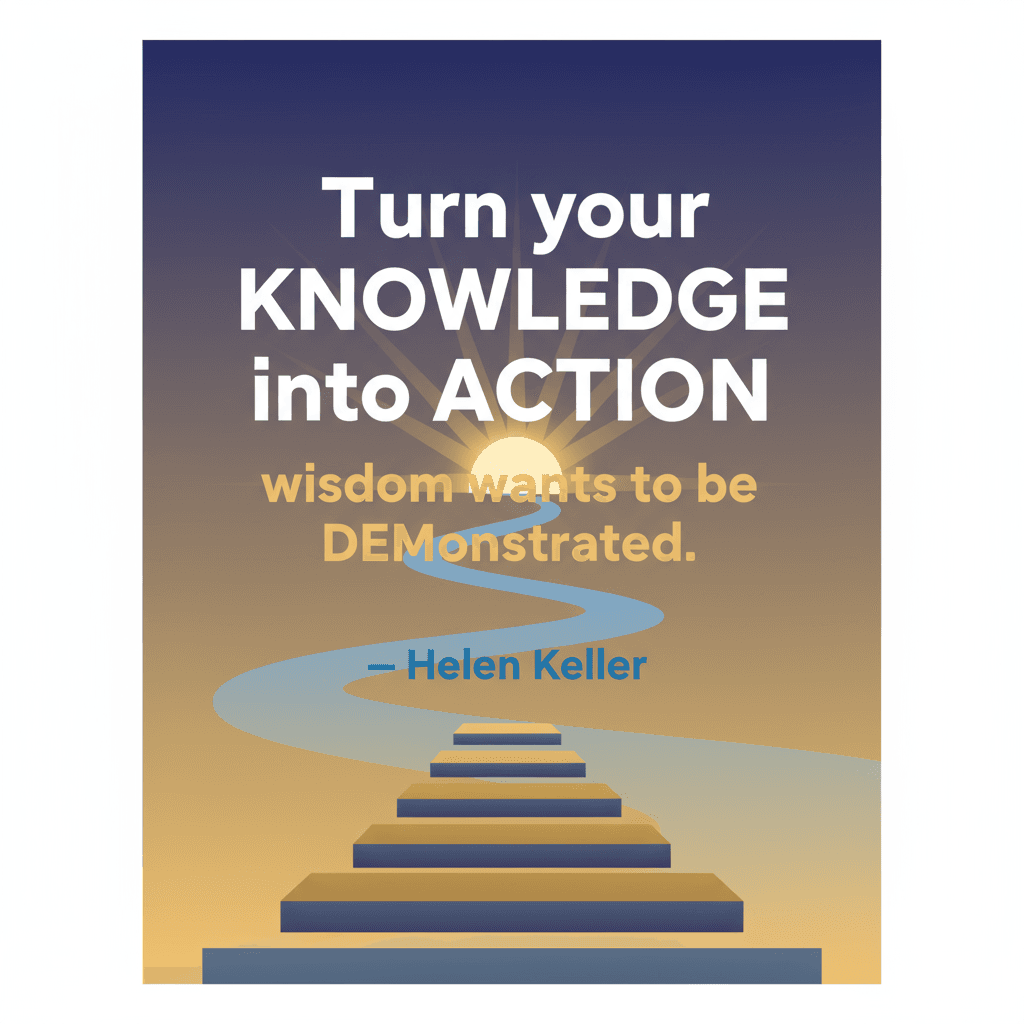
Turn your knowledge into action; wisdom wants to be demonstrated. — Helen Keller
—What lingers after this line?
From Knowing to Doing
Helen Keller’s imperative reframes knowledge as potential energy that only wisdom can release. Information may refine our opinions, yet wisdom insists on outcomes—on choices, behaviors, and consequences that can be seen and tested. In this view, demonstration is not a performance but a proof of understanding under real conditions. When ideas meet constraints, ambiguity, and other people, they either clarify or collapse, and that crucible is where wisdom takes shape. Consequently, the question shifts from What do you know? to What has your knowing changed? This pivot invites accountability and invites courage. To see how this plays out beyond abstraction, Keller’s own life offers a living blueprint.
Helen Keller’s Living Proof
Keller’s breakthrough at the pump in 1887—when Anne Sullivan spelled water into her hand—did not end with comprehension; it began a life of application. The Story of My Life (1903) recounts how language unlocked purpose, leading her to public advocacy for education, disability rights, and equitable opportunity. Her influence did not rest on insight alone but on sustained work that translated compassion into institutions and policies. Thus, the quote reads like autobiography condensed into counsel: begin where you are, then let results—literacy gained, doors opened, lives improved—be the argument. From biography, we can now trace the philosophical roots of this demand for enactment.
Practical Wisdom, Old and Enduring
Aristotle’s Nicomachean Ethics (Book VI) distinguishes phronesis—practical wisdom—from mere cleverness; it is right reasoning aimed at right action. Confucius likewise ties knowledge to conduct, urging learners to practice what they claim to understand (Analects, early passages on ritual and virtue). Even religious aphorisms align: by their fruits you will know them (Matthew 7:16) grounds character in observable outcomes. Carried forward, these traditions converge on a test: does understanding reliably guide choices that promote flourishing? If not, the remedy is not louder claims but better practice. This prepares the ground for modern philosophies that judge ideas by their consequences.
Pragmatism and the Proof of Consequences
William James’s Pragmatism (1907) argues that the meaning of an idea lies in its practical cash value—in the differences it makes when lived. John Dewey’s How We Think (1910) expands this into a cycle of inquiry: define a problem, hypothesize, act, observe, and revise. Science operates similarly; claims must survive replication, not just rhetoric. Therefore, Keller’s line is not a motivational slogan but a methodological standard. If knowledge matters, it should steer action; if action misses the mark, knowledge must be refined. This reciprocal motion—from insight to experiment and back—points us toward methods for making wisdom habitual.
Designing the Bridge from Insight to Action
Translating knowing into doing benefits from structure. Implementation intentions—if–then plans studied by Peter Gollwitzer (1999)—help trigger behaviors at precise cues. Gabriele Oettingen’s WOOP method (2014) adds a realistic constraint check, turning wishful thinking into executable steps. Kolb’s experiential learning cycle (1984) then closes the loop: act, reflect, abstract, and test again. For example, after learning about cognitive bias, schedule a weekly bias audit—red-team a decision, run a blind review, or A/B test assumptions. The moment a practice exists, feedback can find it. With tactics in place, the moral dimension of action comes into sharper focus.
Accountability, Humility, and Ethical Feedback
Because action affects others, wisdom must be answerable to outcomes. Medical ethics captures this in do no harm, while Karl Popper’s call for piecemeal social engineering (The Open Society and Its Enemies, 1945) favors reversible, testable changes over grand but risky schemes. Humility keeps the learner attentive to unintended effects, and accountability ensures revisions follow swiftly. In this light, demonstrated wisdom is not bravado but openness to correction. Failures become data rather than excuses, just as successes become responsibilities to maintain. Having framed the ethos, the final step is pragmatic: begin now and make the results visible.
Where to Start, Today
Pick one piece of knowledge you trust. Define the smallest testable action that would show it makes a difference. Set a short deadline, run the test, and publish the outcome—notes, code, lesson, or protocol—for critique. Then iterate. Eric Ries’s build–measure–learn loop (The Lean Startup, 2011) offers a simple scaffold. Whether it is a classroom practice, a workplace process, or a civic effort, the sequence is the same: enact, observe, refine. In doing so, you honor Keller’s charge and join a lineage that treats wisdom not as a claim to be defended, but as a capacity to be demonstrated.
One-minute reflection
Where does this idea show up in your life right now?
Related Quotes
6 selectedKnowledge without application is simply knowledge. Applying the knowledge to one’s life is wisdom. — Karen A. Baquiran
Karen A. Baquiran
At its core, Karen A. Baquiran’s statement separates the accumulation of knowledge from its practical use.
Read full interpretation →Instead of seeing philosophy as an end to which one aspires, see it as something one applies. Not occasionally, but over the course of a life—making incremental progress along the way. — Ryan Holiday
Ryan Holiday
Ryan Holiday’s point begins by shifting philosophy away from the pedestal. Rather than treating it as a distant intellectual achievement, he frames it as a tool meant to be used in ordinary life.
Read full interpretation →It is by acts and not by ideas that people live. — Anatole France
Anatole France
At its core, Anatole France’s remark argues that life is sustained by what people actually do, not merely by what they think or proclaim. Ideas may inspire, guide, or justify, yet they remain inert until translated into...
Read full interpretation →Sharpen your mind with action and temper your will with mercy — C.S. Lewis
C.S. Lewis
C.S. Lewis’s line works like a paired instruction: cultivate a mind that cuts cleanly, and shape a will that does not crush.
Read full interpretation →Don't explain your philosophy. Embody it. — Epictetus
Epictetus
Epictetus’ line reads like a quiet reprimand to anyone tempted to turn self-improvement into a performance. Rather than persuading others with polished ideas, he urges you to let your conduct carry the argument.
Read full interpretation →Begin again with the same heart and a wiser hand. — Yoko Ono
Yoko Ono
Yoko Ono’s line is brief, but it opens a whole philosophy of renewal: you can restart without denying what came before. “Begin again” implies a conscious decision to step back into life—work, love, art, or healing—after...
Read full interpretation →More From Author
More from Helen Keller →True confidence, like deep rivers, flows calmly and silently without the need for continual recognition. — Unknown (Wait: Skipping) -> My limits are not a debate. — Unknown (Wait: Skipping) -> Never bend your head. Always hold it high. Look the world straight in the eye. — Helen Keller
Helen Keller’s line begins with a physical image, yet it quickly opens into a moral one: to hold one’s head high is to move through the world with unshaken self-respect. In that sense, true confidence does not beg for ap...
Read full interpretation →I long to accomplish a great and noble task; but it is my chief duty to accomplish small tasks as if they were great and noble. — Helen Keller
Helen Keller’s words open with a familiar human desire: the longing to do something magnificent. Yet she immediately redirects that ambition toward duty, reminding us that life is rarely built from grand gestures alone.
Read full interpretation →Everything has its wonders, even darkness and silence, and I learn, whatever state I may be in, therein to be content. — Helen Keller
Helen Keller’s line begins by widening the definition of “wonder.” Rather than reserving amazement for bright, dramatic, or easily celebrated experiences, she insists that every aspect of existence contains something wor...
Read full interpretation →Reach with both hands for what you imagine; momentum answers effort. — Helen Keller
Helen Keller’s phrase, “Reach with both hands,” turns imagination into something physical: a posture of full commitment rather than a halfhearted try. Instead of treating a goal as a distant wish, she frames it as someth...
Read full interpretation →