
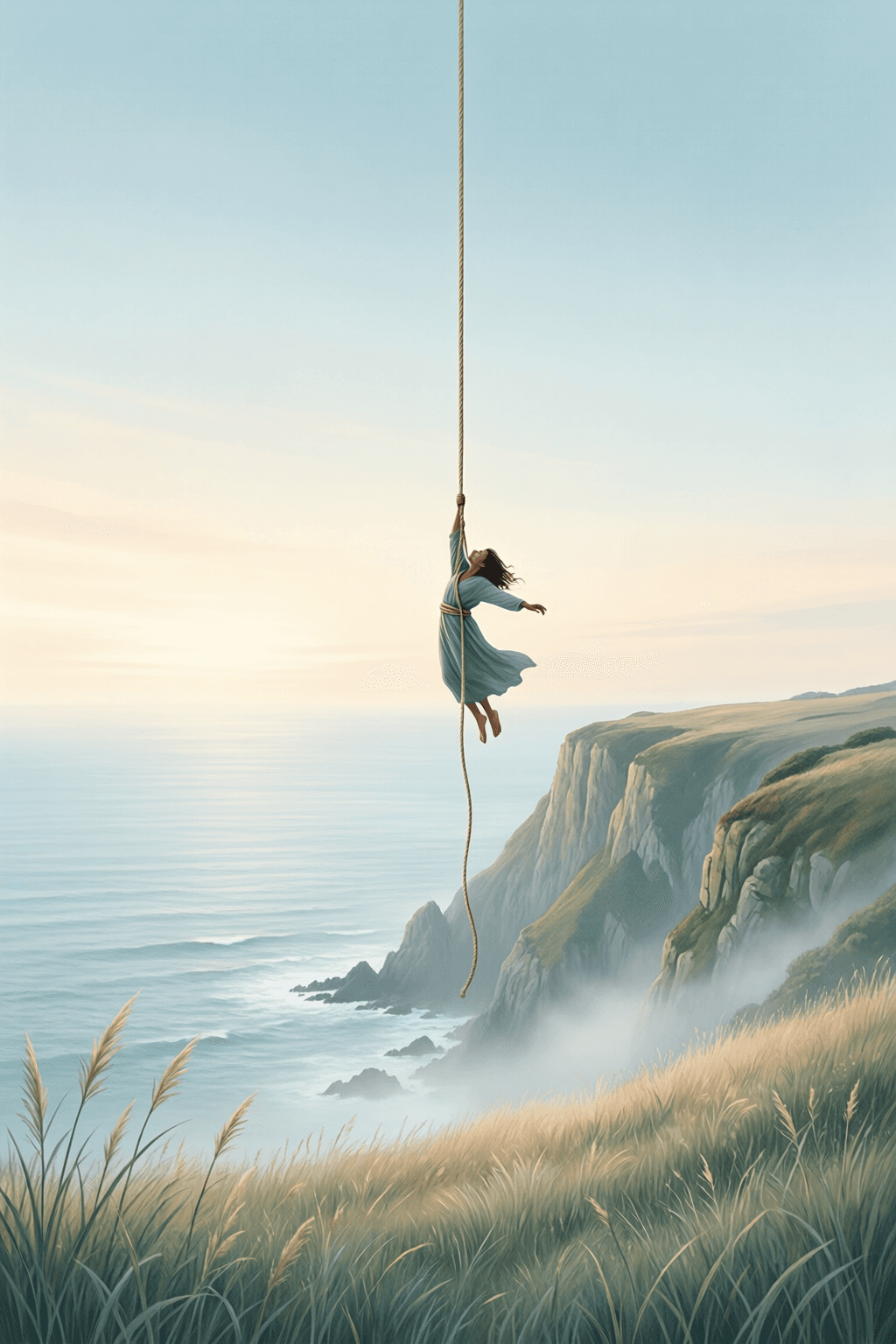
When you feel like you've reached the end of your rope, tie a knot in it and hang on—or better yet, realize you can just let go and float. — Mary Oliver
—What lingers after this line?
From Desperation to Possibility
At first, Mary Oliver’s line begins with a familiar survival lesson: when life feels unbearable, hold on. The image of reaching the end of a rope evokes exhaustion, fear, and the instinct to preserve oneself at any cost. In that sense, the advice to tie a knot suggests resilience—an improvised act of courage when strength is nearly gone. Yet Oliver immediately opens a second door. Rather than treating endurance as the only noble response, she suggests that another possibility exists: letting go. This turn shifts the quote from mere perseverance to imaginative freedom, asking whether what we call crisis may also be a rigid attachment to struggle itself.
The Rope as a Mental Habit
Seen more closely, the rope can symbolize the stories we cling to—control, certainty, identity, or the belief that we must solve everything through force. In this reading, tying a knot means doubling down on effort, which is sometimes necessary. People in grief, illness, or transition often survive by doing exactly that: creating one more small grip for the next difficult hour. However, Oliver’s wisdom deepens when she questions the rope itself. Her better-yet alternative implies that some forms of suffering come not only from hardship, but from the tense conviction that we must keep clutching. As a result, the quote invites readers to examine whether their struggle is against life—or against their inability to release it.
Letting Go Without Giving Up
Importantly, letting go here is not surrender in the bleak sense of defeat. Instead, it resembles the kind of acceptance described in Buddhist teachings, where freedom emerges not from domination but from nonattachment; the Dhammapada, compiled around the 3rd century BC, repeatedly links peace to release from grasping. Oliver’s image of floating captures that gentler form of wisdom. Therefore, the quote distinguishes between quitting and yielding. A swimmer caught in a current, for example, survives not by thrashing harder but by adjusting to the water’s movement. In the same way, Oliver suggests that sometimes the most life-giving act is not resistance, but trust in a larger element carrying us.
Nature’s Logic of Buoyancy
Because Oliver’s poetry so often listens to the natural world, the image of floating also feels distinctly ecological. In water, buoyancy is not earned through strain; it becomes available when the body stops fighting and aligns with physical reality. This is one reason the quote feels persuasive: it borrows from nature’s quiet instruction that balance often appears after unnecessary tension ends. From there, the metaphor broadens. Leaves ride a stream, birds lean into wind currents, and even Thoreau’s Walden (1854) frames simplicity as a release into a more faithful rhythm of life. Oliver’s floating, then, is not passivity. It is participation in a wiser order that human anxiety too often ignores.
A Compassionate Revision of Strength
Traditionally, strength is praised as endurance under pressure, and the first half of the quote honors that instinct. Many cultural sayings celebrate grit, stoicism, and persistence because they help people survive genuine trials. Nevertheless, Oliver revises that tradition with compassion: she implies that strength can also mean loosening the jaw, unclenching the hands, and allowing oneself to be carried for a while. This is a subtle but powerful moral shift. It gives dignity not only to fighters, but also to the weary, the overwhelmed, and the healing. In that sense, Oliver broadens courage itself, suggesting that there are moments when the bravest thing is not to hold on harder, but to stop mistaking tension for life.
Why the Quote Endures
Finally, the line endures because it speaks to two truths people cycle through repeatedly: sometimes we must persist, and sometimes we must release. Its emotional intelligence lies in refusing a single rule for every crisis. By offering both the knot and the float, Oliver acknowledges that wisdom depends on recognizing which moment we are in. That balance helps explain the quote’s lasting appeal. It comforts without becoming sentimental and encourages without becoming severe. Much like Oliver’s broader body of work in Devotions (2017), it reminds readers that survival is not always a contest of force; sometimes it is an art of trusting what remains when our grip loosens.
One-minute reflection
What does this quote ask you to notice today?
Related Quotes
6 selectedWhen you feel like you are drowning in life, don't blame the ocean. You have to learn how to swim. — Anne Lamott
Anne Lamott
Anne Lamott’s line begins with a blunt but compassionate shift in perspective: when life feels overwhelming, the first impulse is often to blame circumstances, other people, or fate itself. Yet the quote redirects attent...
Read full interpretation →Self-mastery rarely looks impressive. It simply holds. — James Clear
James Clear’s observation begins by stripping self-mastery of glamour. It is not usually a heroic moment, a public triumph, or a dramatic display of willpower.
Read full interpretation →When I hear somebody sigh, 'Life is hard,' I am always tempted to ask, 'Compared to what?' — Sydney J. Harris
Sydney J. Harris
Sydney J. Harris’s remark begins with an ordinary expression of fatigue: “Life is hard.” Yet his response, “Compared to what?” quietly turns complaint into inquiry.
Read full interpretation →Don't fight the challenges. Just find a new way to stand. — Germany Kent
Germany Kent
Germany Kent’s words begin with a quiet reversal of instinct: instead of treating every challenge as an enemy to defeat, she invites us to reconsider our posture toward difficulty. The emphasis is not on surrender, but o...
Read full interpretation →Optimist: someone who figures that taking a step backward after taking a step forward is not a disaster, it's more like a cha-cha. — Robert Brault
Robert Brault
Robert Brault’s line begins with a witty redefinition: an optimist is not someone who denies backward motion, but someone who interprets it differently. Instead of treating a setback as proof of failure, the optimist see...
Read full interpretation →A mind grows by staying with difficulty long enough for the experience to change it. — Mary Catherine Bateson
Mary Catherine Bateson
Mary Catherine Bateson’s observation begins with a quiet but demanding truth: the mind does not grow merely by encountering difficulty, but by remaining with it. Challenge becomes transformative only when we resist the u...
Read full interpretation →More From Author
More from Mary Oliver →Everything that is made is made by slow, steady effort. — Mary Oliver
Mary Oliver’s line distills a quiet truth: meaningful things rarely appear all at once. Instead, they emerge through repetition, patience, and attention, whether one is writing a poem, raising a family, or restoring a ga...
Read full interpretation →The real flex is no longer looking busy. It is looking peaceful. It is having ambition without self-destruction. — Anonymous (skipped) -> The quietest moments are often where the greatest strength is found. — Mary Oliver
At first glance, these paired lines challenge a modern performance ritual: the need to appear constantly overwhelmed in order to seem important. Instead of praising busyness, they propose a subtler ideal—peacefulness as...
Read full interpretation →The slow work of cultivation is the only antidote to the frantic pace of our digital existence. — Mary Oliver
Mary Oliver’s line sets two tempos against each other: the hurried pulse of digital life and the patient rhythm of cultivation. By calling cultivation an antidote, she implies that our overstimulated routines are not mer...
Read full interpretation →The real work is to look at the world and feel that you belong to it. — Mary Oliver
Mary Oliver’s line begins with a deceptively simple instruction: the ‘real work’ is not conquest, achievement, or self-display, but learning to see. By telling us to look at the world, she shifts attention outward, away...
Read full interpretation →