
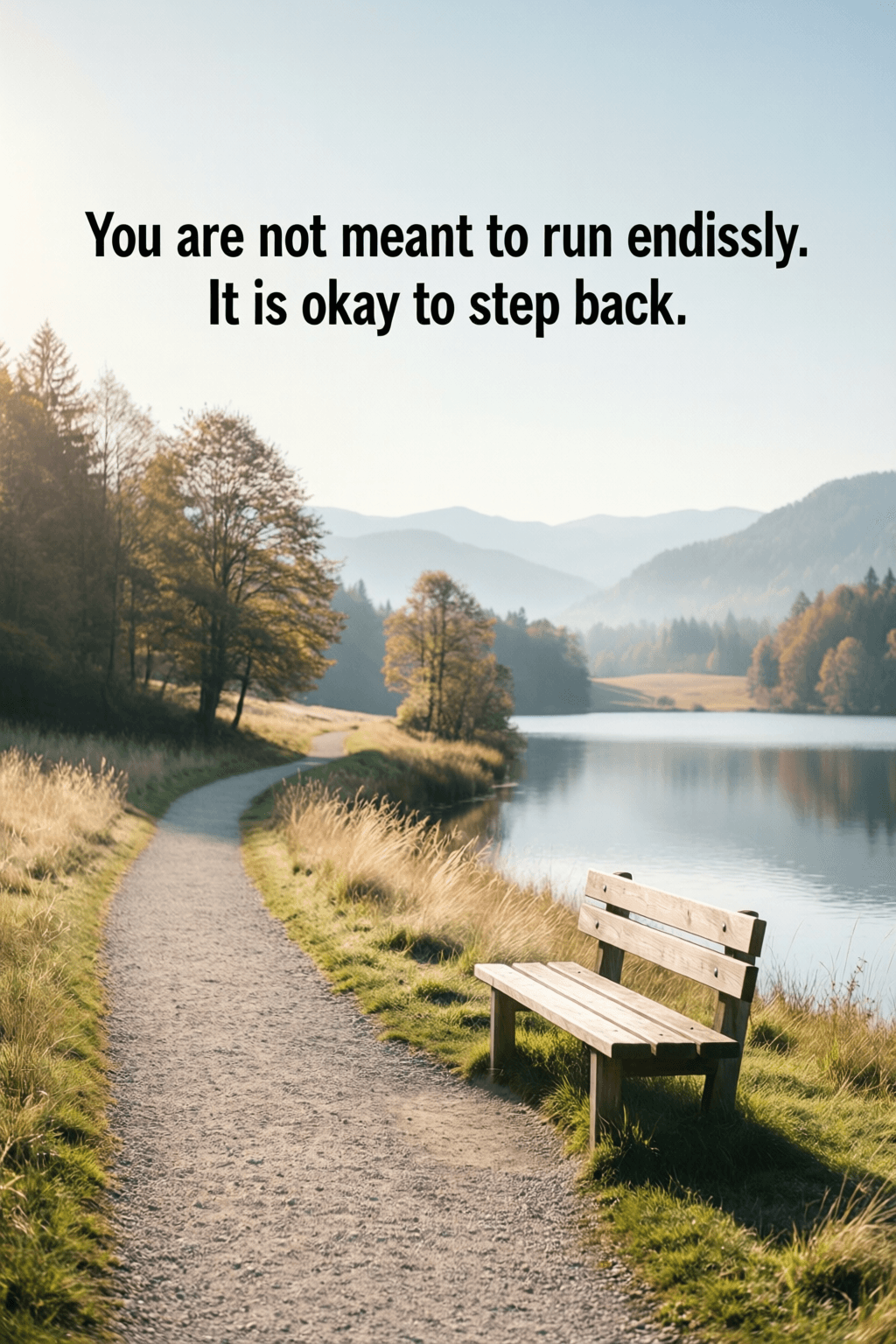
You are not meant to run endlessly. It is okay to step back. — Tessa, MSc Psychologist
—What lingers after this line?
A Gentle Rejection of Constant Motion
At its core, Tessa’s line challenges the modern belief that worth is measured by relentless output. By saying, “You are not meant to run endlessly,” she reframes exhaustion not as a badge of honor but as a signal that human beings have limits. In a culture that often rewards overwork, this reminder feels both simple and quietly radical. From there, the second sentence—“It is okay to step back”—offers more than comfort; it grants permission. Rather than treating rest as failure, it presents pause as a necessary part of functioning well, suggesting that recovery is not separate from progress but one of its conditions.
The Psychology of Human Limits
Seen through a psychological lens, the quote aligns with what clinicians and researchers have long observed: sustained stress without recovery erodes mental clarity, mood, and resilience. Herbert Freudenberger’s early work on burnout in the 1970s described how chronic demands can drain motivation and distort self-perception, especially when people ignore their need for rest. Consequently, stepping back is not avoidance in every case; often, it is prevention. A short withdrawal from pressure—whether through sleep, reflection, or reduced commitments—can interrupt the cycle of depletion before it becomes collapse. Tessa’s wording is gentle, yet it rests on a serious truth about how minds and bodies actually endure.
Rest as an Act of Self-Respect
Beyond psychology, the quote also speaks to self-worth. Many people feel guilty when they slow down, as though pausing proves they are weak, lazy, or falling behind. However, Tessa’s statement subtly reverses that logic: to recognize one’s limits is not a defect but a form of honesty. In that sense, stepping back becomes an act of self-respect. This idea echoes broader traditions of care and balance. For instance, the biblical Sabbath principle, established in Exodus, frames rest not as indulgence but as a rhythm built into life itself. By extension, Tessa’s advice suggests that sustainable living requires boundaries, not endless endurance.
A Counterpoint to Hustle Culture
In today’s hustle culture, constant activity is often packaged as ambition. Social media celebrates early mornings, side projects, and unbroken discipline, creating the impression that successful people never stop. Against this backdrop, Tessa’s quote functions as a corrective, reminding us that perpetual acceleration is neither natural nor universally healthy. Moreover, the phrase “step back” is important because it implies perspective, not surrender. Athletes rest between training cycles to improve performance, and creative workers often solve problems after leaving them alone for a while. Similarly, stepping back in ordinary life can restore judgment, energy, and direction, making it a strategic pause rather than a retreat from responsibility.
Compassionate Advice for Everyday Life
Ultimately, the strength of the quote lies in its compassionate practicality. It does not demand a dramatic life overhaul; instead, it invites a humane adjustment: stop, breathe, reassess, and continue only when you are able. That advice is especially meaningful for people who feel trapped by obligations, perfectionism, or the fear of disappointing others. Thus, the quote becomes both reassurance and instruction. It reassures us that fatigue does not mean failure, and it instructs us to honor the pause before damage deepens. In a world that often praises endurance without asking its cost, Tessa offers a healthier measure of wisdom: knowing when to step back is part of moving forward.
One-minute reflection
Where does this idea show up in your life right now?
Related Quotes
6 selectedBurnout is not a personal failure. It is the body's signal that you have been trying to live in a season of endless harvest without ever letting the field lie fallow. — Tessa, MSc Psychologist
Tessa, MSc Psychologist
At its core, Tessa’s quote rejects the harsh idea that burnout reflects weakness, poor character, or personal inadequacy. Instead, it reframes exhaustion as a meaningful signal from the body and mind: something essential...
Read full interpretation →You are allowed to pause, even if everything feels urgent. — Emily Nagoski
Emily Nagoski
At its core, Emily Nagoski’s line offers something many people rarely grant themselves: permission. In a culture that equates constant motion with worth, the reminder that you may pause—even when everything feels urgent—...
Read full interpretation →Rest is not a retreat; it is a reset. It is the necessary pause that allows us to show up grounded rather than reactive. — Sophia A. Nelson
Sophia A. Nelson
At first glance, Sophia A. Nelson’s statement challenges a common assumption: that rest is somehow equivalent to stepping back, giving up, or retreating from responsibility.
Read full interpretation →Doing nothing for a while can be the most productive thing you do. — Tessa, Psychologist
Tessa, Psychologist
At first glance, Tessa’s remark sounds like a contradiction: how can doing nothing count as productive? Yet the statement points to a deeper truth about human energy and attention.
Read full interpretation →Needing rest doesn't make you ungrateful. It makes you human. — Tessa Geurts-Meulendijks
Meulendijks
At its core, Tessa Geurts-Meulendijks’s quote gently challenges a common guilt: the fear that needing pause means failing to appreciate life’s blessings. Instead, it reframes rest as evidence of our humanity, not our mor...
Read full interpretation →Self-care means giving yourself permission to pause. — Cecilia Ahern
Cecilia Ahern
Cecelia Ahern’s line reframes self-care in a strikingly simple way: it is not merely a list of soothing activities, but an inner act of permission. In a culture that rewards constant productivity, many people feel guilty...
Read full interpretation →More From Author
More from Tessa, MSc Psychologist →Burnout is not a personal failure. It is the body's signal that you have been trying to live in a season of endless harvest without ever letting the field lie fallow. — Tessa, MSc Psychologist
At its core, Tessa’s quote rejects the harsh idea that burnout reflects weakness, poor character, or personal inadequacy. Instead, it reframes exhaustion as a meaningful signal from the body and mind: something essential...
Read full interpretation →You do not need to burn out to prove your commitment. — Tessa, MSc Psychologist
At first glance, Tessa’s statement challenges a deeply ingrained modern belief: that real commitment must be proven through exhaustion. In many workplaces and caregiving roles, burnout is worn almost like a badge of hono...
Read full interpretation →