
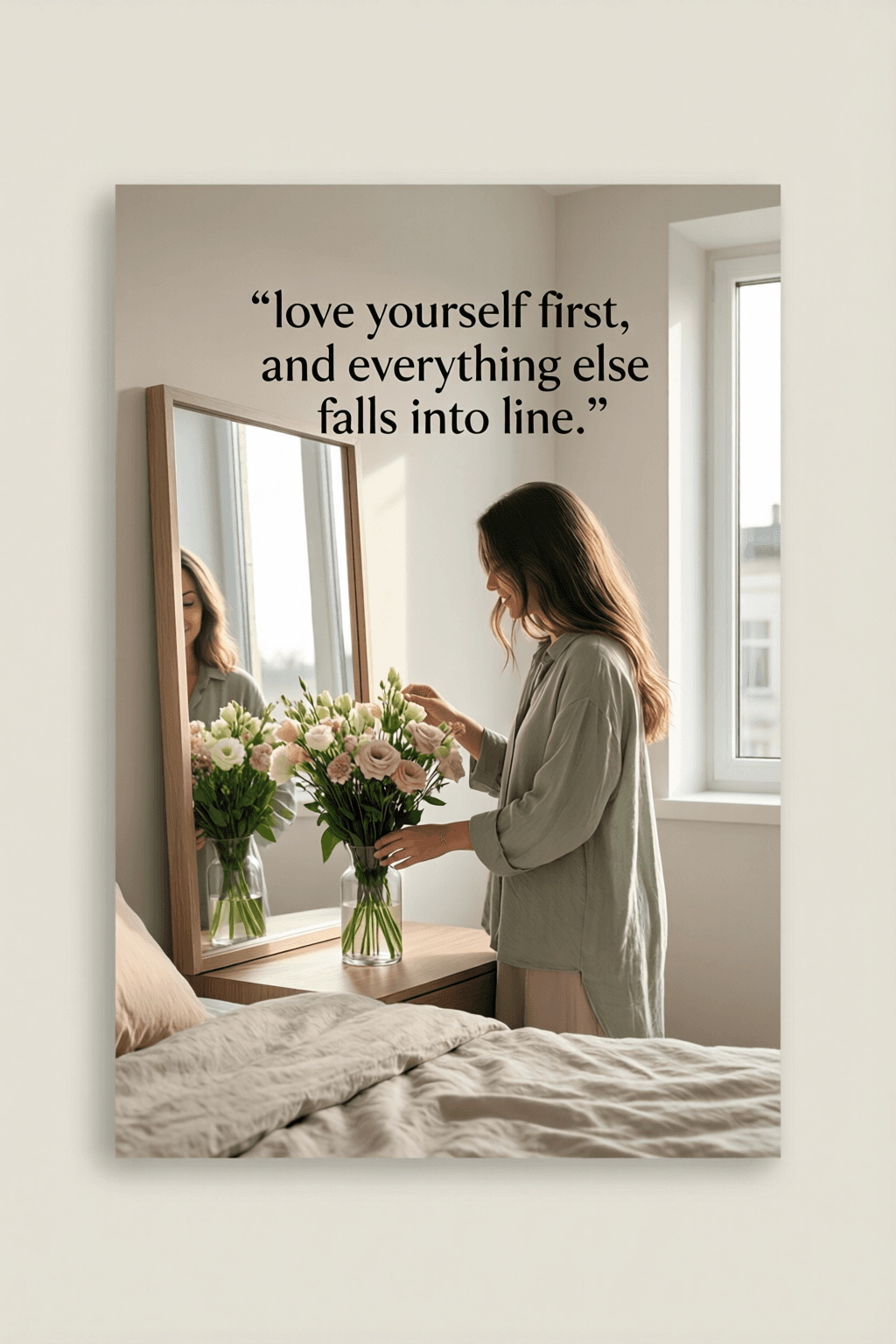
I have an everyday religion that works for me: love yourself first, and everything else falls into line. — Lucille Ball
—What lingers after this line?
An Everyday Creed
Lucille Ball frames self-love not as vanity, but as a practical belief system for daily life. By calling it an “everyday religion,” she gives the idea both intimacy and seriousness: this is not an abstract philosophy reserved for rare moments, but a habit meant to guide ordinary choices. In that sense, her quote suggests that how we treat ourselves quietly shapes how we experience the world. From this starting point, the phrase “everything else falls into line” implies order rather than magic. Ball is not promising a life free of struggle; instead, she suggests that inner regard creates a stable center. Once a person stops living from self-rejection, decisions, relationships, and ambitions can begin to align with greater clarity.
Why Self-Love Comes First
The logic of the quote becomes clearer when we consider that self-love often determines what we accept, pursue, and endure. If people believe they are worthy of care, they are more likely to set boundaries, seek nourishing relationships, and recover from setbacks without collapsing into shame. Thus, loving oneself first acts less like selfishness and more like emotional groundwork. Moreover, this idea echoes older ethical traditions. Aristotle’s Nicomachean Ethics (4th century BC) distinguishes healthy self-regard from selfish greed, implying that a well-ordered person can act more virtuously toward others. Ball’s wording is simpler and more modern, yet it carries a similar insight: inner respect is often the beginning of outer balance.
The Difference Between Self-Love and Narcissism
At this point, an important distinction emerges: self-love is not the same as self-absorption. Narcissism demands admiration and often ignores others, whereas genuine self-love makes room for humility, accountability, and connection. In other words, valuing oneself properly can reduce the frantic need for external validation rather than intensify it. This difference matters because popular culture often confuses confidence with ego. Psychologists such as Kristin Neff, in her work on self-compassion (Self-Compassion, 2011), argue that treating oneself kindly during failure leads to resilience, not arrogance. Seen through that lens, Ball’s advice encourages a steadier inner voice—one that supports growth without turning the self into an idol.
How Inner Regard Shapes Relationships
Once self-love is established, Ball suggests, other parts of life begin to organize themselves—especially relationships. People who respect their own needs are often better equipped to love others without desperation or resentment. Rather than asking a partner, friend, or audience to supply constant worth, they can enter connection with a fuller sense of self. Literature repeatedly illustrates the opposite pattern: characters starved of self-worth often attach themselves destructively to others. By contrast, Bell Hooks’s All About Love (2000) argues that love cannot thrive where there is persistent self-neglect. Ball’s quote fits this broader tradition by implying that healthy love radiates outward from a person who has first made peace with herself.
A Practical Philosophy for Resilience
Finally, the enduring appeal of Ball’s statement lies in its practicality. Self-love here is not sentimental indulgence, but a daily discipline of speaking honestly to oneself, forgiving mistakes, and refusing to build a life on self-contempt. These small acts can influence work, health, creativity, and relationships in ways that feel quietly transformative. Given Lucille Ball’s own public life—marked by ambition, reinvention, and the pressures of fame—the quote also carries the weight of lived experience. It reads like distilled wisdom from someone who understood that external success cannot compensate for inner hostility. Therefore, her “everyday religion” remains compelling because it offers not perfection, but a durable way to stand upright in the world.
Recommended Reading
As an Amazon Associate, we earn from qualifying purchases.
One-minute reflection
What's one small action this suggests?
Related Quotes
6 selectedWhatever you do in life, choose a theme that grounds your decisions when things feel noisy. — Erica Diamond
Erica Diamond
At its core, Erica Diamond’s quote argues that life becomes clearer when guided by a central theme rather than by scattered impulses. That theme might be integrity, service, creativity, or peace, but its real function is...
Read full interpretation →Self-respect is the first step to self-love. It is the invisible coat of mail that keeps you safe from the noise of the world. — Henry Wadsworth Longfellow
Henry Wadsworth Longfellow
Longfellow begins with a sequence that feels both simple and profound: before a person can truly love themselves, they must first respect themselves. In other words, self-love is not merely a warm feeling or a moment of...
Read full interpretation →You cannot build a life of purpose on the foundations of other people's expectations. Stop optimizing your life for an audience and start orienting it toward your own values. — Oliver Burkeman
Oliver Burkeman
At its core, Burkeman’s quote exposes how easily a life can become a performance. Many people make choices about work, relationships, and success not because those choices feel meaningful, but because they appear admirab...
Read full interpretation →You yourself, as much as anybody in the entire universe, deserve your love and affection. — Dalai Lama
Dalai Lama
At its core, this Dalai Lama quotation insists that self-love is not vanity but fairness. We often extend patience, kindness, and forgiveness to friends while withholding the same warmth from ourselves.
Read full interpretation →It is not selfish to love yourself, to take care of yourself, and to make your happiness a priority. It's necessary. — Mandy Hale
Mandy Hale
Mandy Hale’s quote immediately challenges a common moral suspicion: that caring for oneself must come at the expense of others. Instead, she reframes self-love, self-care, and personal happiness as necessities rather tha...
Read full interpretation →Rest is not an act of selfishness, but rather the purest form of self-love. — Sonia Choquette
Sonia Choquette
At first glance, Sonia Choquette’s quote challenges a deeply ingrained belief: that slowing down is indulgent or unproductive. Instead, she reframes rest as an essential act of care, suggesting that choosing pause over c...
Read full interpretation →More From Author
More from Lucille Ball →It's a hell of a start, being able to recognize what makes you happy. — Lucille Ball
Lucille Ball frames happiness not as a finish line, but as a starting point: if you can name what truly lifts you, you’ve already begun to steer your life with intention. Before goals, habits, or major decisions, there’s...
Read full interpretation →One of the things I learned the hard way was that it doesn't pay to get discouraged. — Lucille Ball
Lucille Ball’s line reframes discouragement as a bad investment: it “doesn’t pay.” Rather than a moral plea to be cheerful, it’s a pragmatic calculation about return on effort. When we stop after a setback, we halt compo...
Read full interpretation →The more you do, the more you can do. — Lucille Ball
This quote highlights the concept of gradual improvement. By continuously engaging in tasks and challenges, one builds skills and abilities, which in turn makes tackling future tasks easier.
Read full interpretation →I'd rather regret the things I've done than regret the things I haven't done. — Lucille Ball
This quote highlights the idea of embracing one's decisions and experiences, suggesting that it's better to take action and face the consequences than to live with the uncertainty of missed opportunities.
Read full interpretation →