
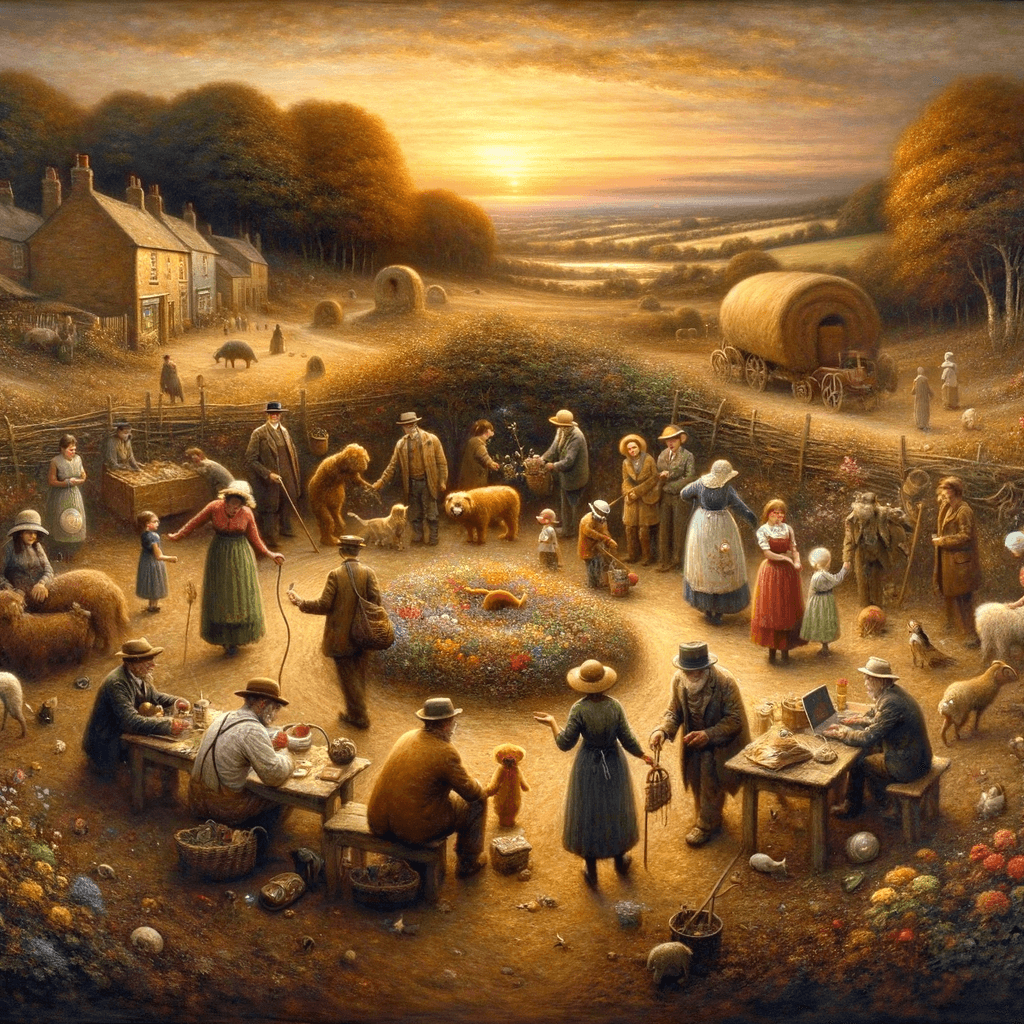
Sometimes the smallest things take up the most room in your heart. — A.A. Milne, UK.
—What lingers after this line?
Significance of Small Gestures
This quote highlights how seemingly insignificant moments or gestures can have a profound emotional impact, suggesting that love and affection can be found in the little things.
Emotional Attachment
It reflects the notion that our hearts can be filled with fondness for small experiences, memories, or objects which play a big role in shaping our happiness and emotional well-being.
Appreciation for Simplicity
The quote encourages an appreciation for the simple joys in life, reminding us to cherish and find value in the minor details rather than focusing solely on grand experiences.
Childlike Perspective
A.A. Milne, known for his beloved children's stories, emphasizes a childlike perspective that finds wonder and joy in minor things, reinforcing the idea that innocence and simplicity often hold great significance.
Universal Resonance
The sentiment in this quote resonates with many people, depicting a common human experience where minor events—such as a smile, a kind word, or a moment of connection—can leave a lasting impression on our hearts.
Recommended Reading
As an Amazon Associate, we earn from qualifying purchases.
One-minute reflection
What's one small action this suggests?
Related Quotes
6 selectedIt is nice when I have days off to go home and relax and literally take the weight off my shoulders and enjoy the simple things. — Michael B. Jordan
Michael B. Jordan
At its heart, Michael B. Jordan’s reflection presents rest not as laziness, but as a vital form of release.
Read full interpretation →Sometimes, the simple things are more fun and meaningful than all the banquets in the world. — E.A. Bucchianeri
E.A. Bucchianeri
At first glance, Bucchianeri’s line contrasts modest pleasures with extravagant abundance, yet its deeper point is about value rather than scale. A banquet symbolizes excess, display, and public celebration, while ‘simpl...
Read full interpretation →Tenderness is not a sign of weakness. It is the signature of a soul that has learned the value of its own heart. — Yung Pueblo
Yung Pueblo
Yung Pueblo opens by challenging a familiar cultural reflex: the assumption that softness equals fragility. In many environments, emotional restraint is treated like armor, while tenderness is misread as a crack in the s...
Read full interpretation →Wear tenderness like armor and act with fierce kindness — Alice Walker
Alice Walker
Alice Walker’s line pivots on a deliberate paradox: armor is meant to harden, yet she asks us to “wear tenderness” as if softness could be protective. By pairing “tenderness” with “armor,” she challenges the assumption t...
Read full interpretation →Dare to be tender in a world that confuses softness with weakness. — Emily Dickinson
Emily Dickinson
Dickinson’s line begins with a verb of courage: “Dare.” From the outset, tenderness isn’t presented as a personality trait you either have or lack, but as a choice that carries consequences. To be tender is to remain ope...
Read full interpretation →Find the work that wakes your joy, and do it with stubborn tenderness — Helen Keller
Helen Keller
Helen Keller’s line begins by treating joy as more than a fleeting mood—it becomes an instrument of direction. The “work that wakes your joy” implies something latent inside you, not manufactured on command, that rises w...
Read full interpretation →More From Author
More from A.A. Milne, UK. →