
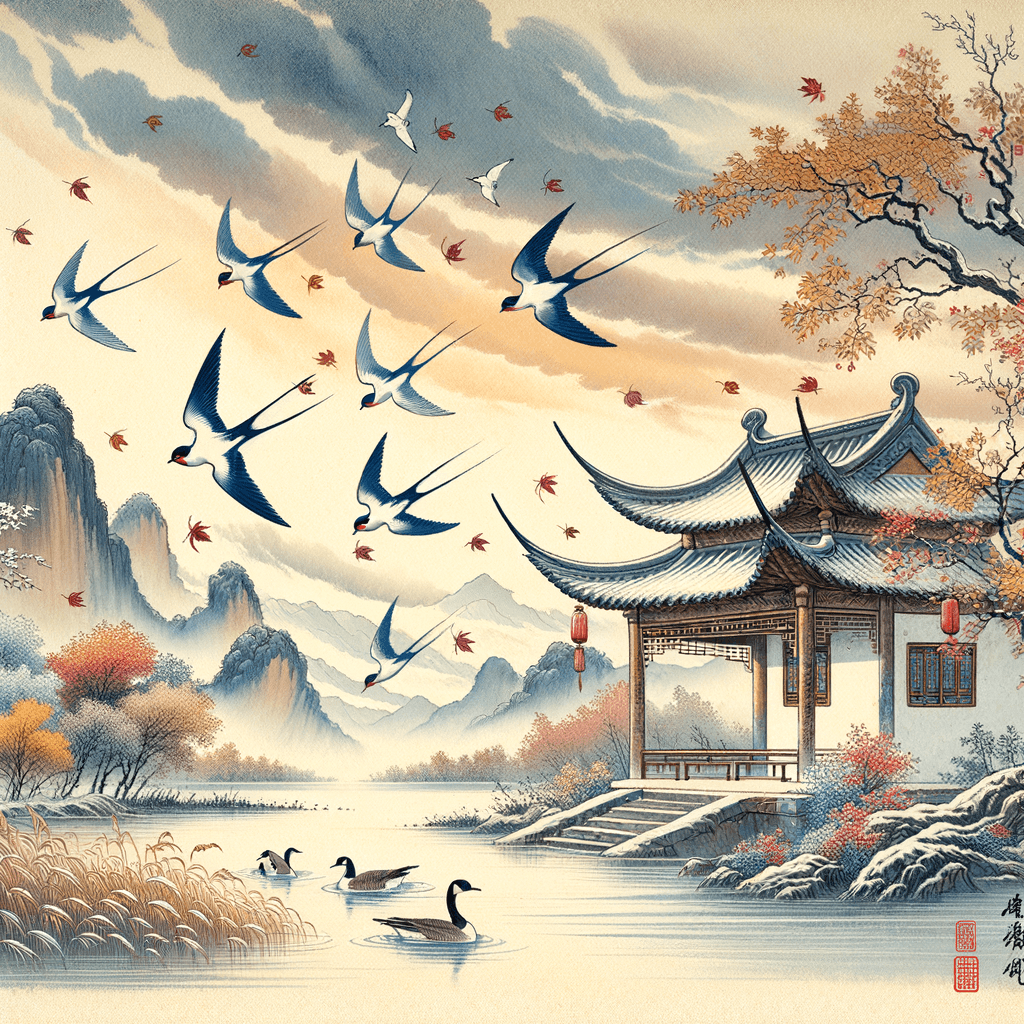
The autumn wind is bleak and the weather is cool; the grass and trees wither and dew turns into frost. Swallows depart in flocks while wild geese fly south. Thinking of you traveling far away, my heart breaks with sorrow.
—What lingers after this line?
Seasonal Imagery
The quote paints a vivid picture of autumn using elements such as cold weather, withering grass, and frost. These elements set a melancholic and somber mood.
Symbolism of Migration
The departure of swallows and geese symbolizes separation and the inevitability of change. The migrating birds represent loved ones who must leave, evoking feelings of loneliness and loss.
Emotional Resonance
The heartache described is a universal sentiment that many people experience when they are parted from a loved one. The poet's sorrow is palpable, making it easy for readers to empathize.
Nature Reflecting Emotions
The desolate autumn landscape mirrors the internal emotional state of the poet. The bleakness of the environment amplifies the sense of despair and longing.
Cultural Context
In many cultures, autumn is often associated with endings and farewells. This cultural context enriches the poem, resonating with readers' understanding of autumn as a time of transition and reflection.
One-minute reflection
What does this quote ask you to notice today?
Related Quotes
6 selectedEvery leaf that falls to the ground is a love letter from the trees to autumn.
Unknown
This metaphor suggests that the falling leaves represent a message or a gesture of affection from the trees to the season of autumn, indicating a harmonious relationship between nature and the changing seasons.
Read full interpretation →Each fallen leaf is a poem written by the season.
the season.
This quote suggests that each fallen leaf is a form of artistic expression by nature, akin to a poem. Just as poems communicate emotions and ideas, fallen leaves tell the story of the season.
Read full interpretation →I searched for him a thousand times in the crowd. Suddenly I turned my head, and there he was, at the dimly lit place where the lanterns were few. -- Xin Qiji
Xin Qiji
Xin Qiji frames love as a relentless act of looking: the speaker scans a crowd again and again, as if repetition might conjure the beloved into view. The exaggeration of “a thousand times” is less a statistic than a port...
Read full interpretation →Transform longing into art; the soul does its work through making. — Kahlil Gibran
Kahlil Gibran
Gibran frames longing not as a deficit to be cured but as a force that can be transmuted. The ache for someone, somewhere, or some meaning becomes raw material—an emotional pigment waiting to be mixed into form.
Read full interpretation →Sing so your longing becomes fuel, then walk toward the light you name — Sappho
Sappho
Sappho’s line begins by treating longing not as a weakness to hide but as raw material to work with. Instead of letting desire pool into paralysis, she frames it as something already full of energy—an inner pressure seek...
Read full interpretation →Translate longing into craft, and the world will begin to answer. — Frida Kahlo
Frida Kahlo
Kahlo’s line treats longing not as a weakness to outgrow but as a potent substance—like pigment or clay—waiting to be shaped. Rather than asking us to suppress desire, grief, or yearning, she implies these feelings can b...
Read full interpretation →More From Author
More from Unknown →The language is the substrate. The architecture is the contract.
The line sets up a deliberate pairing: language lies beneath everything, while architecture governs everything above it. In other words, what you can express determines what you can build, and what you commit to structur...
Read full interpretation →A scroll is not a break; it is a trap disguised as rest. — Unknown
The quote begins by challenging a familiar story we tell ourselves: that a brief scroll is a harmless pause between tasks. On the surface, it looks like recovery—no effort, no decision, no commitment.
Read full interpretation →Don't let your ice cream melt while you're counting someone else's sprinkles. — Unknown
The quote uses ice cream as a simple stand-in for life’s fleeting pleasures: what you have is delicious, but it won’t last forever if you ignore it. Meanwhile, “counting someone else’s sprinkles” captures the habit of mo...
Read full interpretation →If your absence doesn't affect them, your presence never mattered. — Unknown
The quote frames absence as a revealing experiment: remove yourself, and the reaction—concern, curiosity, indifference—becomes a kind of data. If nothing changes when you’re gone, it suggests your role was never integrat...
Read full interpretation →