
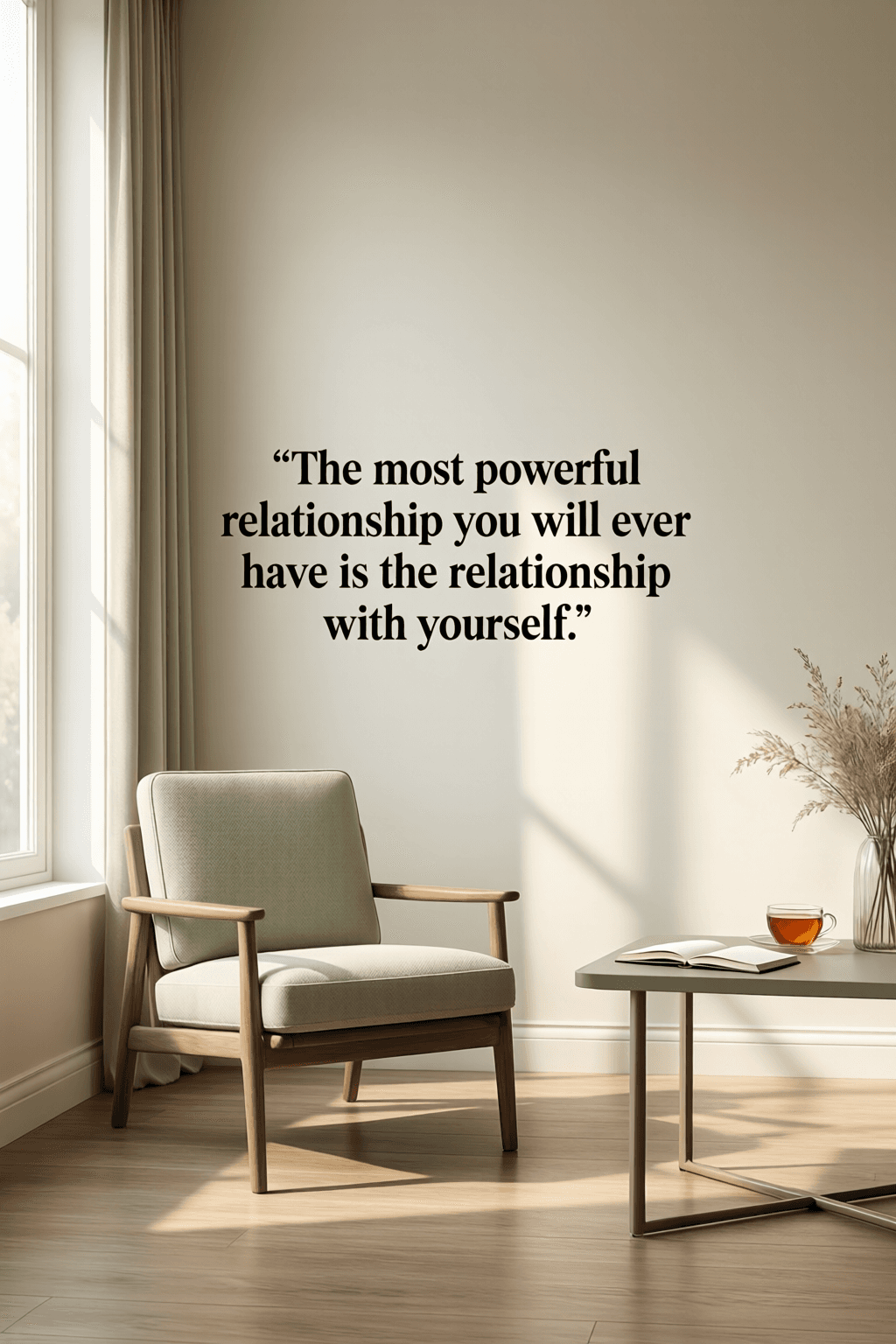
The most powerful relationship you will ever have is the relationship with yourself. — Nedra Glover Tawwab
—What lingers after this line?
Why the Inner Relationship Matters Most
Nedra Glover Tawwab’s quote places self-relationship at the center of human life, suggesting that every other bond is filtered through the one we have with ourselves. In other words, the way we speak to ourselves, interpret our worth, and respond to our own needs quietly shapes our daily experience. Because this relationship is constant, it becomes the foundation beneath confidence, resilience, and emotional stability. From this starting point, the quote feels less like a slogan and more like a practical truth. Unlike friendships or romance, which may change over time, the self is the one companion we cannot leave behind. Therefore, strengthening that bond is not selfishness but essential maintenance for a meaningful life.
Self-Talk as a Daily Architecture
Building on that idea, the relationship with yourself is largely constructed through self-talk. A person who constantly rehearses criticism creates an inner climate of tension, while someone who practices honesty with compassion builds trust within. Psychologist Kristin Neff’s work on self-compassion, especially in Self-Compassion (2011), shows that treating oneself kindly can improve emotional resilience more effectively than harsh self-judgment. Consequently, Tawwab’s insight points to the invisible conversations that shape identity. The issue is not pretending everything is fine, but learning to correct yourself without contempt. Over time, that shift transforms the self from an adversary into an ally.
Boundaries Begin Inside First
Just as important, a strong relationship with yourself influences the boundaries you set with others. Nedra Glover Tawwab’s own writing in Set Boundaries, Find Peace (2021) argues that clear limits are rooted in self-awareness and self-respect. If you do not believe your time, energy, or feelings matter, it becomes far harder to protect them in relationships, work, or family life. Seen this way, inner connection is not abstract; it has visible consequences. People who trust themselves are better able to say no, to ask for what they need, and to step away from harmful dynamics. Thus, the private bond within becomes the standard by which external relationships are measured.
How Self-Relationship Shapes Love and Friendship
From there, the quote extends naturally into our closest relationships. The expectations we carry into love and friendship often reflect what we already believe about ourselves. If we feel unworthy, we may tolerate neglect; if we feel secure, we are more likely to seek reciprocity and respect. As Alain de Botton observes in Essays in Love (1993), romantic life often exposes private emotional patterns we barely recognize in ourselves. Therefore, the relationship with yourself does not compete with love for others; it governs how well you can receive and sustain it. A healthier inner bond makes room for intimacy without making another person responsible for your entire sense of worth.
Resilience in Solitude and Struggle
Moreover, the strength of your self-relationship becomes clearest during loneliness, failure, or uncertainty. When external validation fades, what remains is the internal voice that interprets the moment: either as proof of inadequacy or as part of being human. Viktor Frankl’s Man’s Search for Meaning (1946) illustrates, in a profound context, how inner orientation can sustain a person even when outer circumstances are stripped away. For that reason, Tawwab’s statement is also about endurance. A nurturing relationship with yourself does not eliminate pain, but it helps you remain intact within it. It offers companionship in moments when no one else can fully enter your experience.
Turning Insight into Practice
Finally, the quote invites action rather than admiration. A better relationship with yourself is built through repeated acts: resting without guilt, noticing your emotions, keeping promises to yourself, and forgiving imperfection while still pursuing growth. Small rituals—journaling, therapy, meditation, or simply pausing before self-criticism—become ways of practicing inner loyalty. In the end, Tawwab’s words endure because they unite dignity with responsibility. The most powerful relationship in life is not automatically healthy; it must be cultivated. Yet once it is, it becomes the quiet source from which clarity, peace, and stronger connections with others can grow.
Recommended Reading
As an Amazon Associate, we earn from qualifying purchases.
One-minute reflection
What's one small action this suggests?
Related Quotes
6 selectedYour life is your own to build. Do not reserve space in your heart for those who do not make an effort to stay. — Angel Chernoff
Angel Chernoff
At its core, Angel Chernoff’s line begins with a declaration of personal agency: your life is yours to shape. Rather than treating identity as something determined by other people’s approval or absence, the quote redirec...
Read full interpretation →Your worth is not a spreadsheet, and your output is not your identity. Protect your energy like it's the only currency you have. — Glennon Doyle
Glennon Doyle
At its core, Glennon Doyle’s statement rejects a modern habit of turning human value into something quantifiable. A spreadsheet can track hours, profits, tasks, and metrics, but it cannot measure dignity, tenderness, res...
Read full interpretation →Your value does not decrease based on someone's inability to see your worth. — Zig Ziglar
Zig Ziglar
At its heart, Zig Ziglar’s statement insists that human worth is not a fluctuating market price set by other people’s opinions. Someone may overlook, underestimate, or dismiss you, yet their failure of perception does no...
Read full interpretation →You don't have to earn your right to slow down. — Dr. Thema Bryant
Dr. Thema Bryant
At first glance, Dr. Thema Bryant’s line sounds simple, yet it quietly confronts a powerful modern belief: that rest must be justified by exhaustion, productivity, or achievement.
Read full interpretation →It is an absolute human certainty that no one can know his own beauty until it has been reflected back to him in the mirror of another loving, caring human being. — John Joseph Powell
John Joseph Powell
John Joseph Powell’s statement begins with a striking claim: self-knowledge, at least in its deepest emotional form, is never entirely solitary. We may examine our achievements, traits, and flaws on our own, yet our sens...
Read full interpretation →What people in the world think of you is really none of your business. — Martha Graham
Martha Graham
Martha Graham’s remark cuts directly against a common human habit: measuring ourselves through the eyes of others. At its heart, the quote argues that public opinion is unstable, partial, and often beyond our control.
Read full interpretation →More From Author
More from Nedra Glover Tawwab →Boundaries are not walls to keep others out, but gates to protect your own nervous system. — Nedra Glover Tawwab
At first glance, boundaries are often mistaken for rejection, distance, or emotional coldness. Yet Nedra Glover Tawwab’s image of gates rather than walls shifts the entire meaning: boundaries are not built to punish othe...
Read full interpretation →You do not have to fix everything today, this week, or alone. You can rebuild—gently, slowly, and sustainably. — Nedra Glover Tawwab
Nedra Glover Tawwab’s words begin by challenging a familiar pressure: the belief that healing must happen immediately and completely. By saying, “You do not have to fix everything today, this week, or alone,” she interru...
Read full interpretation →The greatest gift you can give an anxious mind is a home that serves as a sanctuary, where you can be heard without being judged. — Nedra Glover Tawwab
At its core, Nedra Glover Tawwab’s quote redefines home as more than a physical shelter. She presents it as an emotional refuge, a place where an anxious mind can finally lower its guard.
Read full interpretation →A boundary is not about pushing people away; it's about protecting the energy you need to thrive. — Nedra Glover Tawwab
At first glance, boundaries are often mistaken for walls, as if saying no automatically signals rejection. Yet Nedra Glover Tawwab’s statement gently corrects that misunderstanding: a boundary is less about distancing ot...
Read full interpretation →