
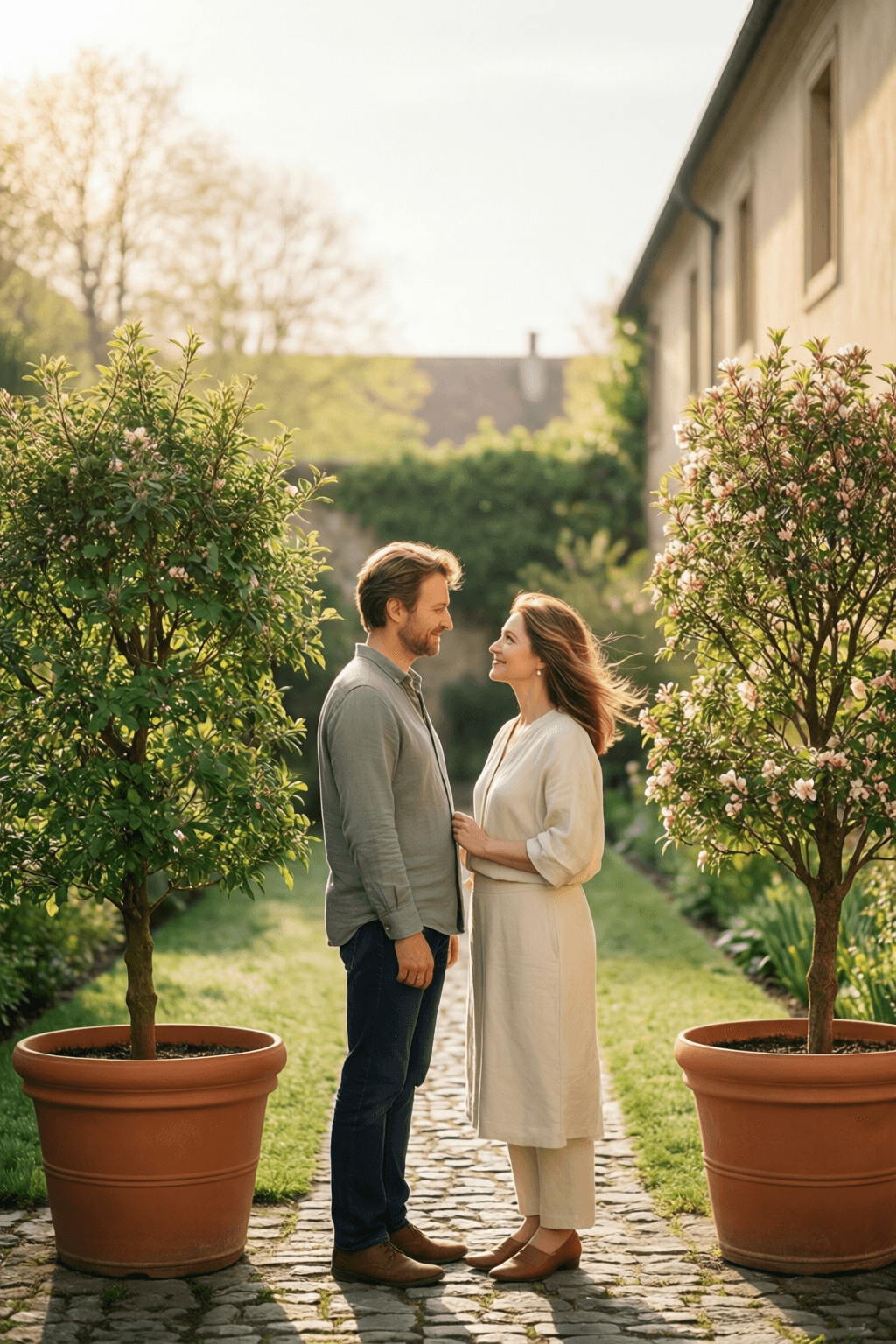
To love is not about merging. It is a noble calling for the individual to ripen, to differentiate, to become a world in oneself in response to another. — Rainer Maria Rilke
—What lingers after this line?
Love Beyond Fusion
At first glance, Rilke challenges one of romance’s most familiar ideals: the desire to ‘become one.’ Instead, he argues that genuine love is not a collapse of boundaries but a deepened encounter between two distinct people. In this view, love does not erase the self; rather, it calls the self into sharper focus. By rejecting merger, Rilke protects the dignity of individuality. Love becomes meaningful precisely because it occurs between two separate centers of consciousness. The beloved is not someone to absorb or be absorbed by, but someone whose presence summons greater inward depth.
The Noble Work of Ripening
From there, the word ‘ripen’ becomes essential to understanding the quote’s moral force. Ripening suggests patience, seasonality, and inward development rather than instant emotional completion. Love, then, is less a sudden solution to loneliness than a long discipline of maturing under the influence of another person. This idea echoes Rilke’s broader thought in Letters to a Young Poet (1903–1908), where he repeatedly praises solitude as a condition for authentic growth. In that spirit, love is noble because it does not demand premature surrender; instead, it asks each person to become more fully formed.
Differentiation as Devotion
As the thought unfolds, Rilke presents differentiation not as distance but as a form of fidelity. To differentiate is to know one’s own mind, values, and vocation clearly enough to meet another honestly. Without that inner definition, relationships can slide into dependency, imitation, or fear-driven attachment. Modern psychology offers a useful parallel here. Family systems theorist Murray Bowen, especially in Family Therapy in Clinical Practice (1978), described ‘differentiation of self’ as the capacity to remain emotionally connected without losing personal clarity. Rilke’s insight anticipates this: love is strongest when intimacy and selfhood grow together.
Becoming a World in Oneself
Rilke’s most striking phrase is surely ‘to become a world in oneself.’ With it, he suggests that a mature person carries an inner richness—memories, convictions, imagination, and spiritual depth—that cannot be reduced to the relationship alone. Love should expand that inner world, not replace it. Consequently, the beloved is not the entirety of existence but the one before whom existence becomes more vivid. This is why Rilke’s idea feels both demanding and liberating: one must cultivate a life large enough to offer, rather than merely a need to fill. The relationship flourishes because each person brings a real world to the meeting.
Response Rather Than Possession
Just as importantly, Rilke says this becoming happens ‘in response to another.’ That phrase softens the emphasis on individuality with an equally strong emphasis on relation. We do not mature in isolation alone; we are awakened, challenged, and refined by the presence of someone we love. Yet response is very different from possession. The other person does not function as property, completion, or proof of worth. Instead, they act more like a summons—calling forth courage, honesty, and depth. In this sense, love is dialogical: each self becomes more fully itself through answering the reality of another.
A Demanding Ideal for Modern Love
Finally, Rilke offers a corrective to modern fantasies of total emotional fusion, where constant closeness is often mistaken for intimacy. His vision is harder, but also more durable. It asks lovers to resist the temptation to disappear into each other and to practice the more difficult art of standing fully present as distinct persons. That is why the quote still feels urgent. It frames love not as escape from individuality but as its highest test. To love well is to become more complete, more responsible, and more inwardly alive—so that union is not the loss of self, but the meeting of two ripened worlds.
Recommended Reading
As an Amazon Associate, we earn from qualifying purchases.
One-minute reflection
What's one small action this suggests?
Related Quotes
6 selectedFamily is not defined by our genes, it is built and maintained through love. — Unknown (Wait, skipping to) Family is the best thing you could ever wish for. — Michael J. Fox
Michael J. Fox
Taken together, these two quotations broaden the idea of what family means. The first insists that family is not merely a biological fact but a relationship built through care, loyalty, and steady affection.
Read full interpretation →To love is to recognize that another person is a separate universe, and yet to choose, daily, to walk through it beside them. — Chimamanda Ngozi Adichie
Chimamanda Ngozi Adichie
At its heart, Adichie’s line defines love not as possession but as perception. To love someone is first to grasp that they are irreducibly distinct: a ‘separate universe’ with their own memories, fears, loyalties, and in...
Read full interpretation →Love is not affectionate feeling, but a steady wish for the loved one's ultimate good as far as it can be obtained. — C.S. Lewis
C.S. Lewis
At first glance, C.S. Lewis challenges one of the most common assumptions about love: that it is mainly a warm feeling.
Read full interpretation →The best way to turn a house into a home is to fill it with love and laughter. — William J. Bennett
William J. Bennett
At first glance, Bennett’s quote draws a clear line between a house and a home. A house is a physical structure, defined by rooms, doors, and possessions; a home, by contrast, is shaped by emotional life.
Read full interpretation →I have found that if you love life, life will love you back. — Arthur Rubinstein
Arthur Rubinstein
At its heart, Arthur Rubinstein’s remark suggests that life answers the attitude we bring to it. To love life is not to deny pain or difficulty; rather, it is to meet experience with receptivity, gratitude, and enthusias...
Read full interpretation →It is an absolute human certainty that no one can know his own beauty until it has been reflected back to him in the mirror of another loving, caring human being. — John Joseph Powell
John Joseph Powell
John Joseph Powell’s statement begins with a striking claim: self-knowledge, at least in its deepest emotional form, is never entirely solitary. We may examine our achievements, traits, and flaws on our own, yet our sens...
Read full interpretation →More From Author
More from Rainer Maria Rilke →Everything is blooming most recklessly; if it were voices instead of colors, there would be an unbelievable shrieking into the heart of the night. — Rainer Maria Rilke
At first glance, Rilke turns a peaceful image of blooming nature into something almost overwhelming. Flowers do not merely open; they burst forth “most recklessly,” suggesting a vitality so abundant that it exceeds calm...
Read full interpretation →And now let us believe in a long year that is given to us, new, untouched, full of things that have never been. — Rainer Maria Rilke
Rilke opens by shifting the tone from planning to believing: the year is “given to us,” implying something received rather than conquered. This framing matters because it replaces the pressure of achievement with the hum...
Read full interpretation →The purpose of life is to be defeated by greater and greater things. — Rainer Maria Rilke
Rainer Maria Rilke’s line treats “defeat” not as failure to avoid, but as a destination worth moving toward. The purpose of life, in this view, is measured by what can humble us—truths, beauties, responsibilities, or ide...
Read full interpretation →Dance with difficulty until it yields a new rhythm of strength. — Rainer Maria Rilke
Rilke’s line reframes difficulty from something to defeat into something to move with. To “dance” implies contact, attention, and responsiveness—an active relationship rather than a battle of will.
Read full interpretation →