
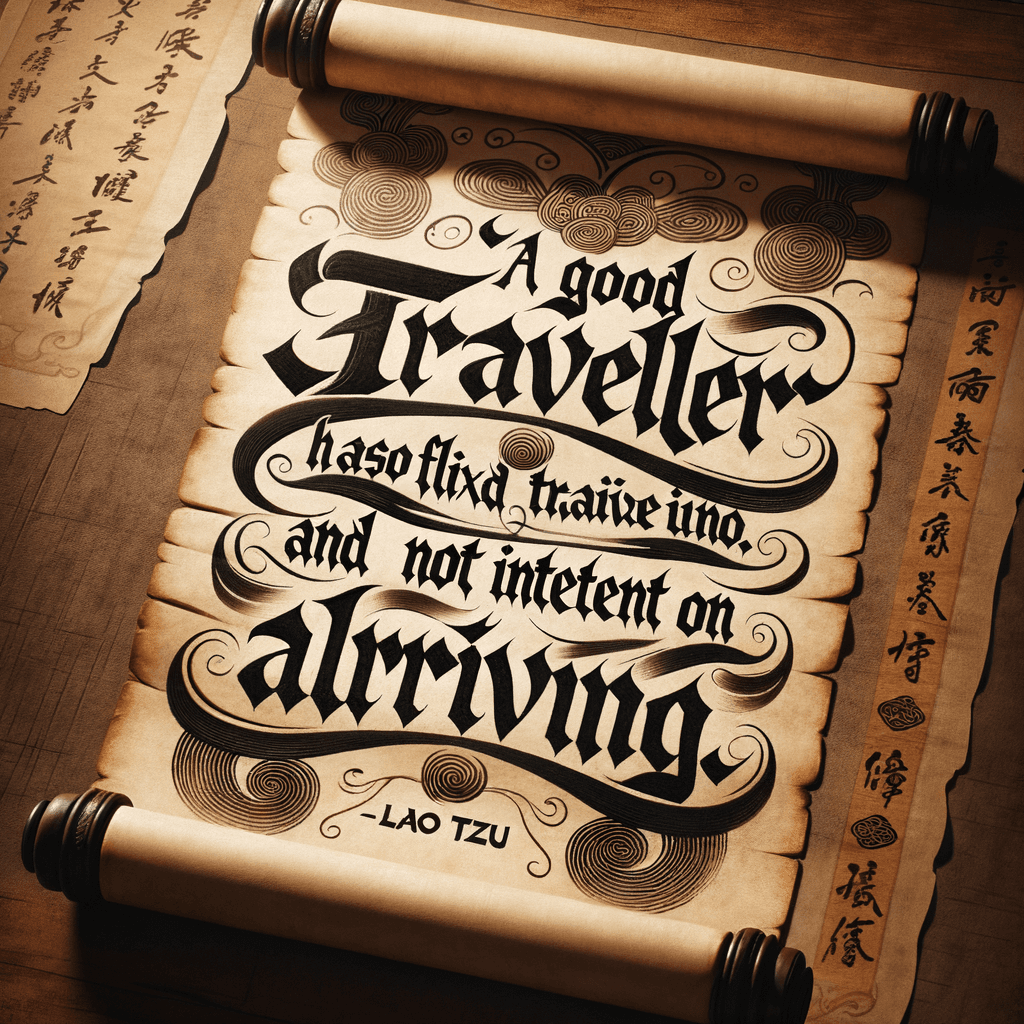
A good traveler has no fixed plans and is not intent on arriving. - Lao Tzu
—What lingers after this line?
Embracing the Journey
This quote suggests that a good traveler values the journey itself more than the destination. The experiences and lessons gained along the way are more important than simply reaching a particular place.
Flexibility and Adaptability
Lao Tzu emphasizes the importance of being flexible and adaptable. Without rigid plans, a traveler can more easily adjust to unexpected situations and embrace new opportunities and experiences.
Mindfulness and Presence
The quote encourages mindfulness, being present in each moment rather than being fixated on the end goal. Enjoying each step of the journey can lead to a richer, more fulfilling experience.
Letting Go of Expectations
A key idea here is to let go of expectations. By not being intent on arriving, travelers can appreciate what comes their way, experiencing life more fully without the pressure of predefined outcomes.
Philosophical Roots
Lao Tzu, an ancient Chinese philosopher and the author of the Tao Te Ching, often taught about living in harmony with the Tao, or 'the Way.' This quote reflects Taoist principles of naturalness, simplicity, and spontaneity.
One-minute reflection
What does this quote ask you to notice today?
Related Quotes
6 selectedHeaven and Earth are not benevolent: they regard the myriad things as straw dogs; the sage is not benevolent: he regards the common people as straw dogs.
Lao Tzu
At the outset, the line jars modern readers because “not benevolent” seems to deny ordinary morality. In the Daodejing (ch.
Read full interpretation →To desire nothing is to be serene. — Laozi
Lao Tzu
Laozi’s assertion that ‘to desire nothing is to be serene’ invites us to consider the burdens imposed by desire. In the *Tao Te Ching* (c.
Read full interpretation →Act without expectation; that is the essence of true action. — Lao Tzu
Lao Tzu
This quote emphasizes the importance of acting without attachment to outcomes or rewards. True action, according to Lao Tzu, is selfless and performed for its own sake, not for personal gain or recognition.
Read full interpretation →If you obey all the rules, you miss all the fun. — Katharine Hepburn
Katharine Hepburn
Katharine Hepburn’s line is intentionally mischievous: it pokes at the suspicion that strict rule-following can drain life of spontaneity. Her phrasing doesn’t merely celebrate disobedience; it frames “fun” as something...
Read full interpretation →Happiness is the absence of the striving for happiness. — Chuang Tzu
Chuang Tzu
Chuang Tzu’s line begins with a paradox: the more we chase happiness as an object to capture, the more it recedes. In other words, striving turns joy into a future prize, which quietly trains the mind to feel that the pr...
Read full interpretation →You can’t be that kid at the top of the water slide, overthinking it. You have to go down the chute. — Tina Fey
Tina Fey
Tina Fey’s image of a child frozen at the top of a water slide captures a familiar moment: standing on the edge of action, paralyzed by what might go wrong. The slide itself is a metaphor for opportunities, risks, and cr...
Read full interpretation →More From Author
More from Lao Tzu →If you want to be out front, then act as if you were behind. — Lao Tzu
Lao Tzu’s saying begins with a paradox: to move ahead of others, one must behave as though one is behind them. Rather than urging weakness or hesitation, the quote points to a subtler form of strength—leadership that doe...
Read full interpretation →Do you have the patience to wait until your mud settles and the water is clear? — Lao Tzu
Lao Tzu’s question frames patience not as passive delay but as an active kind of wisdom. The image of muddy water settling on its own suggests that confusion often clears not through force, but through restraint.
Read full interpretation →Anything that is living must have a rest. If it does not rest, it will lose its strength. — Lao Tzu
Lao Tzu’s insight begins with a simple observation: all living things move in cycles, not in endless exertion. By saying that anything alive must rest, he frames rest not as laziness but as a biological and spiritual nec...
Read full interpretation →Yield and overcome, bend and be straight. — Lao Tzu
At first glance, Lao Tzu’s line seems contradictory: how can yielding lead to overcoming, or bending result in straightness? Yet this paradox lies at the heart of Taoist thought.
Read full interpretation →