
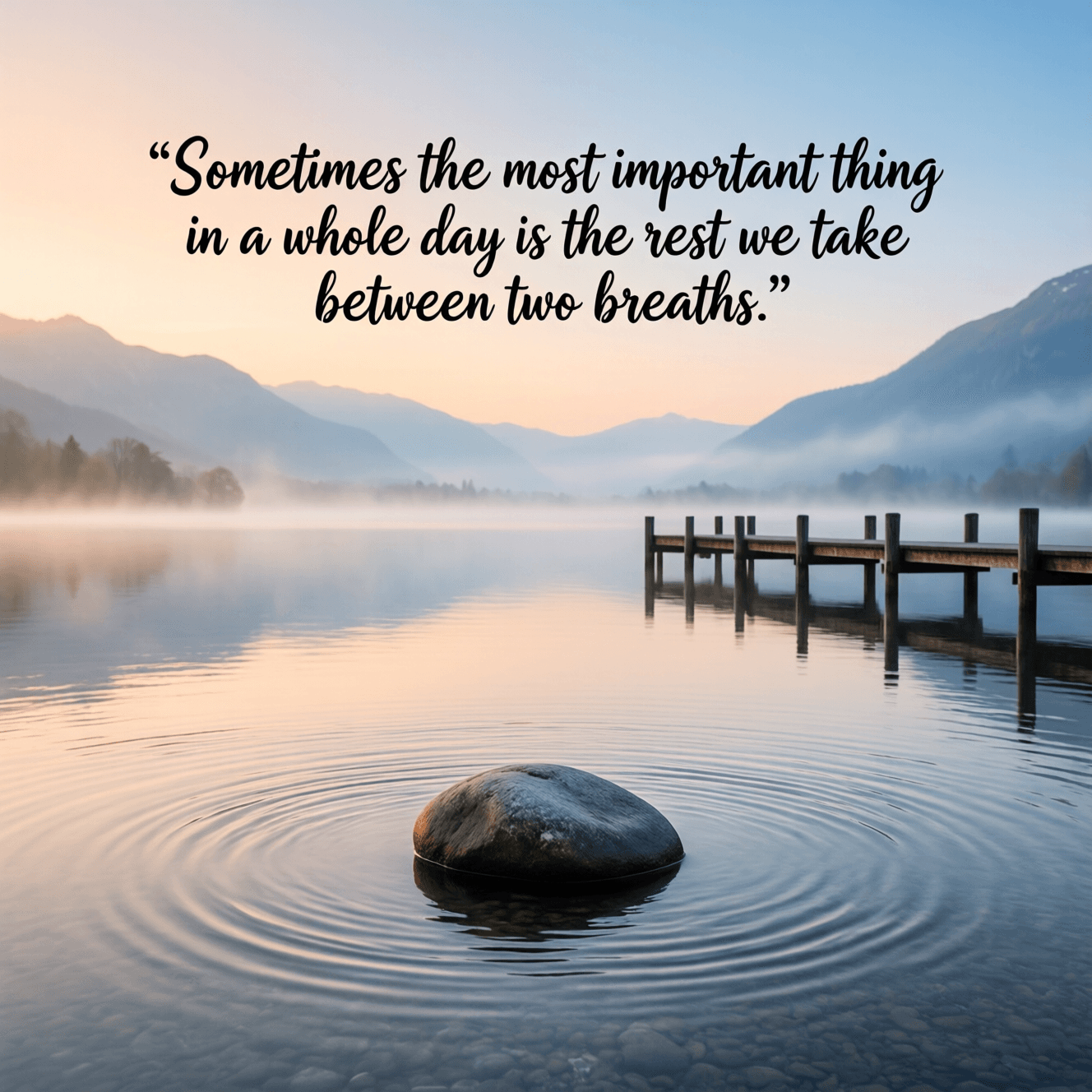
Sometimes the most important thing in a whole day is the rest we take between two breaths. — Etty Hillesum
—What lingers after this line?
A Pause That Reorders the Day
Etty Hillesum’s line reframes “importance” as something subtle rather than spectacular: not the meetings, errands, or achievements, but a nearly invisible interval of rest. By pointing to the space between two breaths, she suggests that what restores us can be smaller than thought, yet decisive in how we meet the next moment. This begins as a paradox—how could the tiniest pause matter most? Yet the quote implies that the quality of a day is often determined less by what happens to us than by the brief resets that keep us from being swept away by it.
Hillesum’s Context: Inner Freedom Under Pressure
The sentence gains weight when read alongside Hillesum’s own witness. In Etty Hillesum’s diaries and letters—later published as Etty Hillesum, *An Interrupted Life* (written 1941–1943)—she explores how to protect an “inner space” even amid persecution and fear. Her attention to small moments of stillness was not a luxury but a practice of survival. From that perspective, the “rest between two breaths” becomes a micro-sanctuary: a way to preserve dignity and clarity when the outer world is unstable. The quote quietly argues that inner freedom can be exercised in seconds.
Breath as a Doorway to Presence
From context, the quote moves naturally toward attention itself. Breath is always happening, but noticing it turns us toward the present, where we can actually choose our next response. The “between” is crucial: it is not merely breathing, but the moment that feels like a threshold—neither the past inhale nor the next exhale. In many contemplative traditions, this threshold is treated as a training ground for presence. It’s a reminder that life is not only made of events, but also of the awareness that meets them—and awareness often returns through the simplest bodily rhythm.
A Nervous System Reset in Plain Sight
Moreover, the line captures something psychologically practical: brief pauses can interrupt spirals of stress. A single conscious breath can slow a racing mind, soften reactivity, and create just enough distance to prevent an impulsive word or action. What looks like “doing nothing” is, in fact, a rapid recalibration. Consider an ordinary anecdote: someone about to send a heated message stops, inhales, and waits a heartbeat before exhaling. That sliver of rest may be the difference between escalation and repair. Hillesum’s insight dignifies that small self-interruption as a daily turning point.
Rest Is Not Escape but Return
It might be tempting to hear “rest” as withdrawal from responsibility, but Hillesum points in the opposite direction. The rest between breaths is not an avoidance of life; it is a return to it—meeting reality with steadier hands. Rather than demanding long retreats, she highlights a form of rest that can travel with us into crowded rooms and difficult conversations. In that way, the quote becomes an ethic of attention: if we can rest briefly, we can respond more humanely. The pause is not the end of action; it is what makes better action possible.
Making the Smallest Practice a Daily Anchor
Finally, Hillesum’s sentence invites a modest practice: treat micro-rest as essential, not incidental. A few times a day, notice the natural pause after an inhale or exhale, even for a second, and let the body register safety. Over time, these moments can become an anchor—less dramatic than a resolution, but more reliable. The deeper promise is cumulative: when the day feels fragmented, the breath offers continuity. The most important thing may indeed be that tiny interval of rest, because it quietly teaches us how to begin again—repeatedly, and without spectacle.
One-minute reflection
Where does this idea show up in your life right now?
Related Quotes
6 selectedThe most productive thing you can do is often the very thing you feel most guilty for: resting. — Etty Hillesum
Etty Hillesum
At first glance, Etty Hillesum’s remark sounds contradictory: how can doing less become the most productive choice? Yet that tension is exactly her point.
Read full interpretation →Rest is not a passive indulgence; it is the essential rhythm that allows the heart to beat again. — Pema Chödrön
Pema Chödrön
At first glance, Pema Chödrön’s line challenges a common assumption: that rest is mere inactivity or a reward for productivity. Instead, she frames it as an essential rhythm, something woven into life itself rather than...
Read full interpretation →Taking a break isn't quitting; it's giving yourself the space to breathe. — Benjamin Moore
Benjamin Moore
At first glance, Benjamin Moore’s quote challenges a common fear: that stepping back means giving up. Instead, it reframes a break as an intentional act of care, a pause that preserves energy rather than abandons effort.
Read full interpretation →Sometimes the bravest thing you can do is rest, release, and allow yourself to not be okay for a moment. — Prayer Pure
Prayer Pure
At first glance, bravery is often associated with endurance, action, and the refusal to slow down. Yet this quote gently overturns that expectation by suggesting that courage can also look like surrendering the need to a...
Read full interpretation →You are worth the quiet moment. You are worth the deeper breath. You are worth the time it takes to slow down, be still, and rest. — Morgan Harper Nichols
Morgan Harper Nichols
At its core, Morgan Harper Nichols’s reflection challenges the modern habit of treating rest as something earned only after exhaustion. By saying “you are worth” the quiet moment, the deeper breath, and the time to slow...
Read full interpretation →Shifting the mind into lower gear can bring better health, inner calm, enhanced concentration and the ability to think more creatively. — Carl Honoré
Carl Honoré
Carl Honoré’s insight begins with a simple but countercultural claim: the mind often works better when it stops racing. In a world that rewards speed, multitasking, and constant responsiveness, shifting into a “lower gea...
Read full interpretation →More From Author
More from Etty Hillesum →Wisdom is knowing when to have rest, when to have activity, and how much of each to have. — Etty Hillesum
Etty Hillesum’s insight begins with a simple but demanding idea: wisdom is not merely knowing what is good, but knowing when it is good. Rest and activity are both necessary, yet either can become harmful when taken at t...
Read full interpretation →The most productive thing you can do is often the very thing you feel most guilty for: resting. — Etty Hillesum
At first glance, Etty Hillesum’s remark sounds contradictory: how can doing less become the most productive choice? Yet that tension is exactly her point.
Read full interpretation →The most important thing in a day is the rest between two deep breaths. — Etty Hillesum
Etty Hillesum’s line quietly overturns the usual way we measure a day—by tasks completed, hours spent, or problems solved. Instead, she points to something so small it’s easy to miss: the moment of rest between two deep...
Read full interpretation →Sometimes the most important thing in a day is the rest between two deep breaths. — Etty Hillesum
Etty Hillesum’s line places surprising importance on something almost invisible: the brief rest between inhaling and exhaling. Rather than pointing to major achievements or dramatic turning points, she suggests that what...
Read full interpretation →