
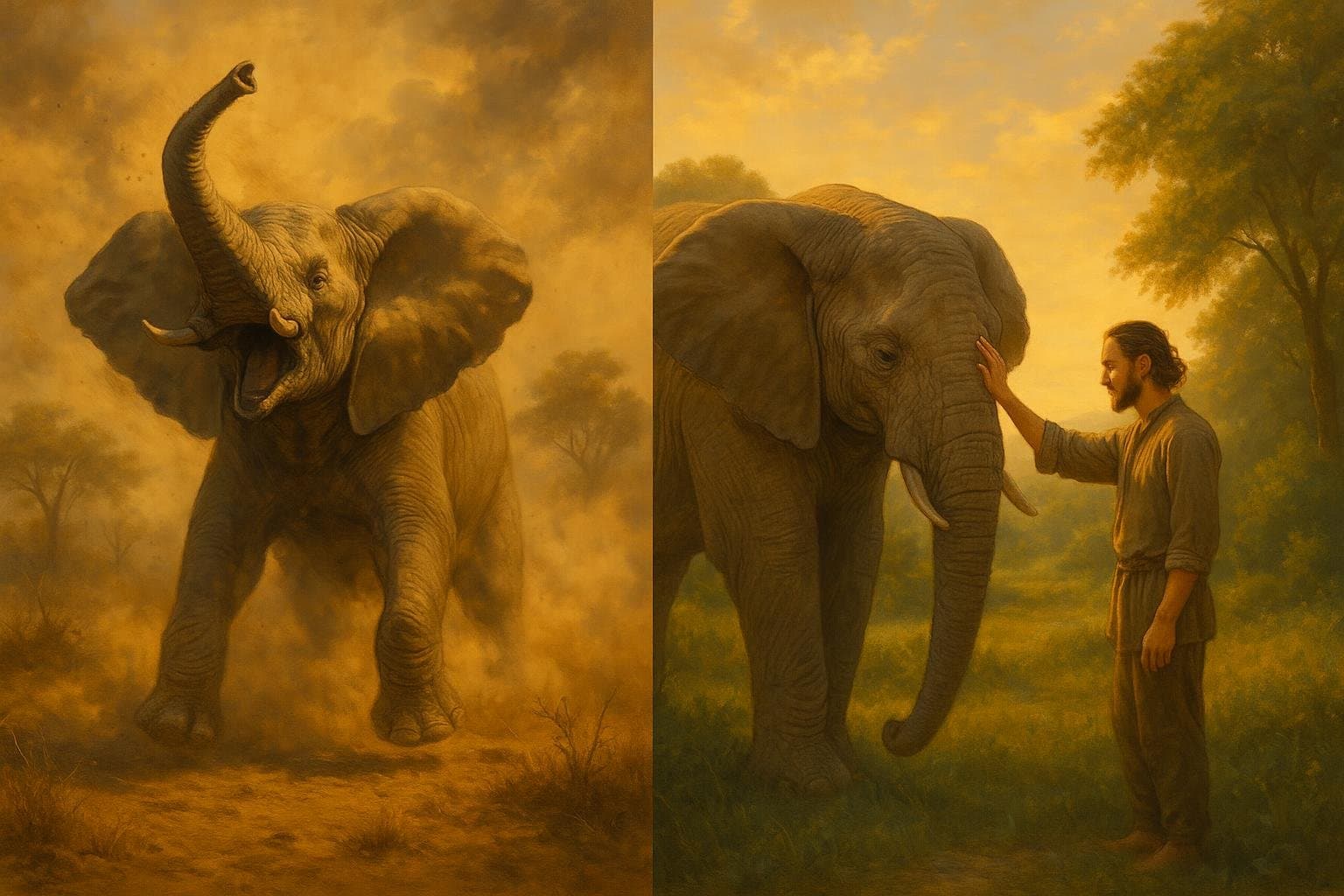
To tame the elephant, you must first understand the elephant. — Thich Nhat Hanh
—What lingers after this line?
The Elephant as a Metaphor for the Mind
Thich Nhat Hanh’s imagery of taming the elephant invites us to consider the mind’s power and unpredictability. Like an elephant, our thoughts and emotions can appear unwieldy, stubborn, and difficult to direct. Before attempting to control or direct these inner forces, the first task is to truly understand them: their patterns, strengths, and vulnerabilities.
Roots in Buddhist Mindfulness
This metaphor draws inspiration from the Buddhist tradition, where taming the mind is likened to training a wild animal. In numerous sutras, the Buddha himself compared a person who tries to subdue their mind, without knowledge or patience, to a trainer struggling with an untamed elephant (Majjhima Nikaya 20). Mindfulness, then, becomes an act of compassionate observation, not forceful domination.
Practical Implications in Self-Discipline
Translating this wisdom to everyday life, we see that self-discipline requires self-knowledge. Whether tackling habits, emotions, or challenges, those who pause to observe their impulses—rather than immediately trying to repress them—are more successful in lasting change. This is mirrored in cognitive behavioral therapy, where recognizing patterns precedes intervention.
Empathy and the Taming Process
Understanding is not merely intellectual—it demands empathy towards oneself. Just as a mahout gains an elephant’s trust through patience and kindness, we too must approach our inner struggles without harshness. Thich Nhat Hanh often instructed his students to ‘embrace their feelings,’ facilitating transformation through acceptance instead of conflict.
From Understanding to Harmony
Ultimately, the progression from understanding to control leads to inner harmony rather than internal battle. When the elephant feels seen and respected, it willingly collaborates with its guide. Likewise, when we fully understand and accept our minds, self-mastery emerges not as forced obedience but as a natural partnership, echoing Thich Nhat Hanh’s vision of compassionate wisdom.
Recommended Reading
As an Amazon Associate, we earn from qualifying purchases.
One-minute reflection
Why might this line matter today, not tomorrow?
Related Quotes
6 selectedIn the quiet of your own mind, you hold the power to reclaim your attention from the chaos of the world. — Thich Nhat Hanh
Thich Nhat Hanh
Thich Nhat Hanh’s words begin with a gentle but radical claim: the mind contains a quiet space that cannot be fully colonized by the world’s noise. Rather than portraying attention as something stolen forever by distract...
Read full interpretation →To find peace, you must stop trying to solve every problem at once. Sometimes the most productive thing you can do is simply breathe and be present. — Thich Nhat Hanh
Thich Nhat Hanh
At first glance, Thich Nhat Hanh’s insight challenges a habit many people mistake for responsibility: the need to solve every problem immediately. When the mind races from one worry to the next, it often creates more str...
Read full interpretation →The goal is not to be good at everything, but to be present for the things that matter most. — Thich Nhat Hanh
Thich Nhat Hanh
Thich Nhat Hanh’s quote gently redirects ambition. Rather than chasing excellence in every possible area, he suggests that a meaningful life depends on discernment: knowing what deserves our energy and then meeting it wi...
Read full interpretation →We have to be careful not to spend our lives anticipating the next thing. — Thich Nhat Hanh
Thich Nhat Hanh
Thich Nhat Hanh’s warning points to a quiet but pervasive habit: living in the mental future. Anticipation can feel productive—planning, improving, preparing—but it can also become a way of postponing life itself.
Read full interpretation →We are so obsessed with doing that we have no time and no room left for being. — Thich Nhat Hanh
Thich Nhat Hanh
Thich Nhat Hanh’s remark points to a modern dilemma: busyness can become so normal that it feels virtuous, even when it quietly erodes our inner life. When our days are packed with tasks, notifications, and goals, “doing...
Read full interpretation →The feeling that any task is a nuisance will soon disappear if it is done in mindfulness. — Thich Nhat Hanh
Thich Nhat Hanh
Thich Nhat Hanh begins with an everyday truth: much of our irritation comes not from the task itself, but from the label we attach to it. When we decide something is a nuisance—washing dishes, replying to emails, standin...
Read full interpretation →More From Author
More from Thich Nhat Hanh →In the quiet of your own mind, you hold the power to reclaim your attention from the chaos of the world. — Thich Nhat Hanh
Thich Nhat Hanh’s words begin with a gentle but radical claim: the mind contains a quiet space that cannot be fully colonized by the world’s noise. Rather than portraying attention as something stolen forever by distract...
Read full interpretation →To find peace, you must stop trying to solve every problem at once. Sometimes the most productive thing you can do is simply breathe and be present. — Thich Nhat Hanh
At first glance, Thich Nhat Hanh’s insight challenges a habit many people mistake for responsibility: the need to solve every problem immediately. When the mind races from one worry to the next, it often creates more str...
Read full interpretation →Gratitude is not merely an emotion; it is the practice of noticing the quiet light that persists, even when the world feels loud and uncertain. — Thich Nhat Hanh
At first glance, gratitude may seem like a simple emotional response to good fortune. Yet Thich Nhat Hanh reframes it as a discipline of attention, suggesting that thankfulness is less about waiting for ideal circumstanc...
Read full interpretation →To be kind to oneself is to understand that even the most beautiful garden needs a season of rest before it can bloom again. — Thich Nhat Hanh
At first glance, Thich Nhat Hanh’s image of the garden transforms self-kindness into something organic rather than indulgent. Just as a garden cannot flower endlessly without pause, the human spirit cannot remain product...
Read full interpretation →