
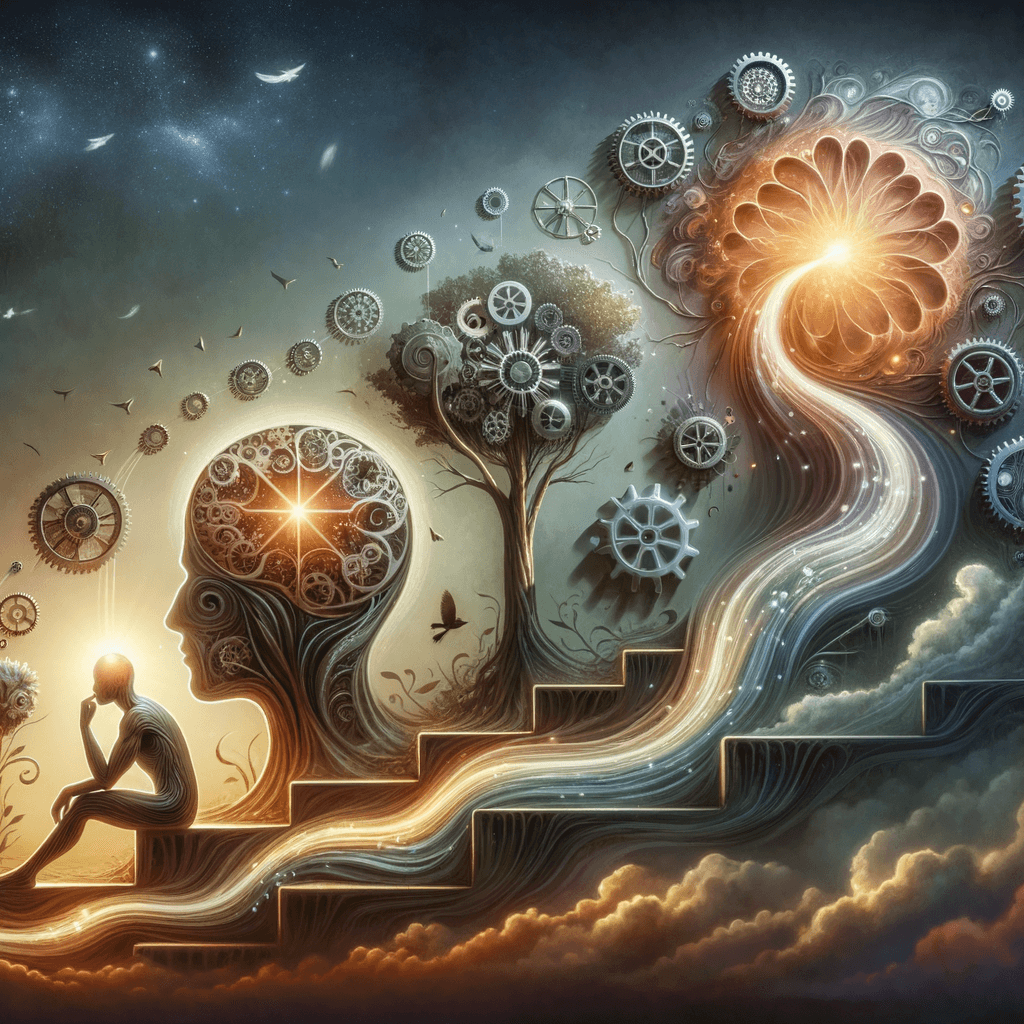
Watch your thoughts, for they will become actions. Watch your actions, for they’ll become habits. Watch your habits, for they will forge your character. — Lao Tzu
—What lingers after this line?
Power of Thoughts
This quote highlights how our thoughts are the foundation of our behavior. What we think shapes our worldview and directly influences how we act in life.
Link Between Thoughts and Actions
It emphasizes the idea that thoughts are not isolated but transform into actions over time. By paying attention to what we think consistently, we can control how we behave.
Formation of Habits
Once actions are repeated frequently, they become habits. Habits, whether beneficial or harmful, originate from individual choices—choices that begin with thoughts.
Impact on Character
The quote implies that the culmination of these habits shapes our character, ultimately determining who we are as individuals.
Self-Awareness
Lao Tzu encourages introspection and mindfulness. By monitoring our thoughts, actions, and habits, we can take control of the direction our life takes and the person we become.
Philosophical Influence
Lao Tzu, the founder of Taoism, often discussed the flow and interconnectedness of life. This quote reflects his philosophy of living in harmony with natural processes, including one's internal development.
One-minute reflection
Why might this line matter today, not tomorrow?
Related Quotes
6 selectedConsistency is the sum that equals what we become. — Marcus Aurelius
Marcus Aurelius
Marcus Aurelius’ line frames becoming as a kind of moral mathematics: each repeated action adds to the total of a life. Rather than imagining identity as a single grand decision, the quote suggests that character is accu...
Read full interpretation →Let your thoughts pass like clouds, and remember — you are the sky, not the storm. — Keshava Francis
Keshava Francis
At its core, Keshava Francis’s line invites a gentle shift in identity: instead of treating every thought or emotion as the whole self, it asks us to see consciousness as something larger and steadier. Thoughts may darke...
Read full interpretation →No matter how full a reservoir of maxims one may possess, if one has not taken advantage of every concrete opportunity to act, one's character may remain entirely unaffected. — William James
William James
At first glance, William James draws a sharp line between knowing and becoming. A person may store up countless moral sayings, noble principles, and wise resolutions, yet these remain largely ornamental if they never pas...
Read full interpretation →The discipline of desire is the backbone of character. — Will Durant
Will Durant
At first glance, Will Durant’s line suggests that character is not built by suppressing desire, but by governing it. Desire is the engine of human action: it pushes us toward pleasure, ambition, recognition, and comfort.
Read full interpretation →A bird is known by its song and a man by his deeds. — Miguel de Cervantes
Miguel de Cervantes
Cervantes condenses a large moral idea into a vivid comparison: just as a bird announces itself through its song, a person reveals his true nature through action. In other words, identity is not established by claims, ap...
Read full interpretation →The little things? The little moments? They aren't little. — Jon Kabat-Zinn
Zinn
At first glance, Jon Kabat-Zinn’s line overturns an ordinary habit of thought: we tend to rank experiences by size, drama, or public importance. Yet his point is that what we casually call “little” often carries the true...
Read full interpretation →More From Author
More from Lao Tzu →Do you have the patience to wait until your mud settles and the water is clear? — Lao Tzu
Lao Tzu’s question frames patience not as passive delay but as an active kind of wisdom. The image of muddy water settling on its own suggests that confusion often clears not through force, but through restraint.
Read full interpretation →Anything that is living must have a rest. If it does not rest, it will lose its strength. — Lao Tzu
Lao Tzu’s insight begins with a simple observation: all living things move in cycles, not in endless exertion. By saying that anything alive must rest, he frames rest not as laziness but as a biological and spiritual nec...
Read full interpretation →Yield and overcome, bend and be straight. — Lao Tzu
At first glance, Lao Tzu’s line seems contradictory: how can yielding lead to overcoming, or bending result in straightness? Yet this paradox lies at the heart of Taoist thought.
Read full interpretation →Confidence is silent. Insecurities are loud. — (Skipped due to author uncertainty) -> Let's use: A truly strong person does not need to dominate. — Lao Tzu
At its core, Lao Tzu’s saying reframes strength as something inward rather than theatrical. A truly strong person, in this view, does not need to overpower others to prove worth, because genuine power is already settled...
Read full interpretation →