
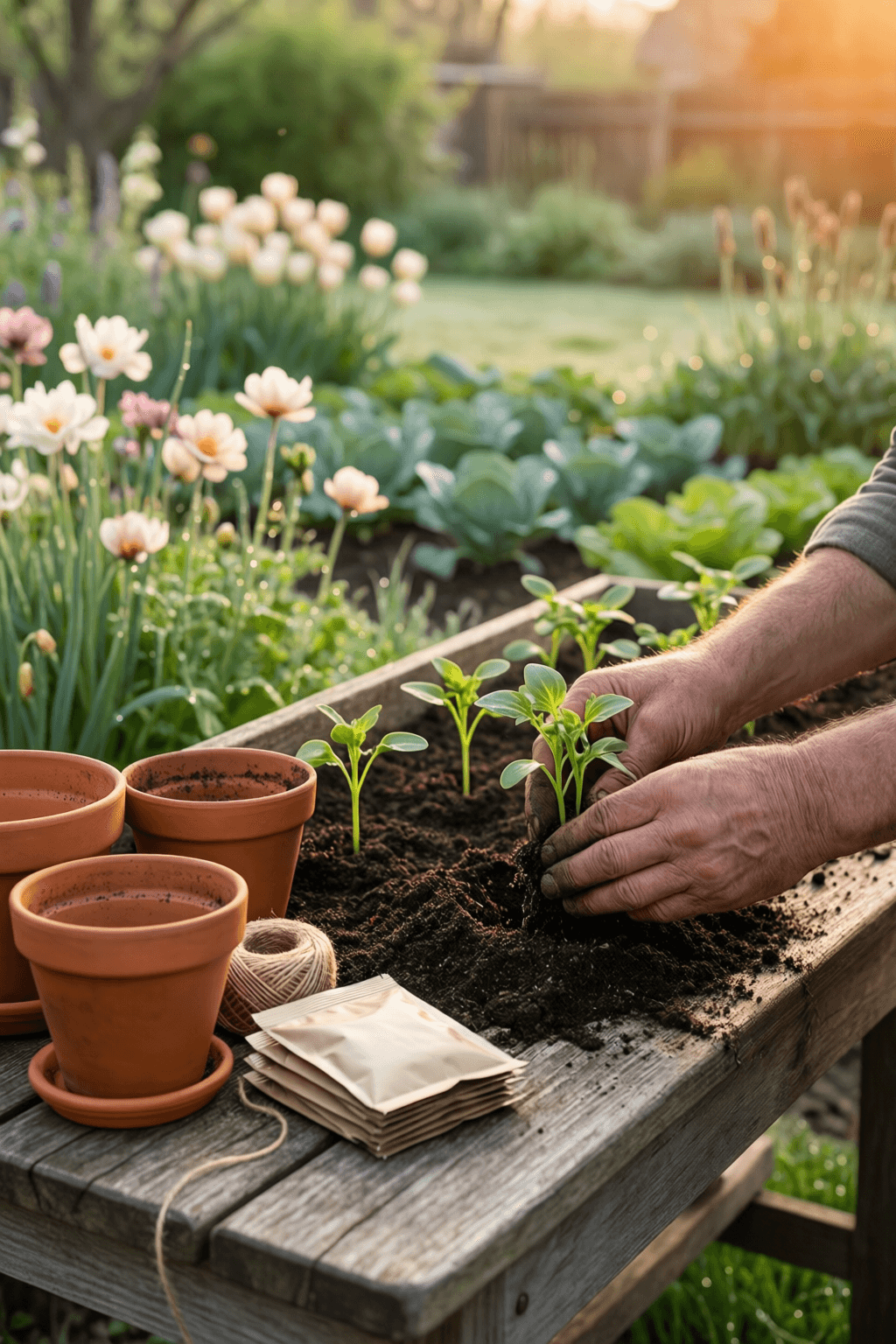
A garden is a grand teacher. It teaches patience and careful watchfulness; it teaches industry and thrift; above all it teaches entire trust. — Gertrude Jekyll
—What lingers after this line?
The Garden as Moral Classroom
Gertrude Jekyll presents the garden not merely as a decorative space but as a living instructor. From the opening phrase, she elevates cultivation into education, suggesting that soil, weather, and seasons quietly shape character as surely as books or formal lessons do. In this view, gardening becomes a daily practice of attention in which the natural world answers human effort with slow, honest feedback. This idea reflects Jekyll’s wider legacy as one of Britain’s most influential garden designers; in works such as Wood and Garden (1899), she repeatedly treats the garden as a place where aesthetic pleasure and ethical discipline meet. Thus, her quotation invites us to see ordinary labor—digging, pruning, waiting—as a form of inward formation.
Patience Learned Through Seasons
First among the garden’s lessons is patience, because nothing in a healthy landscape can be rushed without consequence. Seeds germinate on their own timetable, bulbs sleep before they bloom, and young trees require years before they offer shade. By forcing the gardener to work within seasonal rhythms, the garden gently opposes modern habits of immediacy and control. In that sense, Jekyll’s insight aligns with older agrarian wisdom. Virgil’s Georgics (29 BC), for example, praises the farmer who learns to cooperate with time rather than conquer it. Likewise, the gardener discovers that growth is often invisible before it becomes spectacular, and this repeated experience teaches endurance in other parts of life as well.
Careful Watchfulness and Attention
Yet patience alone is not enough; the garden also teaches careful watchfulness. A skilled gardener learns to notice subtle changes: a leaf paling from poor drainage, a bud opening a day earlier than expected, or pests arriving before major damage is visible. Such attentiveness trains the eye to read small signs and respond with restraint rather than panic. As a result, gardening becomes an education in presence. The Japanese gardening tradition, shaped by centuries of close observation, often treats minute adjustments as essential to harmony, and texts like Sakuteiki (11th century) show how deeply attention mattered in landscape care. Jekyll’s point therefore extends beyond horticulture: to watch carefully is to respect reality before acting upon it.
Industry Joined to Thrift
From observation, Jekyll moves naturally to industry and thrift, virtues rooted in practical work. A flourishing garden demands steady labor—staking, weeding, composting, dividing perennials—and it rewards those who persist in small tasks before they become large problems. At the same time, gardening teaches economy: fallen leaves become mulch, kitchen scraps become compost, and saved seeds become next year’s abundance. Consequently, thrift here does not mean meanness but wise stewardship. The garden reveals that waste often comes from inattention, while richness can emerge from reuse and care. This sensibility recalls William Robinson and other late Victorian garden writers who favored natural, resourceful cultivation over excessive artificial display, reinforcing Jekyll’s belief that good gardening forms sound habits of living.
Entire Trust in Living Processes
Above all, Jekyll says, the garden teaches “entire trust,” and this is the deepest lesson of all. Even the most diligent gardener cannot command rain, guarantee germination, or prevent every blight. One may prepare the ground perfectly and still depend on forces beyond personal control. In that dependence, gardening becomes an act of faith in processes that are partly hidden yet reliably alive. This trust is not passivity; rather, it is cooperation with uncertainty. The same spirit appears in Christian scripture—“Paul’s First Letter to the Corinthians” (3:6) notes, “I planted, Apollos watered, but God gave the growth”—and in many secular reflections on nature. Jekyll’s phrase captures the humility of doing one’s part fully while accepting that life unfolds through powers larger than oneself.
Why the Lesson Still Endures
Finally, the enduring power of Jekyll’s quotation lies in how completely it connects outer cultivation with inner life. In an age of speed, abstraction, and digital overstimulation, the garden remains one of the few places where consequences unfold slowly enough to be understood. It teaches that care must be repeated, that failure can be instructive, and that trust grows through long acquaintance rather than instant certainty. For that reason, her words still resonate far beyond horticulture. Whether one tends roses, vegetables, or a windowsill herb pot, the same pattern appears: effort, attention, waiting, and surrender. The garden’s true harvest, Jekyll suggests, is not only bloom or produce but a steadier, wiser human being.
One-minute reflection
Where does this idea show up in your life right now?
Related Quotes
6 selectedPatience is not passive waiting. Patience is active acceptance of the process required to attain your goals and dreams. — Ray Davis
Ray Davis
Ray Davis’s words begin by correcting a common misunderstanding: patience is not the same as doing nothing. Passive waiting suggests resignation, as if time alone will deliver success.
Read full interpretation →Slow progress today is often stable progress tomorrow. Fast growth collapses easily. Slow growth holds. — Timeless Type
Timeless Type
At first glance, slow progress can feel discouraging, especially in a culture that praises speed, sudden breakthroughs, and visible success. Yet the quote reminds us that what seems unimpressive today may become the foun...
Read full interpretation →Sometimes you have to slow down to go fast. — Jeff Olson
Jeff Olson
Jeff Olson’s line begins with a practical paradox: speed is not always created by rushing. Sometimes the quickest path forward requires pausing long enough to see the road clearly, correct mistakes early, and choose acti...
Read full interpretation →Everything that is great in life is the product of slow growth; the newer, and greater, and higher, and nobler the work, the slower is its growth. — William George Jordan
William George Jordan
William George Jordan’s reflection begins with a quiet but demanding truth: the most meaningful achievements rarely arrive quickly. He suggests that greatness is not manufactured in sudden bursts but cultivated through t...
Read full interpretation →You cannot force ideas. Successful ideas are the result of slow growth. — Alexander Graham Bell
Alexander Graham Bell
Alexander Graham Bell’s statement begins with a quiet warning against impatience: ideas cannot be commanded into maturity simply because we desire results. Like plants, they require conditions, time, and repeated attenti...
Read full interpretation →The moments between your milestones are not filler. — Nelou Keramati
Nelou Keramati
Nelou Keramati’s line challenges the habit of treating life as a sequence of major checkpoints: graduations, promotions, weddings, moves, and visible successes. At first glance, everything between these events can seem l...
Read full interpretation →More From Author
More from Gertrude Jekyll →