
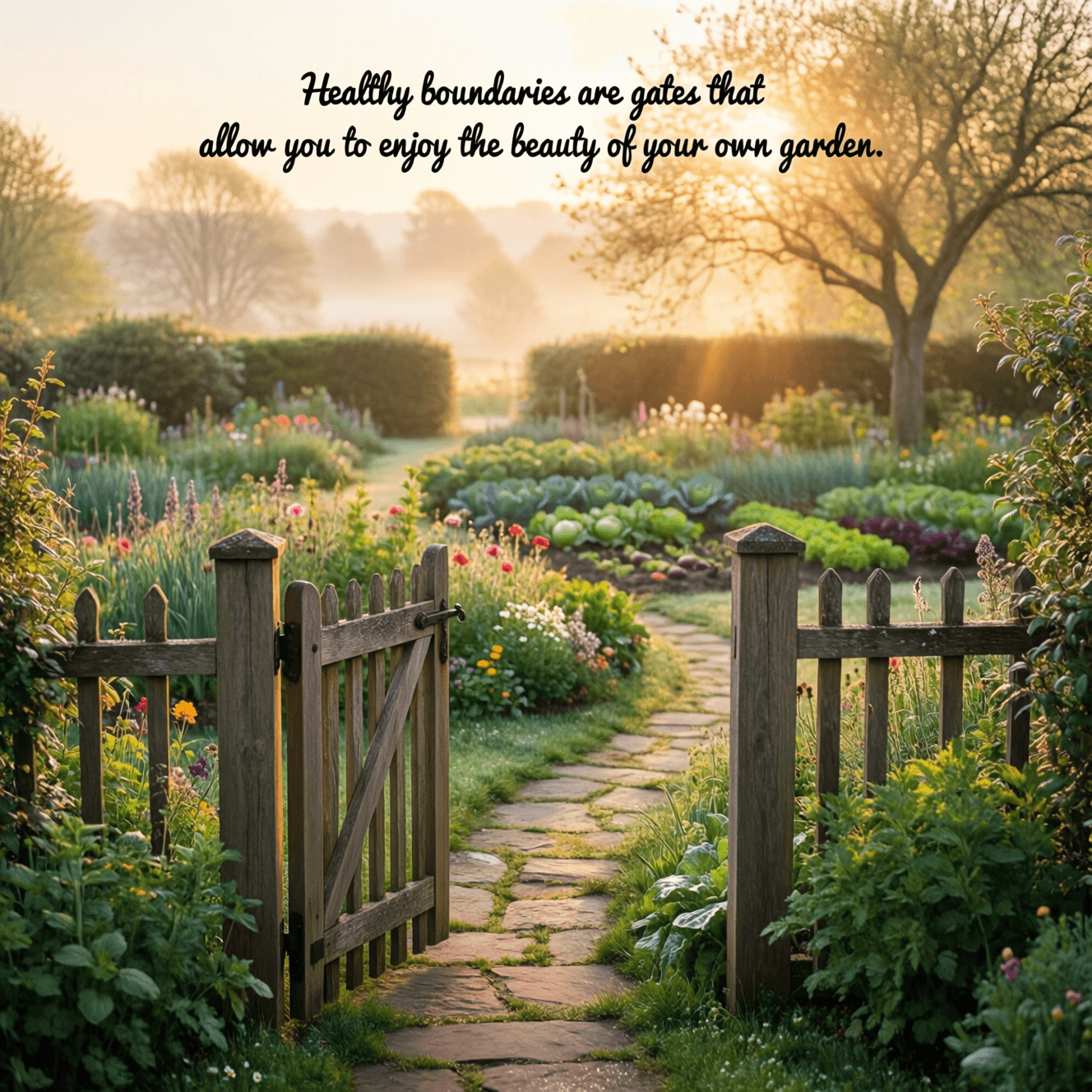
Healthy boundaries are gates that allow you to enjoy the beauty of your own garden. — Lydia Hall
—What lingers after this line?
A Garden as the Self
Lydia Hall’s image of a “garden” gently frames the self as something living—made up of emotions, time, values, and dignity—that must be tended to flourish. Gardens do not thrive by accident; they require attention, seasons of rest, and deliberate care. In the same way, a person’s well-being depends on choosing what to nurture and what to prune. From this starting point, the quote shifts boundaries away from cold rigidity and toward stewardship. Rather than emphasizing what you keep out, Hall emphasizes what you are trying to grow: a life that feels coherent, protected, and genuinely yours.
Gates, Not Walls
Notably, Hall calls boundaries “gates,” not walls—suggesting choice, flexibility, and discernment. A wall implies total shutdown; a gate implies that you decide when to open, for whom, and under what conditions. This distinction matters because many people fear that setting boundaries is inherently unkind, when it can actually be a thoughtful form of relational clarity. As the metaphor develops, a gate also allows movement both ways: you can welcome others in, and you can step out without losing yourself. Boundaries, then, become tools for connection on purpose rather than connection by default.
Protection Enables Enjoyment
The quote’s turning point is the idea that boundaries help you “enjoy the beauty” of your garden. Enjoyment requires safety—psychological and practical—because constant intrusion turns life into vigilance rather than presence. If someone repeatedly tramples your time, dismisses your feelings, or demands access to every corner of your attention, it becomes difficult to appreciate what you’ve built. Seen this way, boundaries are not merely defensive; they create the conditions for peace. With a gate in place, you can linger in what’s good—your creativity, friendships, health, or quiet—without bracing for disruption.
The Right to Choose Access
A garden doesn’t owe entry to every passerby, and neither do you. Hall’s framing quietly affirms that deciding who gets access to your inner life is a legitimate act of self-respect. This includes choosing what topics are off-limits, how quickly intimacy develops, and what behavior you will not normalize, even from people you love. Consequently, boundaries become a form of moral and emotional literacy: they communicate what you value and how you expect to be treated. Over time, the people who can honor the gate tend to deepen trust, while those who cannot reveal their intentions through repeated pressure.
Cultivating Boundaries Through Practice
Like gardening, boundaries are learned through small, repeated acts rather than one dramatic declaration. A simple “I can’t take calls after 9 p.m.” or “I need a day to think before I answer” functions like installing a latch: it’s practical, specific, and easier to maintain than vague promises. Even a brief pause before replying can be a boundary, because it reclaims agency over your time and attention. Finally, the metaphor suggests patience with yourself. Gardens take seasons to mature, and boundaries do too; each time you reinforce the gate with calm consistency, you make it more natural to inhabit your life—present, protected, and able to enjoy what you’ve grown.
One-minute reflection
What feeling does this quote bring up for you?
Related Quotes
6 selectedSetting boundaries is the way we care for ourselves. It is not a way to push others away, but a way to keep ourselves whole. — Melody Beattie
Melody Beattie
At its core, Melody Beattie’s statement reframes boundaries as an act of care rather than rejection. People often fear that saying no, asking for space, or naming limits will appear cold; however, Beattie suggests the op...
Read full interpretation →Boundaries are a part of self-care. They are healthy, normal, and necessary. — Doreen Virtue
Doreen Virtue
At first glance, Doreen Virtue’s quote reframes self-care as something deeper than rest, indulgence, or temporary relief. By calling boundaries a part of self-care, she emphasizes that caring for oneself also means prote...
Read full interpretation →Do not let your mind bully your body into believing it must carry the weight of the world. — Astrid Alauda
Astrid Alauda
Astrid Alauda’s quote speaks with the calm urgency of a reminder many people need: the mind can become a harsh taskmaster. It creates stories of obligation, guilt, and endless responsibility, then persuades the body to l...
Read full interpretation →If it costs my peace, it's outside my boundary. — Adam J. Jackson
Adam J. Jackson
At its core, Adam J. Jackson’s line reframes boundaries as more than rules we impose on others; they become protections for our inner life.
Read full interpretation →The most loving thing I ever did was say no to things that were killing me slowly. — Prentis Hemphill
Prentis Hemphill
At first glance, Hemphill’s line sounds simple, yet it redefines love as an act of protection rather than mere tenderness. Saying no becomes the deepest form of care when a person recognizes that certain habits, relation...
Read full interpretation →Your body remembers every moment you ignored yourself. Let today be different. — Morgan Harper Nichols
Morgan Harper Nichols
At first glance, Morgan Harper Nichols’s line suggests that the body is more than a physical shell; it is a living archive of our habits, hurts, and silences. Every time a person overrides exhaustion, suppresses grief, o...
Read full interpretation →More From Author
More from Lydia Hall →