
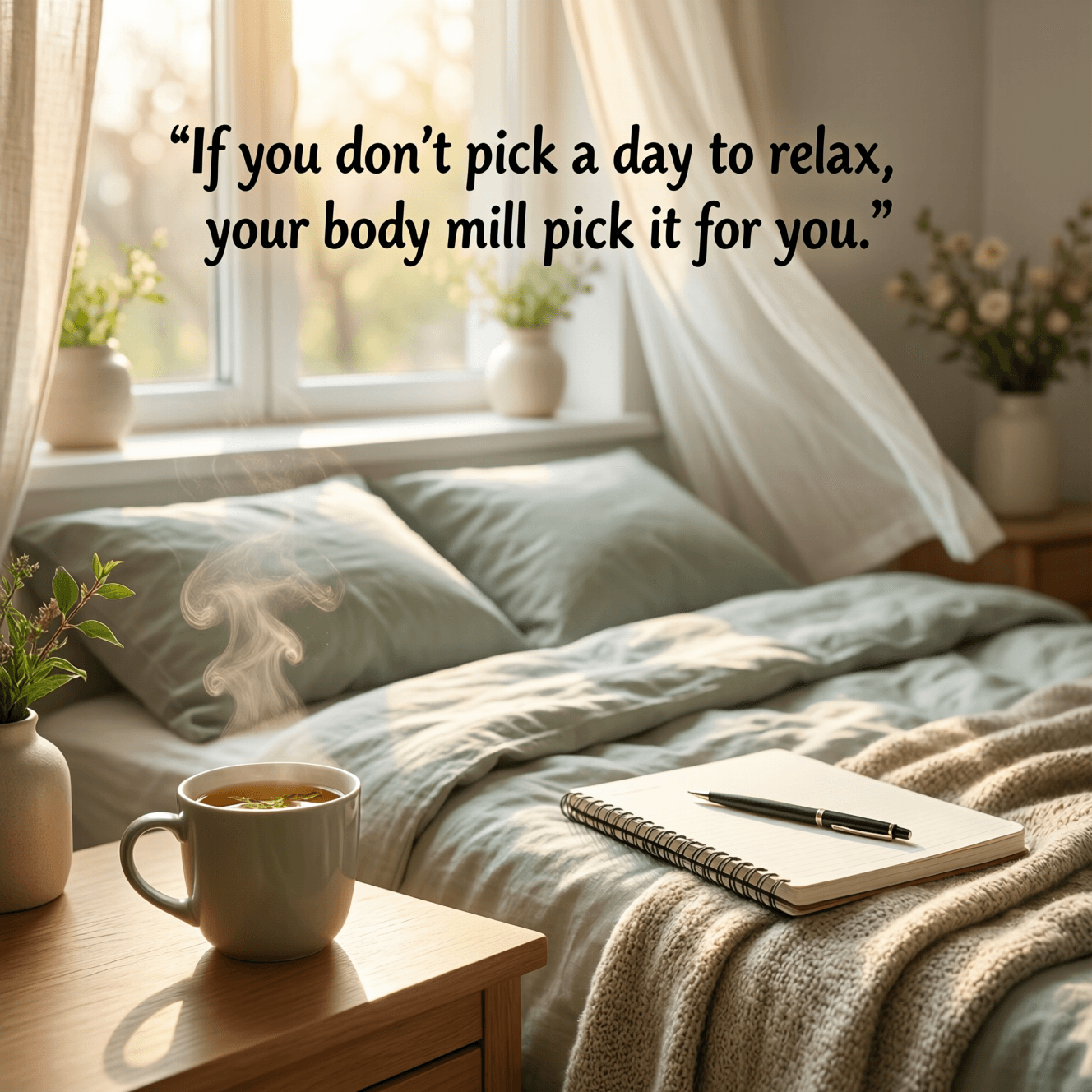
If you don't pick a day to relax, your body will pick it for you. — Courtney Carver
—What lingers after this line?
The Warning Hidden in a Simple Sentence
Courtney Carver’s line reads like friendly advice, but it carries the weight of a warning: rest is not optional in the long run. If we continually postpone recovery, the body will eventually enforce a pause through exhaustion, illness, or injury. In other words, what feels like control—powering through—can quietly become a loss of control when our limits finally assert themselves. From this starting point, the quote reframes relaxation as a decision with consequences rather than a luxury reserved for “when things calm down.” Once you see rest as something that either happens by choice or by breakdown, the urgency to schedule it becomes clearer.
Stress Accumulates Even When You Feel Fine
A key insight behind the quote is that stress doesn’t always announce itself immediately. People often adapt to chronic strain so well that fatigue feels normal, irritability becomes a personality trait, and sleep debt gets treated like ambition. Yet the body is still keeping score, layering tension onto the nervous, immune, and cardiovascular systems. This is why the delayed crash can seem to come “out of nowhere.” What Carver points to is the mismatch between our short-term perception (“I’m managing”) and the body’s long-term accounting (“you’re overdrawing”). Recognizing this gap is often the first step toward treating rest as preventative care.
When the Body ‘Picks the Day’
If relaxation is perpetually deferred, the body may choose a day in blunt ways: a migraine that forces a dark room, a back spasm that makes bending impossible, or a cold that lingers because you never slowed down. These moments can feel like bad luck, but they often function as compelled recovery—an involuntary boundary set by biology. In that light, burnout becomes not just an emotional state but a protective shutdown. Carver’s phrasing captures the irony: the same drive that convinces us we can’t rest today may create a future where we can’t work tomorrow.
Rest as a Form of Responsibility
From here, relaxation shifts from indulgence to stewardship. Choosing a day to rest is a way of maintaining the instrument you rely on for everything else—thinking, caring, producing, and relating. This is especially relevant for people with caregiving roles or high-responsibility jobs, where personal depletion quickly spills into mistakes, impatience, or diminished judgment. Rather than seeing rest as time taken away from duties, the quote suggests rest protects your capacity to meet them. In practical terms, it’s similar to budgeting: regular small deposits prevent catastrophic deficits.
Why Scheduling Rest Actually Works
Carver’s emphasis on “pick a day” highlights that rest often needs structure to survive modern life. If relaxation is left to chance, it competes with louder demands—emails, errands, and the endless sense that something else is more urgent. Scheduling creates a boundary that doesn’t rely on willpower in the moment. This doesn’t have to mean an entire day off; it can be a protected evening, a tech-free morning, or a weekly block that’s treated as non-negotiable. The deeper point is that rest becomes real when it is planned with the same seriousness as work.
A Sustainable Rhythm, Not an Emergency Stop
Ultimately, the quote argues for rhythm over rescue. When relaxation is built into life, it supports steady energy, clearer thinking, and more resilient moods, reducing the odds of forced downtime. Over time, chosen rest can feel less like “falling behind” and more like staying aligned with what the body can realistically sustain. The final takeaway is a quiet kind of agency: you can decide to pause while you still have choices, or you can wait until your body decides for you. Carver invites the former—not as weakness, but as wisdom.
Recommended Reading
As an Amazon Associate, we earn from qualifying purchases.
One-minute reflection
Where does this idea show up in your life right now?
Related Quotes
6 selectedYou are not required to set yourself on fire to keep other people warm. — Hiraeth (widely attributed to various modern wellness writers; citing the common modern adaptation: 'You don't have to set yourself on fire to keep others warm.' — Adrienne Maree Brown)
adrienne maree brown
At its heart, the saying warns against a distorted form of care: sacrificing one’s own well-being so completely that nothing healthy remains to give. The image of burning oneself for someone else’s comfort is vivid becau...
Read full interpretation →The body is not the enemy. It is the messenger. Listen to what it needs before it is forced to scream. — Melissa Steginus
Melissa Steginus
Melissa Steginus reframes a common modern habit: treating the body as a problem to conquer rather than a source of information to understand. Her quote suggests that pain, fatigue, tension, and illness are not betrayals...
Read full interpretation →We are human beings, not human doings. You must prioritize your personal well-being as a necessity, not a luxury. A well-rested mind is the most effective tool you possess. — Arianna Huffington
Arianna Huffington
Arianna Huffington’s quote begins by challenging a modern habit: measuring human value by output alone. By saying we are “human beings, not human doings,” she shifts attention from performance to personhood, suggesting t...
Read full interpretation →Give your heart the space it needs to breathe; you do not have to carry everything all at once. — Anne Lamott
Anne Lamott
Anne Lamott’s line begins with a gentle permission: the heart, like the body, needs space, rhythm, and rest. Rather than treating emotional strength as endless endurance, she reframes care as breathing room—something nec...
Read full interpretation →Burnout occurs when your body and mind can no longer keep up with the tasks you demand of them. Don't try to force yourself to do the impossible. — Del Suggs
Del Suggs
At its core, Del Suggs’s statement frames burnout not as a personal failure, but as a signal that human limits have been exceeded. The body and mind are presented as partners in effort, and when both begin to falter, the...
Read full interpretation →You cannot expect to be there for others if you are never there for yourself. — Alice Morse Earle
Alice Morse Earle
Alice Morse Earle’s statement begins with a simple but demanding truth: care for others cannot be sustained if self-care is absent. In other words, being ‘there for yourself’ means more than indulgence; it means showing...
Read full interpretation →More From Author
More from Courtney Carver →