
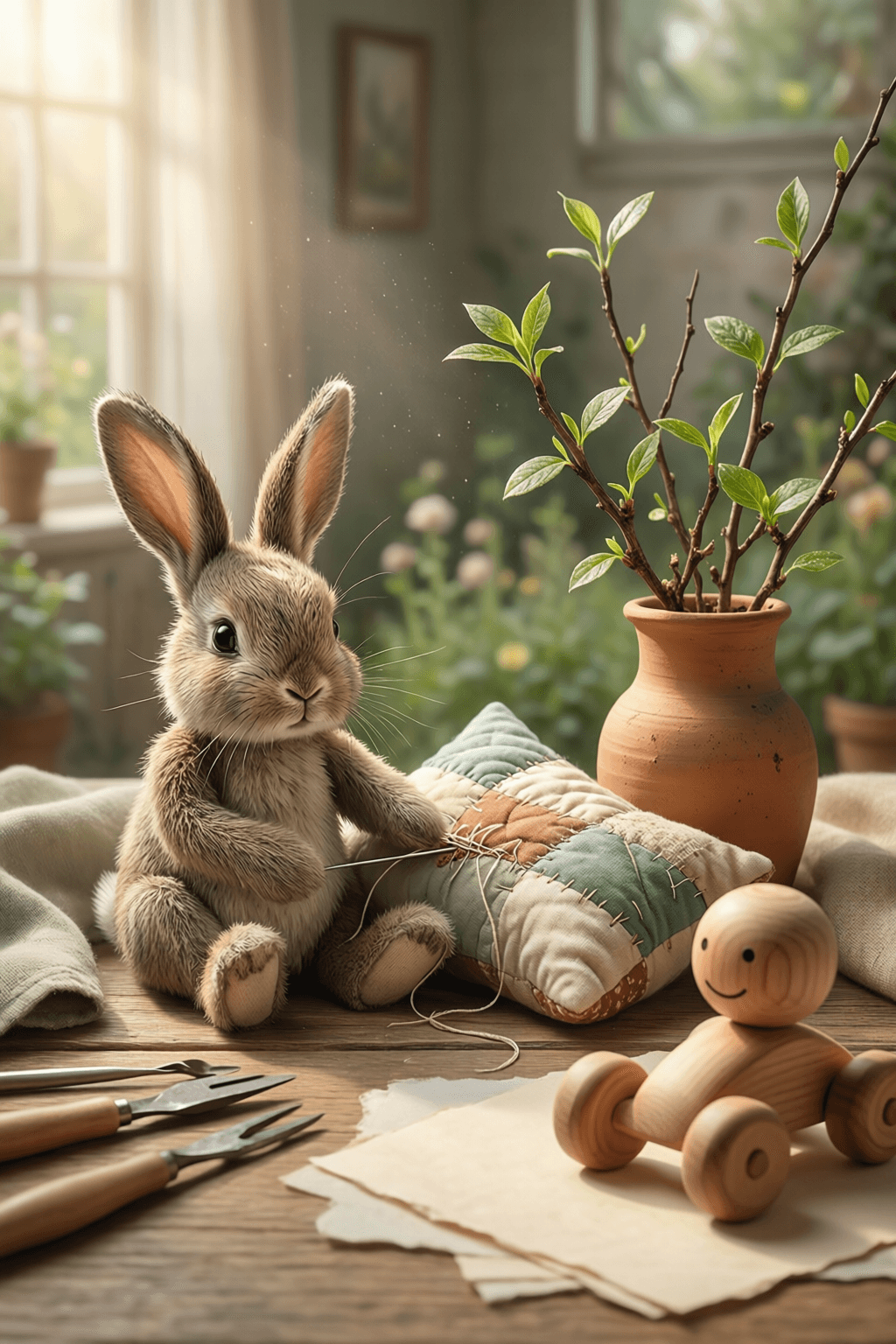
It doesn't happen all at once. You become. It takes a long time. — Margery Williams
—What lingers after this line?
The Slow Nature of Transformation
Margery Williams’s line from The Velveteen Rabbit (1922) begins with a gentle refusal of sudden change. ‘It doesn’t happen all at once’ suggests that becoming—whether becoming real, mature, or fully oneself—is not an event but a process. In that way, the quote offers patience as a form of wisdom, reminding us that meaningful growth rarely arrives in dramatic flashes. From there, the second phrase, ‘You become,’ shifts attention from achievement to unfolding. Williams implies that identity is shaped gradually through experience, affection, and endurance. Rather than chasing instant perfection, the quote invites us to honor the quiet accumulation of moments that slowly make a life authentic.
What It Means to Become Real
In the world of The Velveteen Rabbit, becoming ‘real’ does not mean becoming flawless or glamorous. Instead, it means being deeply loved and changed by that love. The Skin Horse explains that realness comes through wear, vulnerability, and time, suggesting that authenticity is earned through relationship rather than appearance. As a result, Williams subtly overturns conventional ideas of value. Newness and polish may impress at first, yet they do not necessarily make something real. By contrast, what has been cherished, handled, and even worn thin often carries the deepest truth, because it bears the marks of genuine connection.
Love as the Agent of Change
Just as time matters, so does tenderness. Williams’s larger story shows that love is not merely a feeling laid over an object or a person; it is a force that transforms. In this sense, becoming is relational: we are shaped by the care we receive and by the care we learn to return. This idea appears elsewhere in literature as well. Antoine de Saint-Exupéry’s The Little Prince (1943) famously suggests that what is tamed becomes unique through the time invested in it. Similarly, Williams presents love as something that slowly confers reality, making the quote a meditation on how devotion turns existence into meaning.
Patience Against a Culture of Speed
Seen in a modern context, the quote speaks powerfully against the demand for immediate results. Contemporary life often prizes instant success, rapid reinvention, and visible milestones, yet Williams proposes a quieter truth: the most important forms of becoming cannot be rushed. Emotional maturity, trust, and self-knowledge develop over years, often so gradually that we notice them only in retrospect. Therefore, the line can be read as a corrective to impatience. It reassures anyone who feels unfinished that slowness is not failure. On the contrary, taking a long time may be the very condition that allows a person to become something genuine and lasting.
The Marks Left by Living
Another strength of Williams’s vision is its acceptance of change through wear and difficulty. In The Velveteen Rabbit, becoming real involves losing pristine beauty; the toy grows shabby before gaining something deeper. That narrative detail suggests that the marks left by love, sorrow, and perseverance are not evidence of diminishment but of having truly lived. Consequently, the quote offers comfort to those who carry scars, fatigue, or signs of age. It implies that such traces may testify to a long process of becoming. What looks worn on the surface may, in fact, reveal the depth of one’s reality.
A Gentle Philosophy of Selfhood
Ultimately, Williams presents selfhood as something formed slowly in the presence of care. Her words do not urge us to manufacture a perfect identity; instead, they encourage trust in a gradual unfolding. This makes the quote feel both humble and hopeful, because it frames becoming as a lifelong journey rather than a test we must quickly pass. Finally, that is why the line continues to resonate far beyond children’s literature. It speaks to friendship, parenthood, healing, and personal growth with equal grace. By insisting that becoming takes a long time, Williams turns patience into a profound moral and emotional insight.
Recommended Reading
As an Amazon Associate, we earn from qualifying purchases.
One-minute reflection
What feeling does this quote bring up for you?
Related Quotes
6 selectedIf your family or friends are not challenging you to be better, you are not in a support system; you are in a comfort trap. — Jordan Peterson
Jordan Peterson
At its core, Jordan Peterson’s statement draws a sharp distinction between feeling supported and merely feeling comfortable. A true support system does not exist to protect us from every strain; rather, it helps us becom...
Read full interpretation →You are under no obligation to be the same person you were a year, month, or even 15 minutes ago. You have the right to grow. — Awilda Rivera
Awilda Rivera
At its core, Awilda Rivera’s quote challenges the common belief that consistency is always a virtue. Many people feel pressured to preserve an older version of themselves simply because others have grown used to it.
Read full interpretation →True cultivation is a slow, private process that eventually blooms into a public strength. — Anne Lamott
Anne Lamott
At first glance, Anne Lamott’s line emphasizes a truth people often resist: meaningful self-development rarely looks dramatic while it is happening. True cultivation unfolds quietly, in habits, reflection, restraint, and...
Read full interpretation →You cannot change what you refuse to confront. Growth begins when you stop hiding from your own truth. — Marc Chernoff
Marc Chernoff
Marc Chernoff’s quote turns growth into an act of courage rather than comfort. At its heart, the message is simple: real change cannot begin while we avoid the facts of our own lives.
Read full interpretation →Your potential is not a static state; it is a muscle that strengthens only through the resistance of consistent, daily effort. — Robert Kegan
Robert Kegan
At first glance, Robert Kegan’s statement overturns a comforting myth: potential is not something we simply possess in finished form. Instead, he portrays it as a living capacity, one that changes depending on how we use...
Read full interpretation →You cannot find peace by avoiding life. You must engage with the friction of your own growth. — Henri Nouwen
Henri Nouwen
At first glance, Henri Nouwen’s insight overturns a common fantasy: that peace can be reached by retreating from difficulty, conflict, or responsibility. Instead, he argues that genuine inner calm is not the reward of av...
Read full interpretation →More From Author
More from Margery Williams →