
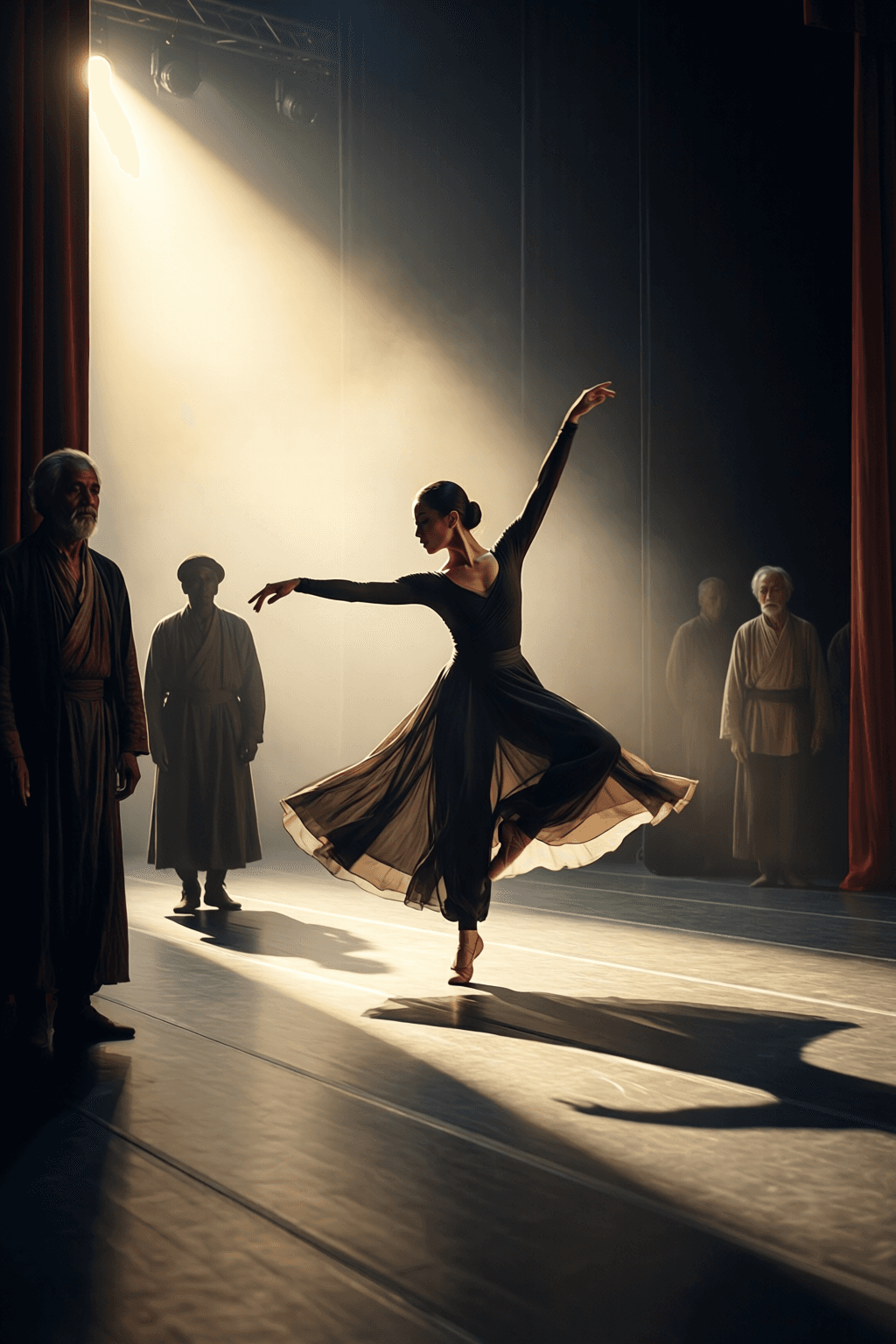
No artist is ahead of his time. He is his time, it's just that others are behind the times. — Martha Graham
—What lingers after this line?
Reframing the Myth of the Misunderstood Genius
At first glance, Martha Graham’s remark overturns a familiar cultural myth: the artist is not some isolated prophet floating above history, but a person deeply shaped by the energies, anxieties, and possibilities of the present. In this view, what appears to be artistic foresight is often a sharper sensitivity to currents already moving through society. Rather than being ‘ahead,’ the artist is simply more awake to the time he inhabits. Graham, whose own modern dance broke decisively from classical conventions in the early twentieth century, embodied this principle. Her work did not come from nowhere; it emerged from a world already shifting toward modernism, psychological depth, and new forms of expression.
How Innovation Reveals the Present
From there, the quote suggests that innovation is less about inventing a future than about naming the present before others can recognize it. Artists often detect changes in feeling long before institutions, audiences, or critics have language for them. What seems radical, then, may simply be accurate. For instance, Picasso’s Cubism in the early 1900s appeared shocking, yet it resonated with a century increasingly defined by fractured perspectives and technological upheaval. Similarly, T. S. Eliot’s The Waste Land (1922) did not predict modern disillusionment so much as crystallize it. In that sense, art becomes a diagnostic instrument, revealing the truth of an age while many still cling to outdated forms.
Why Audiences Often Lag Behind
Naturally, Graham’s second claim—that others are ‘behind the times’—shifts attention from the artist to the audience. Resistance to new art is rarely just about taste; more often, it reflects the human tendency to prefer familiar patterns. People inherit expectations about beauty, meaning, and form, so when art changes faster than those expectations, discomfort follows. History repeatedly confirms this pattern. Igor Stravinsky’s The Rite of Spring (1913) famously provoked outrage at its Paris premiere, not because it belonged to some distant future, but because it expressed a modern intensity audiences were unprepared to accept. Thus, the delay lies not in art’s arrival, but in public recognition.
The Artist as a Vessel of Cultural Change
Seen this way, the artist serves less as a time traveler than as a vessel through which collective transformation becomes visible. Individual genius still matters, of course, but Graham’s statement emphasizes that creativity is never detached from social life. New styles arise when artists absorb political tensions, emotional climates, and philosophical shifts, then convert them into form. This idea echoes John Berger’s Ways of Seeing (1972), which argues that perception itself is historical. What artists do, therefore, is not escape their age but embody it more fully. Their work can feel startling precisely because it gathers scattered signals from everyday life and gives them coherent shape before the culture at large catches up.
A Lesson in Cultural Humility
Finally, Graham’s observation invites humility from critics and audiences alike. If we dismiss unfamiliar work as premature, obscure, or impossible, we may simply be revealing our own attachment to fading assumptions. The problem may not be that the artist has gone too far, but that we have not looked closely enough at the world already changing around us. In the end, the quote offers a democratic rather than mystical account of artistic greatness. Great artists are not aliens from the future; they are acute witnesses to their own moment. Their gift lies in perceiving the present with unusual clarity—and in forcing the rest of us, sooner or later, to do the same.
One-minute reflection
Where does this idea show up in your life right now?
Related Quotes
6 selectedAn artist is not paid for his labor but for his vision. — James McNeill Whistler
James McNeill Whistler
James McNeill Whistler’s remark reframes what, exactly, patrons buy when they commission or purchase art. At first glance, it sounds dismissive of effort, but its real target is a common misunderstanding: that price shou...
Read full interpretation →Gentle breeze and light rain, spring flowers and autumn moon, enduring friendship, never ending in this lifetime.
Unknown
The quote uses natural elements like breeze, rain, flowers, and moon to create a serene and picturesque setting, which evokes a sense of timeless beauty and tranquility.
Read full interpretation →Dreams don’t care how old you are. — Gloria Steinem
Gloria Steinem
Gloria Steinem's words challenge the pervasive notion that ambition has an expiration date. By declaring that 'dreams don’t care how old you are,' she evokes the idea that imagination and desire persist independently of...
Read full interpretation →Dreams don’t have deadlines. — Duke Ellington
Duke Ellington
Duke Ellington’s proclamation that 'dreams don’t have deadlines' highlights a fundamental characteristic of true aspiration—they transcend conventional constraints of time. Unlike tasks measured by schedules or due dates...
Read full interpretation →Come out of the circle of time and into the circle of love. — Rumi
Rumi
Rumi’s evocative statement calls on us to move beyond the everyday constraints of chronology and routine, symbolized by the ‘circle of time.’ He contrasts this temporal loop—marked by deadlines, aging, and the relentless...
Read full interpretation →"I dream my painting and I paint my dream." — Vincent van Gogh
Vincent van Gogh
At first glance, van Gogh’s line fuses intention with action: imagination drafts the plan, and the hand ratifies it on canvas. The saying proposes a circular vow—what he envisions, he renders; what he renders, he then re...
Read full interpretation →More From Author
More from Martha Graham →What people in the world think of you is really none of your business. — Martha Graham
Martha Graham’s remark cuts directly against a common human habit: measuring ourselves through the eyes of others. At its heart, the quote argues that public opinion is unstable, partial, and often beyond our control.
Read full interpretation →To create is to destroy the old version of yourself that no longer fits the new truth you have found. — Martha Graham
Martha Graham’s statement presents creativity not as decoration, but as a radical act of inner change. To create something genuine, she suggests, a person must let go of an earlier self—the habits, beliefs, and identitie...
Read full interpretation →Discipline is not the enemy of creativity; it is the structure that gives your wild ideas a place to land. — Martha Graham
At first glance, discipline and creativity seem like opposites: one suggests rules, repetition, and restraint, while the other evokes freedom, spontaneity, and risk. Yet Martha Graham’s insight dissolves that false divid...
Read full interpretation →Your life is your art. Create it with passion. — Martha Graham
This quote likens life to a work of art, suggesting that individuals are the artists of their own existence. Every decision, action, and experience is a stroke on the canvas of life.
Read full interpretation →