
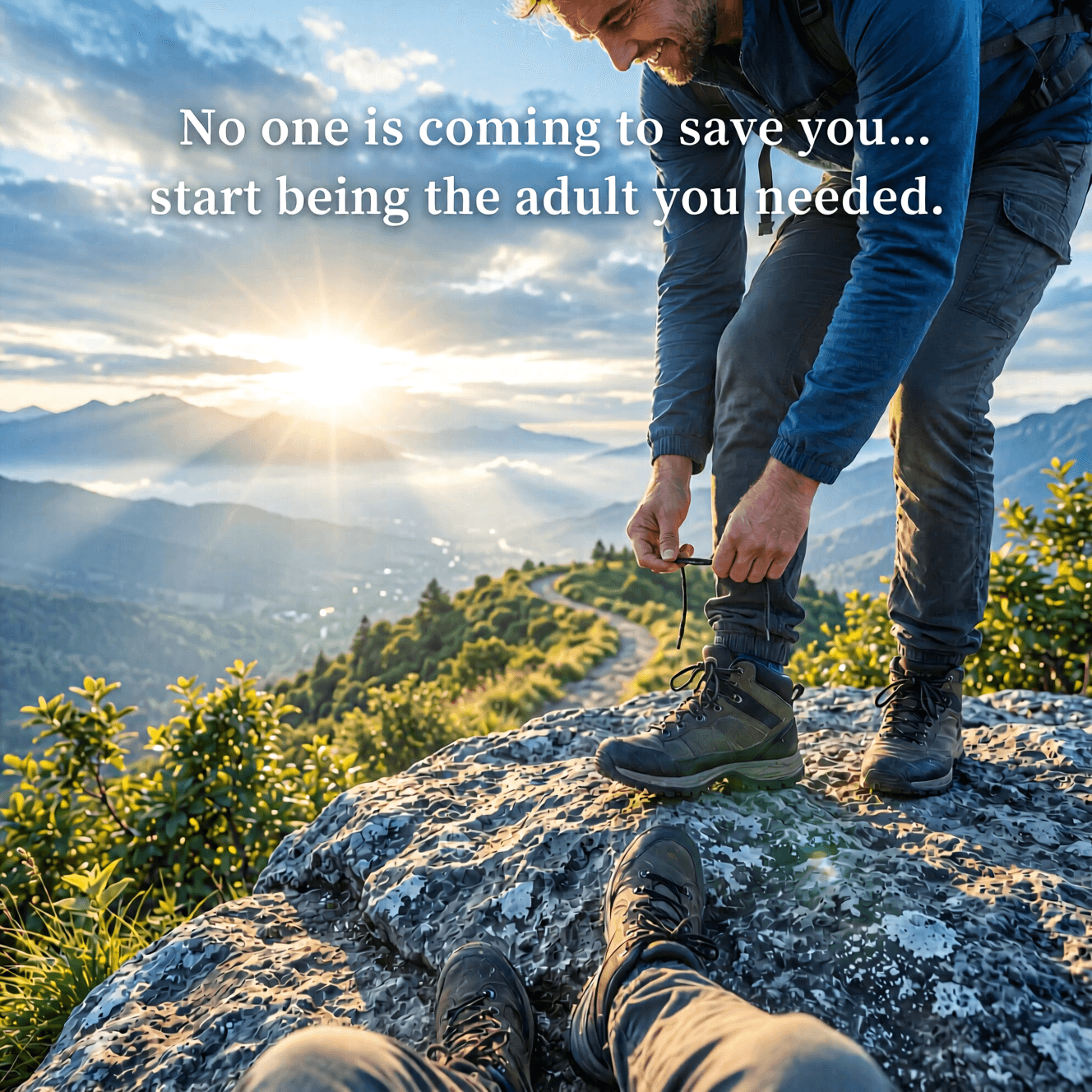
No one is coming to save you. This life is 100% your responsibility. Stop waiting for a hero and start being the adult you needed. — Unknown
—What lingers after this line?
The Shock of Self-Ownership
The quote begins with a jolt: “No one is coming to save you.” It isn’t meant to deny kindness or community, but to strip away the comforting fantasy that a single rescuer—an employer, partner, government, or perfectly timed opportunity—will arrive and fix what feels unfixable. From that blunt opening, it pivots into an empowering claim: if life is “100% your responsibility,” then you have agency even when circumstances are unfair. This reframing turns waiting into choosing, because the moment you accept ownership, you also reclaim the power to act. In that sense, the line functions like a personal manifesto: you may not control what happens to you, but you are accountable for what you do next. That distinction is where resignation ends and adulthood begins.
Why the “Hero” Myth Keeps Us Stuck
Building on the refusal of rescue, the quote targets a common psychological trap: outsourcing our future to a “hero.” Popular storytelling trains us to expect turning points—someone notices your talent, a relationship heals your wounds, a windfall arrives. Yet in real life, that narrative often becomes procrastination in disguise, because hoping for rescue feels safer than risking change. This is why the instruction “stop waiting for a hero” matters: it exposes how passivity can masquerade as patience. As Viktor Frankl describes in *Man’s Search for Meaning* (1946), even when freedom is constrained, people retain the capacity to choose their stance and next step. The hero myth fades when you recognize that your next decision is the plot.
Becoming the Adult You Needed
From there, the quote shifts from critique to repair: “start being the adult you needed.” This line acknowledges that many people are carrying unmet childhood needs—protection, consistency, encouragement, boundaries—and are still hoping someone will finally provide them. The message is not blame; it is an invitation to re-parent yourself with deliberate care. Practically, that can mean learning skills no one taught you: calming your nervous system, setting limits, managing money, asking for help, and keeping promises to yourself. Over time, these acts create an internal guardian who shows up reliably. The transition is subtle but profound: instead of searching the world for the missing adult, you become the person who can finally provide steadiness.
Radical Responsibility Without Self-Hatred
Still, “100% your responsibility” can be misunderstood as harshness, so it helps to draw a boundary between responsibility and shame. Responsibility says, “This is mine to handle,” while shame says, “This is my fault and I am bad.” The quote advocates the first, not the second, because shame collapses initiative whereas responsibility organizes it. In cognitive-behavioral therapy, a core move is to identify controllables—actions, habits, interpretations—rather than ruminating over what cannot be changed. That same logic applies here: you can’t rewrite the past or guarantee outcomes, but you can choose the next right action. The point is not punishment; it’s leverage.
Small Decisions That Create a New Life
Once the framework is set, the practical question becomes: what does “being the adult” look like today? It often starts embarrassingly small—making the appointment, cleaning the corner you avoid, applying for the job even if you fear rejection, or saying “no” without a long apology. These are not dramatic rescues, but they are how self-trust is built. James Clear’s *Atomic Habits* (2018) emphasizes that identity follows repeated behavior: you become the kind of person who shows up by showing up. Each responsible choice is a vote for a new self, and momentum accumulates faster than inspiration. In that way, the hero you were waiting for is constructed, not discovered.
Independence That Still Allows Support
Finally, accepting that no one is coming to save you doesn’t mean you must do everything alone; it means you stop making your wellbeing contingent on someone else’s arrival. Mature responsibility includes seeking support proactively—therapy, mentors, friends, community resources—while keeping ownership of your choices and follow-through. The healthiest reading of the quote is therefore relational rather than isolating: you can welcome help, but you do not abdicate agency. When you become the adult you needed, you don’t just survive without a hero—you learn how to collaborate with others without surrendering your life’s steering wheel.
One-minute reflection
Where does this idea show up in your life right now?
Related Quotes
6 selectedThe work doesn't care about your mood. It only cares if it gets done. Stop waiting for inspiration to do what you already know is required. — Unknown
Unknown
The quote begins with a blunt reminder: the work itself has no sensitivity to how we feel about it. A report, a workout, an exam, or a creative draft doesn’t become easier because we’re energized, nor does it pause becau...
Read full interpretation →Being broke isn't always your fault. Staying broke usually is. — Unknown
Unknown
The quote begins by separating two realities that often get blurred: the forces that push someone into financial hardship and the choices that determine what happens next. Being broke can arrive through layoffs, illness,...
Read full interpretation →Take action in your life. Don't wait for someone to come and rescue you. — Mel Robbins, United States.
Mel Robbins, United States.
This quote emphasizes the importance of taking control of one's own life rather than relying on external help. It encourages individuals to recognize their own power and agency.
Read full interpretation →How to guarantee failure: let other people's opinions determine your priorities. — Alex Hormozi
Alex Hormozi
Alex Hormozi’s warning begins with a simple but uncomfortable truth: failure often starts when a person hands over the authority to decide what matters. Other people’s opinions may sound like advice, concern, criticism,...
Read full interpretation →You rise and fall by your own efforts. Remember, it is a waste of time to worry about anyone else in this struggle. — Rudyard Kipling
Rudyard Kipling
At its heart, Kipling’s statement insists that the decisive force in a person’s life is personal effort. To rise or fall is not, in the first instance, a matter of spectators, rivals, or public opinion, but of one’s own...
Read full interpretation →We are not victims of our impulses or emotions; we have the power to control them. It is time to relinquish the excuses. — Allie Brosh
Allie Brosh
At its core, Allie Brosh’s quote rejects the comforting idea that emotions and impulses are irresistible forces. Instead, it insists that human beings possess agency: the ability to pause, choose, and act deliberately ev...
Read full interpretation →More From Author
More from Unknown →The language is the substrate. The architecture is the contract.
The line sets up a deliberate pairing: language lies beneath everything, while architecture governs everything above it. In other words, what you can express determines what you can build, and what you commit to structur...
Read full interpretation →A scroll is not a break; it is a trap disguised as rest. — Unknown
The quote begins by challenging a familiar story we tell ourselves: that a brief scroll is a harmless pause between tasks. On the surface, it looks like recovery—no effort, no decision, no commitment.
Read full interpretation →Don't let your ice cream melt while you're counting someone else's sprinkles. — Unknown
The quote uses ice cream as a simple stand-in for life’s fleeting pleasures: what you have is delicious, but it won’t last forever if you ignore it. Meanwhile, “counting someone else’s sprinkles” captures the habit of mo...
Read full interpretation →If your absence doesn't affect them, your presence never mattered. — Unknown
The quote frames absence as a revealing experiment: remove yourself, and the reaction—concern, curiosity, indifference—becomes a kind of data. If nothing changes when you’re gone, it suggests your role was never integrat...
Read full interpretation →