
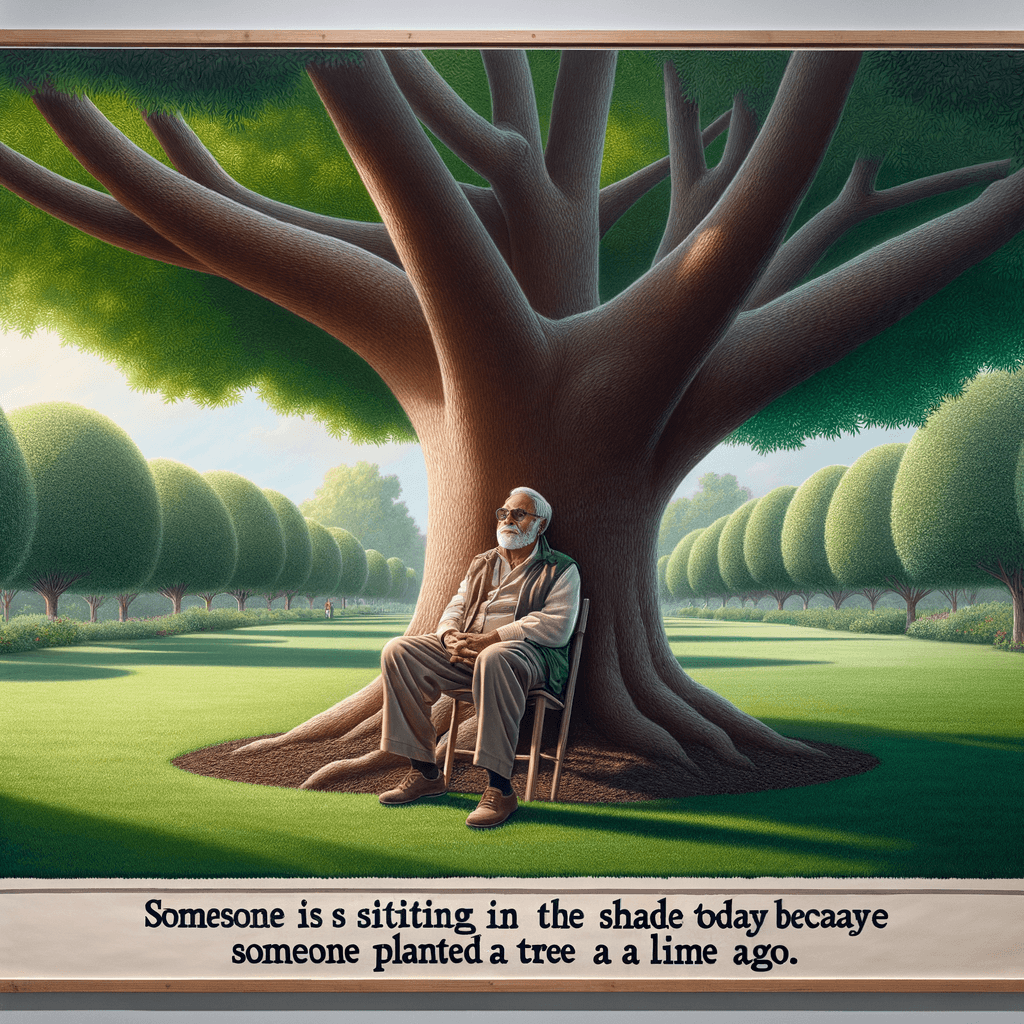
Someone is sitting in the shade today because someone planted a tree a long time ago. — Warren Buffett
—What lingers after this line?
Long-Term Thinking
This quote emphasizes the value of planning for the future. It suggests that today’s comforts and benefits are often a result of past actions and decisions.
Legacy and Impact
Buffett highlights the idea that our actions today can have lasting effects on future generations, encouraging individuals to think about their legacy and the impacts of their choices.
Investment in the Future
The metaphor of planting a tree signifies making investments—be it time, resources, or effort—that may take years to bear fruit. This underscores the importance of patience in seeing the results of one’s labor.
Selflessness and Vision
Planting a tree today for future shade implies a level of selflessness, suggesting that one should act not merely for immediate gratification but for the benefit of others in the long run.
Nature and Sustainability
The quote also reflects on the relationship between humanity and nature, advocating for sustainable practices that will ensure future benefits for society and the environment.
One-minute reflection
Why might this line matter today, not tomorrow?
Related Quotes
6 selectedYou don't have to be a billionaire to believe you can make a difference. Give your time, give your love, or simply give a smile. — Steve Goodier
Steve Goodier
At its core, Steve Goodier’s quote challenges the idea that influence belongs only to the wealthy or powerful. By placing time, love, and even a smile alongside money, he broadens generosity into something almost anyone...
Read full interpretation →Takers must have no limits, because givers never do. — Iyanla Vanzant
Iyanla Vanzant
At first glance, Iyanla Vanzant’s line sounds almost humorous, yet its irony cuts deeply. If givers continue offering time, energy, money, or emotional labor without pause, then takers are effectively trained to expect a...
Read full interpretation →In the ordinary life, we hardly realize that we receive a great deal more than we give, and that it is only with gratitude that life becomes rich. — Dietrich Bonhoeffer
Dietrich Bonhoeffer
Bonhoeffer begins with a quiet but unsettling observation: most of us move through ordinary life without noticing how much we constantly receive. From language and education to food, care, and companionship, our days are...
Read full interpretation →The love we give away is the only love we keep. — Elbert Hubbard
Elbert Hubbard
At first glance, Elbert Hubbard’s line seems to contradict common sense: how can love that is given away be the only love we keep? Yet the paradox is precisely the point.
Read full interpretation →A generous heart is always open, always ready to receive our going and coming. — C. JoyBell C.
C. JoyBell C.
C. JoyBell C.’s line imagines generosity not merely as giving things away, but as creating inner space for others.
Read full interpretation →Peace is not something you wish for. It is something you make, something you do, something you are, and something you give away. — Robert Fulghum
Robert Fulghum
Robert Fulghum’s statement begins by overturning a comforting illusion: peace does not arrive through hope alone. By saying it is not merely something you wish for, he shifts the burden from passive desire to active resp...
Read full interpretation →More From Author
More from Warren Buffett →The difference between successful people and really successful people is that really successful people say 'no' to almost everything. — Warren Buffett
Buffett’s line reframes success as the art of subtraction rather than accumulation. Many capable people become “successful” by taking on more projects, more meetings, and more opportunities, yet that very breadth can dif...
Read full interpretation →The more you learn, the more you earn. — Warren Buffett
This quote emphasizes the idea that continuous learning is directly related to increased financial success. The more knowledge one acquires, the better equipped they are to make informed decisions that can lead to wealth...
Read full interpretation →What consumes your mind controls your life. — Warren Buffett
This quote emphasizes that the thoughts and beliefs you focus on the most will dictate your actions, decisions, and ultimately the course of your life.
Read full interpretation →To invest in yourself is the only investment that never fails. — Warren Buffett
Warren Buffett, renowned for his shrewd financial wizardry, advocates a philosophy that transcends the boardroom: ‘to invest in yourself is the only investment that never fails.’ This foundational idea redirects focus fr...
Read full interpretation →