
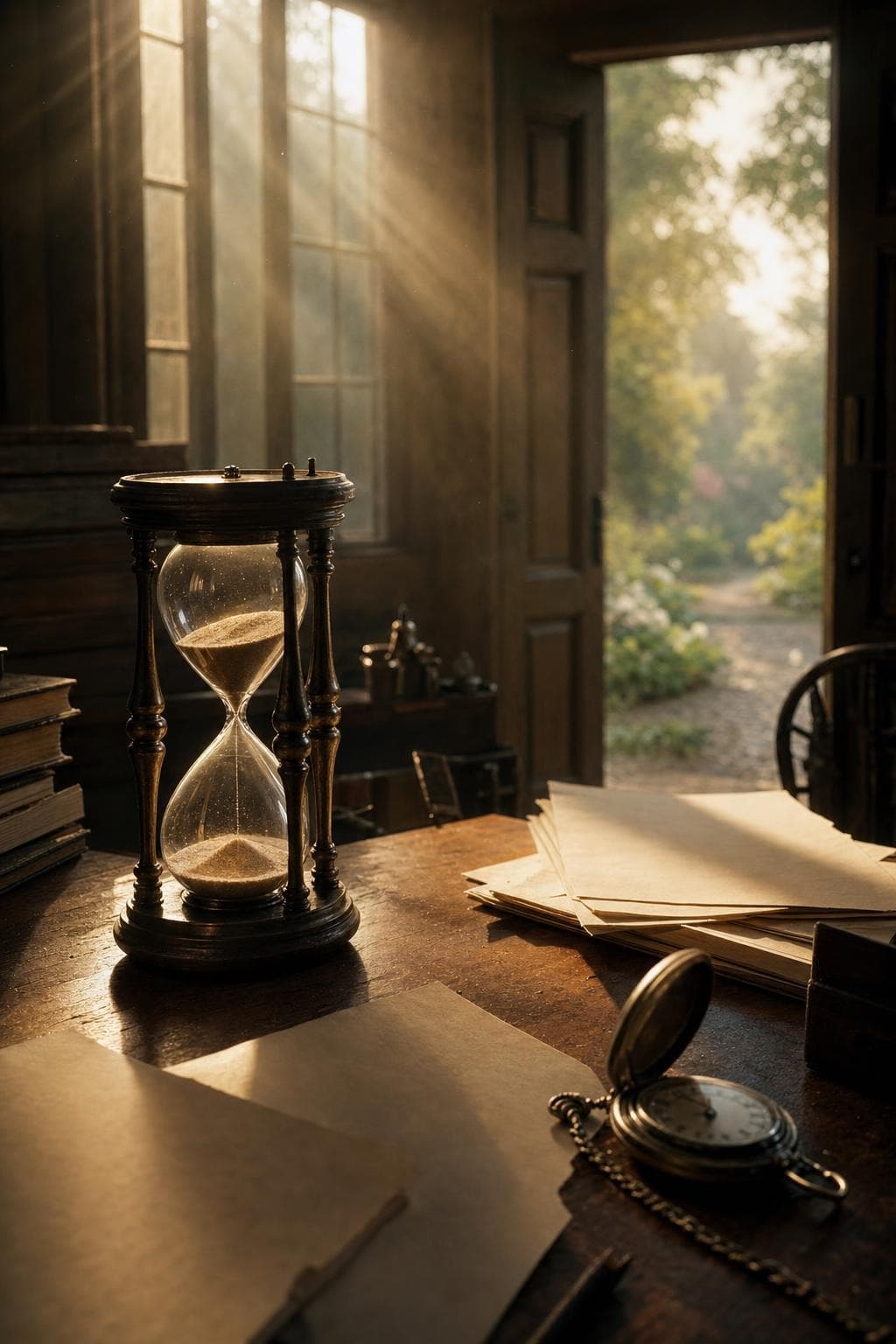
There is no greater harm than that of time wasted. — Michel de Montaigne
—What lingers after this line?
The Weight of an Invisible Loss
Montaigne’s warning begins with a simple but unsettling truth: wasted time often feels harmless because it leaves no immediate wound. Unlike lost money or damaged property, it disappears quietly, making its harm easy to underestimate. Yet precisely because time cannot be recovered, its loss may be the most final of all.
A Renaissance Voice on Human Limits
Moving from the personal to the historical, Montaigne’s Essays (1580) repeatedly examine the fragility of human life and judgment. Writing during an age of political conflict and religious upheaval, he understood that people often spend their brief lives chasing vanity, status, or distraction. His remark therefore reflects not mere efficiency, but a deeper moral concern about how we inhabit our limited days.
Time as the Ground of Meaning
From this perspective, time is not just a resource; it is the condition that makes every other good possible. Friendship, learning, reflection, love, and civic duty all require attention over time. When time is squandered, we do not simply lose hours—we lose the experiences and transformations those hours might have carried.
The Quiet Danger of Distraction
This insight feels especially modern, even though Montaigne wrote centuries before digital life. Today, wasted time often arrives disguised as constant busyness: endless scrolling, shallow multitasking, or obligations accepted without thought. In that sense, Montaigne’s warning asks us to distinguish motion from purpose and stimulation from genuine living.
Reflection as a Remedy
Yet Montaigne does not invite panic or rigid productivity. His own essays wander, pause, reconsider, and return to ordinary experience, showing that well-used time can include contemplation and leisure. The crucial difference lies in awareness: time spent freely and thoughtfully nourishes the self, while time surrendered unconsciously diminishes it.
Choosing the Shape of a Life
Finally, the quote points toward responsibility. Since a life is made out of time, our daily choices gradually become our character and legacy. Montaigne’s message is therefore not simply that we should do more, but that we should live more deliberately, refusing to let our most irreplaceable possession vanish without meaning.
One-minute reflection
Where does this idea show up in your life right now?
Related Quotes
6 selectedThe challenge is not to build a perfect life, but to fortify the vessel that carries you through it. Master your own conduct, for that is your only true domain. — Michel de Montaigne
Michel de Montaigne
Montaigne’s insight shifts attention away from controlling the world and toward strengthening the self that must move through it. Life, in this view, is not a structure we can engineer into perfection, but a changing sea...
Read full interpretation →Our great and glorious masterpiece is to live appropriately. All other things—ruling, hoarding, building—are only little appendages and props. — Michel de Montaigne
Michel de Montaigne
Montaigne turns ordinary ambition upside down by declaring that the real work of a human life is not conquest, wealth, or reputation, but learning how to live properly. In this view, a good life is itself an achievement...
Read full interpretation →To compose our character is our duty, not to compose books, and to win, not battles and provinces, but order and tranquility in our conduct. — Michel de Montaigne
Michel de Montaigne
Montaigne redirects ambition away from public achievement and toward the difficult art of self-formation. At the heart of the quote is a striking reversal: the true work of a human life is not producing admired objects,...
Read full interpretation →My life has been full of terrible misfortunes, most of which never happened. — Michel de Montaigne
Michel de Montaigne
Montaigne’s line captures a familiar irony: the mind can live through disasters that reality never delivers. Although misfortune sounds like an external blow, he points inward, suggesting that a substantial portion of ou...
Read full interpretation →Build a small, steady fire of practice; warmth and skill will follow — Michel de Montaigne
Michel de Montaigne
Montaigne’s line invites us to picture not a roaring blaze, but a modest campfire, patiently tended. This is his metaphor for practice: something that begins almost insignificantly, yet holds the potential to transform i...
Read full interpretation →He who fears he will suffer, already suffers because he fears. — Michel de Montaigne
Michel de Montaigne
This quote highlights a paradox: the act of fearing potential suffering brings immediate suffering. By anticipating pain or hardship, one is already mentally experiencing some of the distress they are trying to avoid.
Read full interpretation →More From Author
More from Michel de Montaigne →The challenge is not to build a perfect life, but to fortify the vessel that carries you through it. Master your own conduct, for that is your only true domain. — Michel de Montaigne
Montaigne’s insight shifts attention away from controlling the world and toward strengthening the self that must move through it. Life, in this view, is not a structure we can engineer into perfection, but a changing sea...
Read full interpretation →Our great and glorious masterpiece is to live appropriately. All other things—ruling, hoarding, building—are only little appendages and props. — Michel de Montaigne
Montaigne turns ordinary ambition upside down by declaring that the real work of a human life is not conquest, wealth, or reputation, but learning how to live properly. In this view, a good life is itself an achievement...
Read full interpretation →To compose our character is our duty, not to compose books, and to win, not battles and provinces, but order and tranquility in our conduct. — Michel de Montaigne
Montaigne redirects ambition away from public achievement and toward the difficult art of self-formation. At the heart of the quote is a striking reversal: the true work of a human life is not producing admired objects,...
Read full interpretation →My life has been full of terrible misfortunes, most of which never happened. — Michel de Montaigne
Montaigne’s line captures a familiar irony: the mind can live through disasters that reality never delivers. Although misfortune sounds like an external blow, he points inward, suggesting that a substantial portion of ou...
Read full interpretation →