
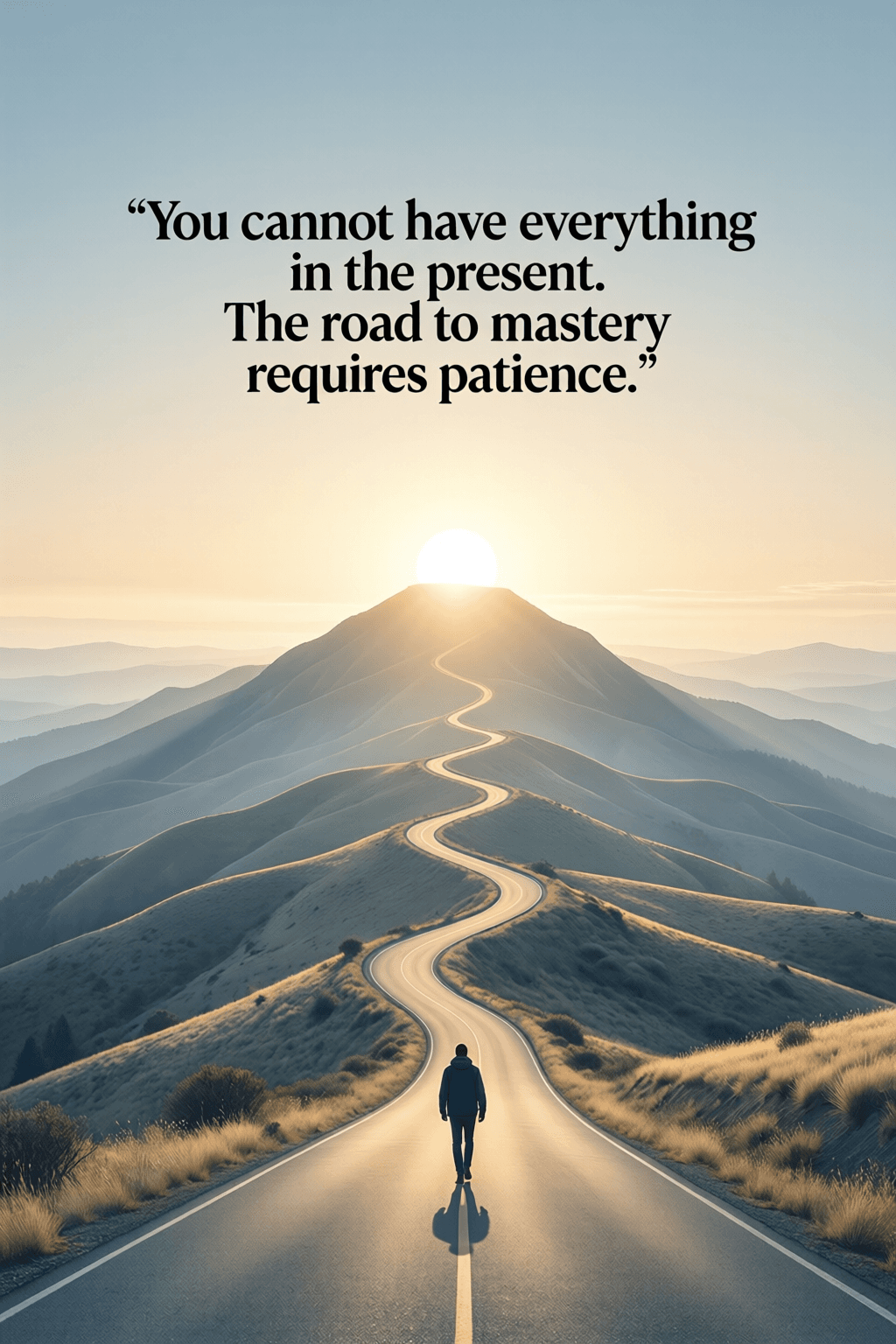
You cannot have everything in the present. The road to mastery requires patience. — Robert Greene
—What lingers after this line?
The Limits of Immediate Gratification
Robert Greene’s statement begins with a hard truth: life does not yield all rewards at once. By saying, “You cannot have everything in the present,” he challenges the modern temptation to expect instant results, instant recognition, and instant skill. In this sense, the quote is less a denial than a correction, reminding us that meaningful achievement unfolds across time rather than appearing on demand. From there, Greene shifts the focus from desire to discipline. Wanting mastery is natural, yet mastery itself belongs to those who can tolerate delay, frustration, and incompleteness. The present moment, then, is not where everything is possessed; it is where everything is practiced.
Why Mastery Is a Long Road
The image of a “road” is crucial because it frames mastery as a journey rather than a sudden transformation. Unlike talent myths that celebrate effortless brilliance, Greene’s language suggests movement through stages: repetition, error, adjustment, and gradual refinement. This idea echoes Aristotle’s *Nicomachean Ethics* (4th century BC), where excellence emerges through habitual action rather than isolated inspiration. As a result, patience is not merely a virtue attached to mastery; it is one of its working conditions. A musician laboring through scales or a writer revising the same page repeatedly advances not by dramatic leaps, but by enduring the slow accumulation of competence.
Patience as Active Endurance
Importantly, Greene does not present patience as passive waiting. Instead, patience here means sustained effort without the guarantee of immediate reward. It is the discipline to keep building when progress feels invisible, much like the craftspeople described in Zen traditions, where mastery in archery or calligraphy develops through years of attentive repetition rather than hurried ambition. Seen this way, patience becomes a form of strength. It allows a person to remain steady through boredom, self-doubt, and setbacks. Rather than surrendering to impatience, the aspiring master learns to trust that unseen growth is still growth.
A Rebuttal to Modern Speed
In a culture shaped by fast feedback and public performance, Greene’s quote sounds almost rebellious. Social media often compresses years of labor into a few polished moments, making mastery appear immediate when it is actually the result of prolonged struggle. Consequently, many people compare their beginnings to someone else’s middle and mistake slow progress for failure. Greene’s words restore proportion. They remind us that the present is often awkward and incomplete by design. Much as Michelangelo’s long apprenticeship preceded his fame, visible excellence usually rests on invisible years. The quote therefore resists the illusion that speed is the same as depth.
Learning to Sacrifice for Future Skill
Embedded in the quote is the idea of sacrifice: to gain something enduring, one must give up the fantasy of having everything now. This may mean accepting temporary obscurity, repetitive practice, or the discomfort of being a beginner. Yet such sacrifice is not purely loss; rather, it is an investment that converts present restraint into future ability. Historical examples reinforce this pattern. Benjamin Franklin’s *Autobiography* (1791) recounts his deliberate self-education through disciplined habits and incremental improvement. In that light, Greene’s message becomes practical: patience is the price paid in the present so that mastery can become possible in the future.
The Inner Transformation of the Learner
Finally, the road to mastery changes more than skill—it changes character. As one submits to time, correction, and repetition, impatience gradually gives way to humility. The learner begins by wanting quick results but often ends by valuing the process itself, discovering that endurance, attention, and resilience are part of what mastery means. Thus, Greene’s quote carries a deeper lesson about maturity. It teaches that not getting everything in the present is not a flaw in life’s design, but a necessary condition for growth. Mastery is valuable precisely because it cannot be rushed; it must be earned through patient becoming.
Recommended Reading
As an Amazon Associate, we earn from qualifying purchases.
One-minute reflection
Where does this idea show up in your life right now?
Related Quotes
6 selectedMastery is not a function of genius or luck. It is a function of time and intense focus applied to a particular field of knowledge. — Robert Greene
Robert Greene
Robert Greene’s statement immediately shifts the conversation away from talent myths and fortunate breaks. Instead of treating mastery as a rare gift bestowed on a chosen few, he presents it as the result of sustained ef...
Read full interpretation →The very desire to find shortcuts makes you eminently unsuited for any kind of mastery. — Robert Greene
Robert Greene
Robert Greene’s statement cuts against a common modern instinct: the wish to advance quickly while avoiding the slow, repetitive labor that excellence demands. At first glance, shortcuts seem practical, even efficient.
Read full interpretation →The only way to become a master is to fall in love with the process, not just the result. Dedicate your life to mastering your craft, and the work will become your greatest teacher. — Robert Greene
Robert Greene
Robert Greene’s quote begins by shifting attention away from applause, recognition, or finished products and toward the daily rhythm of practice itself. In his view, mastery is not granted to those who merely crave resul...
Read full interpretation →Anything worth having is worth waiting for, and everything worth doing is worth doing with patience. — Confucius
Confucius
At its core, this saying ties value to delay. Confucius suggests that truly meaningful things do not arrive instantly; instead, they ask us to endure uncertainty, effort, and time.
Read full interpretation →But patience can't be acquired overnight. It's just like building up a muscle. Every day you need to work on it, to push its limits. — Eknath Easwaran
Eknath Easwaran
Eknath Easwaran frames patience not as a fixed personality trait but as a capacity that develops over time. From the outset, his comparison to building muscle changes the way we think about self-control: instead of waiti...
Read full interpretation →To do anything to a high standard, you must be prepared to be bored for long periods of time. — James Clear
James Clear
James Clear’s observation cuts against the modern preference for constant stimulation. At first glance, high achievement looks exciting from the outside, yet the path toward it is usually repetitive, slow, and uneventful...
Read full interpretation →More From Author
More from Robert Greene →Perspective is the ability to see the bigger picture rather than being focused on the immediate pain. — Robert Greene
Robert Greene’s line begins with a simple but demanding claim: perspective is not the denial of pain, but the capacity to place pain within a wider frame. In other words, the moment may hurt intensely, yet it does not al...
Read full interpretation →The very desire to find shortcuts makes you eminently unsuited for any kind of mastery. — Robert Greene
Robert Greene’s statement cuts against a common modern instinct: the wish to advance quickly while avoiding the slow, repetitive labor that excellence demands. At first glance, shortcuts seem practical, even efficient.
Read full interpretation →Anything that is alive is in a continual state of change and movement. The moment that you rest, thinking that you have attained the level you desire, a part of your mind enters a phase of decay. — Robert Greene
Robert Greene’s statement begins with a simple but far-reaching observation: everything alive is always changing. Growth is not a fixed achievement but an ongoing process of movement, adjustment, and renewal.
Read full interpretation →Discipline is not about suppressing your nature; it is about building the infrastructure that allows your best self to show up consistently. — Robert Greene
At first glance, discipline is often mistaken for harsh restraint, as if becoming better requires silencing instinct and desire. Robert Greene’s insight redirects that assumption: discipline is less about suppression tha...
Read full interpretation →