
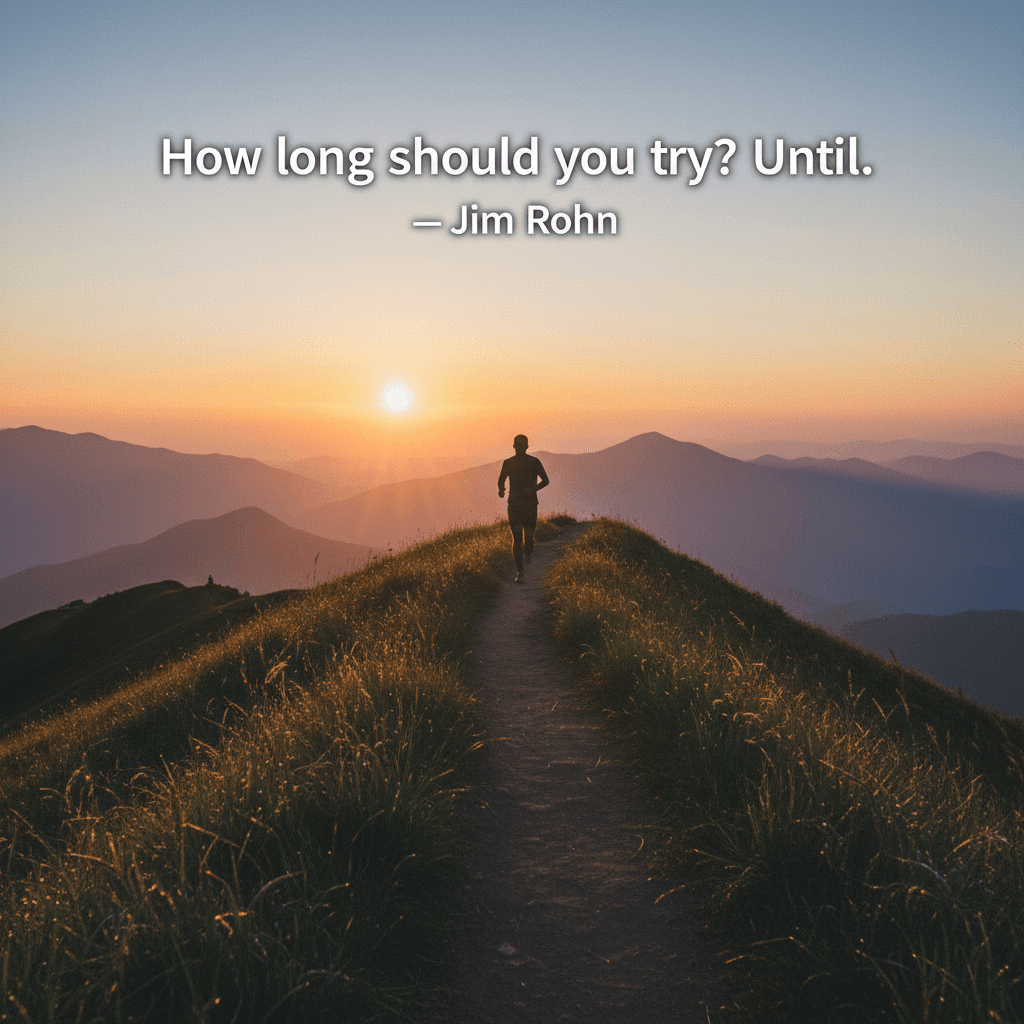
How long should you try? Until. — Jim Rohn
—What lingers after this line?
The Meaning Packed in One Word
Jim Rohn’s terse answer—until—compresses an entire philosophy into a single horizonless adverb. It rejects arbitrary timelines and locates success in sustained engagement rather than instant outcomes. Crucially, until does not endorse stubbornness for its own sake; it implies an unwavering commitment to a worthy aim, coupled with learning along the way. In this reading, persistence becomes a practice of revising methods while preserving the mission, so effort remains purposeful rather than performative.
Stories That Make 'Until' Concrete
To ground this, consider Thomas Edison, whose laboratory ran thousands of filament trials before a commercially viable light bulb emerged; the point was not repetition, but iteration under pressure. Likewise, J. K. Rowling faced a string of rejections before Bloomsbury accepted Harry Potter; her revising persisted until the manuscript met the right champion. Even Winston Churchill’s wartime admonition at Harrow School (1941)—never give in—echoes this ethic: obstacles are signals to adjust the approach, not abandon the cause.
What Science Says About Sticking With It
Moreover, research backs the power of sustained effort. Angela Duckworth’s Grit (2016) shows that passion combined with perseverance predicts achievement beyond raw talent. Carol Dweck’s work on growth mindset (2006) explains why reframing setbacks as information preserves motivation. Complementing this, Anders Ericsson’s studies of deliberate practice (1993; with Pool, *Peak*, 2016) reveal that targeted, feedback-rich effort—not mere repetition—builds expertise. Together, these findings translate until into a learnable skill: keep going, keep improving, and keep correcting course.
Turning Persistence into Daily Systems
In practice, until thrives on systems that automate progress. James Clear’s *Atomic Habits* (2018) popularizes identity-based habits—show up as the kind of person who does the work, then let small actions compound. BJ Fogg’s tiny habits (2019) and Peter Gollwitzer’s implementation intentions (1999) add the how: shrink the first step and predecide the when-then. Thus persistence becomes less about heroic willpower and more about environment, cues, and routines that quietly remove friction.
Iteration: Persist, But Also Adapt
At the same time, until requires intelligent flexibility. Eric Ries’s *The Lean Startup* (2011) frames the pivot-or-persevere decision as a learning milestone: measure what matters, then change what doesn’t. Similarly, John Boyd’s OODA loop (observe–orient–decide–act) urges rapid cycling between action and insight. The throughline is clear: endurance without feedback drifts into futility, while feedback without endurance evaporates before results appear. The winning posture blends both.
Guardrails: Endurance Without Burnout
Sustainable until respects human limits. The World Health Organization’s ICD‑11 (2019) recognizes burnout as an occupational syndrome, reminding us that recovery is not indulgence but infrastructure. Athletes periodize training; knowledge workers can periodize intensity, too—protecting sleep, scheduling deep work, and engineering no-meeting blocks. By designing rest as part of the system, you preserve the capacity to persist, ensuring that long horizons do not become short fuses.
A Simple Plan to Try Until
Finally, translate the philosophy into a rhythm: define a clear outcome and the smallest daily behavior that proves identity—twenty focused minutes, one sales call, a page of code. Track leading indicators, review weekly, and adjust based on evidence rather than mood. To avoid the sunk‑cost trap (Arkes and Blumer, 1985), set prewritten kill or pivot criteria before you start. In this way, until stops being a slogan and becomes a cadence that steadily carries you to the finish.
One-minute reflection
Where does this idea show up in your life right now?
Related Quotes
6 selectedIt is the set of the sails, not the direction of the wind that determines which way we will go. — Jim Rohn
Jim Rohn
Jim Rohn’s image of sails and wind turns a familiar scene into a philosophy of agency. At first glance, wind seems to control everything: it is invisible, powerful, and beyond human command.
Read full interpretation →To ignite your life you must focus on one thing long enough for it to catch fire. — Gary Keller
Gary Keller
Gary Keller’s quote begins with a simple but demanding idea: transformation rarely comes from scattered effort. To “ignite your life” is to create momentum, meaning, and visible progress, yet that spark needs sustained a...
Read full interpretation →If we are facing in the right direction, all we have to do is keep walking. — Thích Nhất Hạnh
Thich Nhat Hanh
Thích Nhất Hạnh’s words begin with a simple but profound premise: progress depends first on direction, not speed. If a person is turned toward compassion, clarity, healing, or truth, then each modest step becomes meaning...
Read full interpretation →Do the best one can. Do it over again. Then still improve, even if ever so slightly, those retouches. — Marguerite Yourcenar
Marguerite Yourcenar
Yourcenar’s words begin with a simple demand: do the best one can. Yet she immediately refuses to let effort become an excuse for stopping.
Read full interpretation →A good-enough novel violently written now is better than a perfect novel meticulously written never. — Elizabeth Gilbert
Elizabeth Gilbert
Elizabeth Gilbert’s line immediately shifts the argument from artistic purity to artistic existence. A “good-enough” novel, even one “violently written,” has entered the world and can move, provoke, or comfort someone; b...
Read full interpretation →There is no road too long to the man who advances deliberately and without undue haste; there are no honors too distant to the man who prepares himself for them with patience. — Jean de La Bruyère
Jean de La Bruyère
At its core, La Bruyère’s line praises steady movement over restless speed. A long road feels intimidating only when seen all at once; once it is broken into deliberate steps, distance loses much of its power.
Read full interpretation →More From Author
More from Jim Rohn →Learn to be thankful for what you already have, while you pursue all that you want. — Jim Rohn
Jim Rohn’s advice begins with a delicate balance: appreciation for the present should not cancel ambition for the future. Instead, gratitude and aspiration can move together, like two steps in the same journey.
Read full interpretation →It is easier to discipline yourself now than to regret your lack of discipline later. — Jim Rohn
Jim Rohn’s saying turns discipline into a simple comparison of costs. On one side is the discomfort of acting now: waking up early, saving money, studying longer, or saying no to distraction.
Read full interpretation →Beyond a wholesome discipline, be gentle with yourself. — Jim Rohn
At first glance, Jim Rohn’s line places two values side by side that are often treated as opposites: discipline and gentleness. Yet the force of the quote lies in its quiet correction.
Read full interpretation →Your level of success is determined by your level of discipline and your ability to protect your own energy, not just your capacity to endure. — Jim Rohn
At first glance, Jim Rohn’s quote challenges a common cultural myth: that success belongs mainly to those who can suffer the longest. Instead, he shifts attention toward discipline and energy management, suggesting that...
Read full interpretation →