
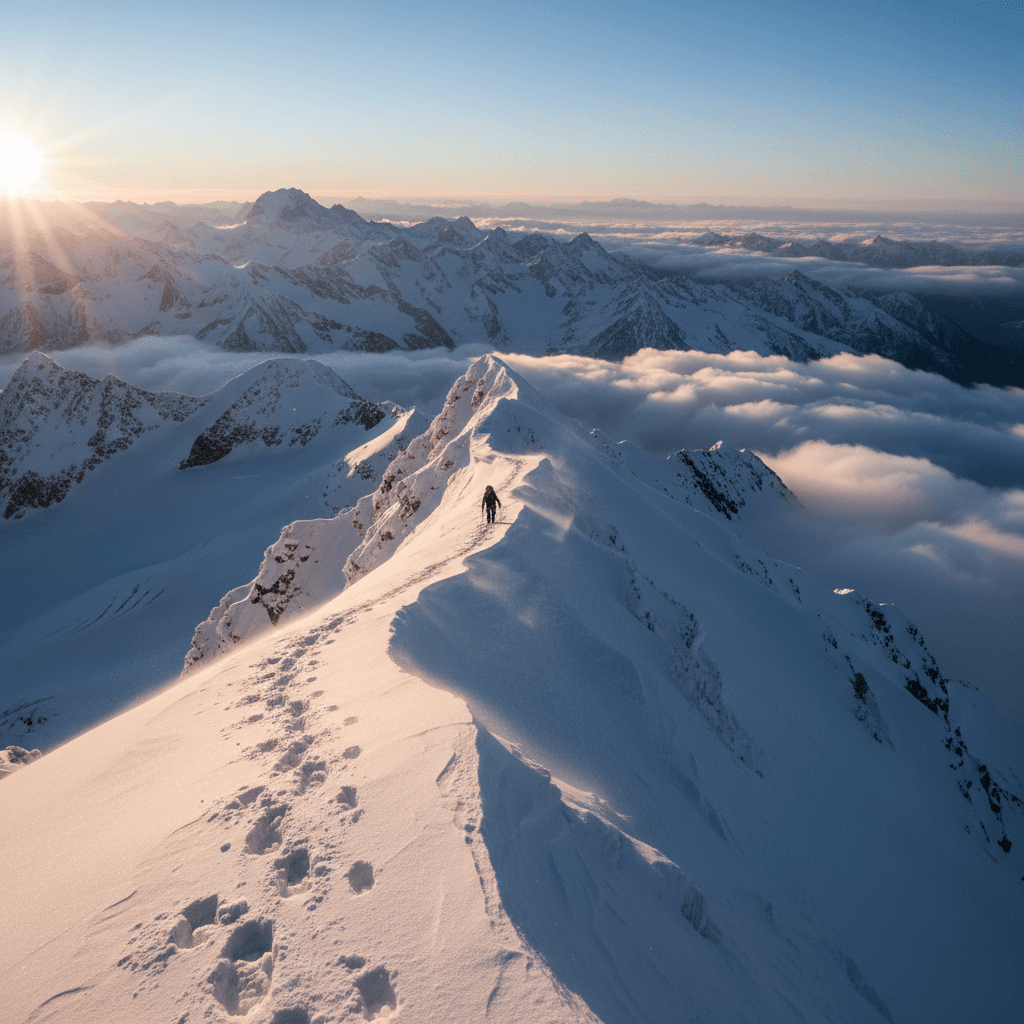
Seek the summit with gratitude in every step — Edmund Hillary
—What lingers after this line?
Gratitude as a Climber’s Compass
Edmund Hillary’s line joins two essential impulses: the drive to reach a summit and the discipline to appreciate each step. Ambition without gratitude burns out in thin air; gratitude without direction stalls on the trail. Taken together, they form a compass that steadies attention, regulates effort, and turns the journey itself into a source of strength. By thanking the small gains, we create momentum that does not depend on perfect conditions, which is precisely why this mindset travels well from mountains to daily life.
Hillary and Norgay on Everest, 1953
History offers a vivid illustration. On 29 May 1953, Edmund Hillary and Tenzing Norgay reached the top of Everest via the South Col route during John Hunt’s British expedition, a feat documented in Hunt’s The Ascent of Everest (1953) and Hillary’s High Adventure (1955). Their success rested on months of preparation, careful acclimatization, and the steady accumulation of small victories: a camp placed, a ridge crossed, a crevasse bridged. Hillary later emphasized gratitude toward Tenzing and the Sherpa community, signaling that the summit was a team accomplishment. This attitude points to a deeper psychology of progress.
The Psychology of Small Wins
Gratitude sharpens the perception of small wins, and small wins compound. Teresa Amabile and Steven Kramer’s The Progress Principle (2011) shows that noticing incremental progress boosts motivation and creativity. Likewise, gratitude research by Robert Emmons and Michael McCullough (2003) found that intentional thankfulness improves well-being and resilience. On the mountain, this means celebrating a stable breath, a well-placed crampon, or a clear weather window. Each acknowledgment reduces anxiety and sustains effort, just as endurance athletes reframe hardship into the manageable next step. From here, the social fabric of an expedition becomes crucial.
Ropes, Teams, and Humble Dependence
Mountaineering is a web of mutual reliance: route fixers, Sherpa loads, cooks, meteorologists, and rope partners. Gratitude nurtures trust, which in turn lowers coordination costs and raises safety margins. Hunt’s 1953 expedition emphasized disciplined roles and shared credit, and Hillary repeatedly credited Tenzing’s strength and judgment. When teammates feel seen, they communicate earlier, belay more attentively, and make wiser turn-around decisions. Thus, thanking each contribution is not sentimentality; it is operational excellence that sets the stage for surviving setbacks.
Turning Setbacks into Fuel
Storms close in, lungs rebel, and plans change. Gratitude reframes such setbacks as information rather than failure, preserving morale for another try. Hillary’s experience on earlier Himalayan expeditions in 1951–52 provided precisely the lessons that made 1953 possible, a pattern echoed in resilience research that stresses learning from near-misses. Even the language of antifragility (Nassim Taleb, 2012) captures this: systems grow stronger when stress is processed constructively. Thanking the warning, the forced rest, or the turned-back attempt converts immediate loss into durable readiness. This outlook naturally widens into stewardship.
Giving Back to the Mountain
Gratitude matures into responsibility. After Everest, Hillary founded the Himalayan Trust (1960), partnering with Sherpa communities to build schools, clinics, and bridges in the Khumbu. This was not an epilogue to adventure but its ethical continuation: the summit confers a duty to the path and the people who supported it. By transforming acclaim into service, Hillary showed that the highest point on the map is only a midpoint in a life of contribution. From this arc, the principle descends gracefully into everyday practice.
Carrying the Summit Mindset Home
In work, parenting, study, or recovery, the same formula applies: set a clear summit, then name and thank each step. Concretely, end the day by listing three advances, however small—an email clarified, a page written, a walk completed. This brief ritual anchors motivation overnight and primes the next ascent. Thus, we seek the summit without hurry and walk the path without complaint, because gratitude turns each step into proof that we are already moving higher.
One-minute reflection
Why might this line matter today, not tomorrow?
Related Quotes
6 selectedIf we are facing in the right direction, all we have to do is keep walking. — Thích Nhất Hạnh
Thich Nhat Hanh
Thích Nhất Hạnh’s words begin with a simple but profound premise: progress depends first on direction, not speed. If a person is turned toward compassion, clarity, healing, or truth, then each modest step becomes meaning...
Read full interpretation →Learn to be thankful for what you already have, while you pursue all that you want. — Jim Rohn
Jim Rohn
Jim Rohn’s advice begins with a delicate balance: appreciation for the present should not cancel ambition for the future. Instead, gratitude and aspiration can move together, like two steps in the same journey.
Read full interpretation →Do the best one can. Do it over again. Then still improve, even if ever so slightly, those retouches. — Marguerite Yourcenar
Marguerite Yourcenar
Yourcenar’s words begin with a simple demand: do the best one can. Yet she immediately refuses to let effort become an excuse for stopping.
Read full interpretation →You are not Atlas carrying the world on your shoulder. It is good to remember that the planet is carrying you. — Vandana Shiva
Vandana Shiva
Vandana Shiva’s words begin by overturning a familiar heroic image: the individual as Atlas, straining beneath the weight of the world. Instead, she gently corrects that illusion, reminding us that we are not supporting...
Read full interpretation →A good-enough novel violently written now is better than a perfect novel meticulously written never. — Elizabeth Gilbert
Elizabeth Gilbert
Elizabeth Gilbert’s line immediately shifts the argument from artistic purity to artistic existence. A “good-enough” novel, even one “violently written,” has entered the world and can move, provoke, or comfort someone; b...
Read full interpretation →There is no road too long to the man who advances deliberately and without undue haste; there are no honors too distant to the man who prepares himself for them with patience. — Jean de La Bruyère
Jean de La Bruyère
At its core, La Bruyère’s line praises steady movement over restless speed. A long road feels intimidating only when seen all at once; once it is broken into deliberate steps, distance loses much of its power.
Read full interpretation →More From Author
More from Edmund Hillary →The hardest battles are fought in the mind. You've got this. — Edmund Hillary
Edmund Hillary’s words shift the idea of struggle away from outward obstacles and into a far more intimate space: the mind. At first glance, battles seem to happen on mountains, in workplaces, or within crises, yet his i...
Read full interpretation →People do not decide to become extraordinary. They decide to accomplish extraordinary things. — Edmund Hillary
Edmund Hillary’s statement draws a critical distinction between personal identity and concrete accomplishment. Rather than viewing greatness as an innate state one simply adopts, Hillary points out that extraordinariness...
Read full interpretation →