
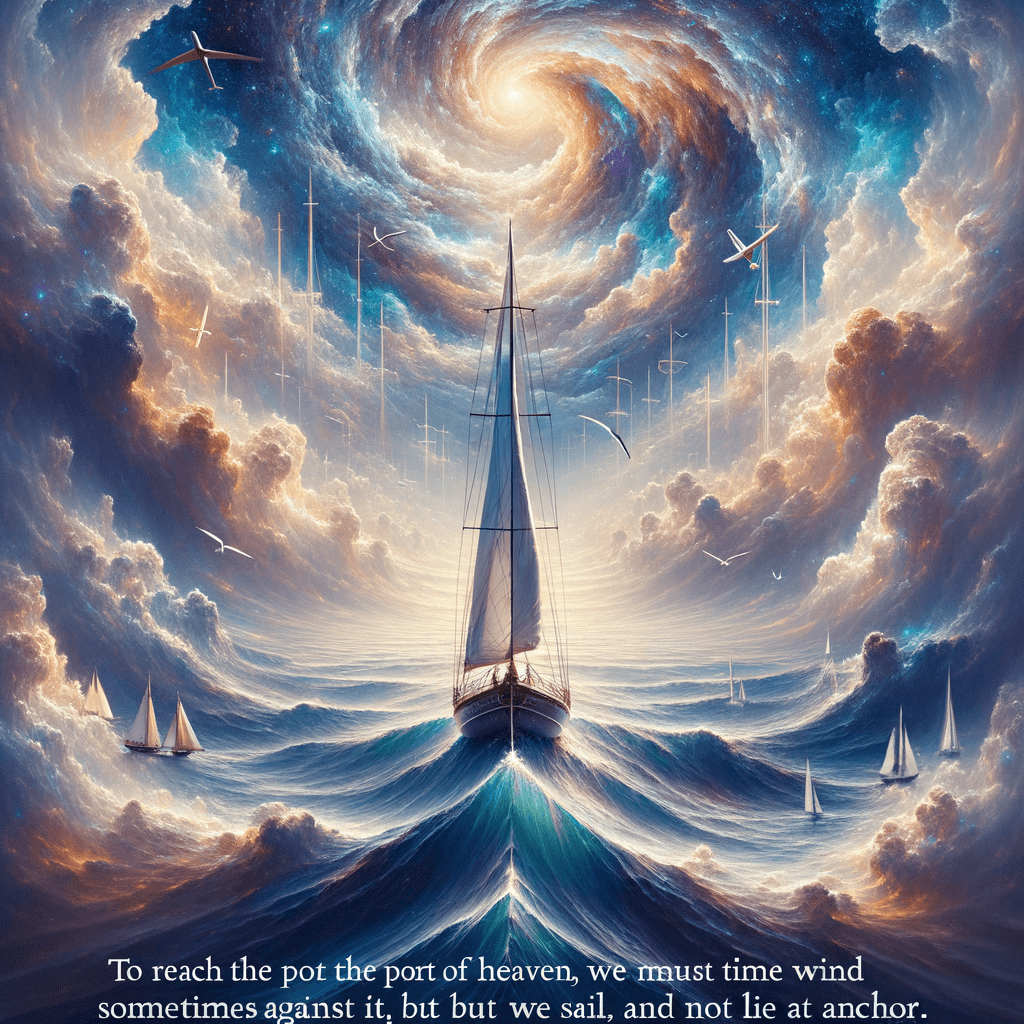
To reach the port of heaven, we must sail sometimes with the wind and sometimes against it, but we must sail, and not drift, nor lie at anchor. — Oliver Wendell Holmes Jr.
—What lingers after this line?
Perseverance in Life's Journey
This quote emphasizes the importance of actively pursuing our goals and dreams, symbolized by the journey to the 'port of heaven.' It suggests that we must be determined and persistent in our efforts.
Adapting to Challenges
Holmes acknowledges that there will be times when we must navigate against the wind, representing the challenges and obstacles we encounter. Adapting our strategies is essential to overcoming difficulties.
The Importance of Action
The quote stresses that it is crucial to take action ('sail') rather than being passive ('drift' or 'lie at anchor'). It encourages individuals to remain proactive and engaged in their pursuits.
Life's Ups and Downs
The metaphor of sailing illustrates the ups and downs of life. Just as sailors must adjust to changing winds, we too must be flexible and resilient in the face of life's uncertainties.
Holmes' Perspective
Oliver Wendell Holmes Jr. was an influential American physician, poet, and Supreme Court Justice. His reflections often blend philosophy with practical wisdom, urging individuals to embrace both the beauty and struggles of life.
One-minute reflection
What's one small action this suggests?
Related Quotes
6 selectedA good-enough novel violently written now is better than a perfect novel meticulously written never. — Elizabeth Gilbert
Elizabeth Gilbert
Elizabeth Gilbert’s line immediately shifts the argument from artistic purity to artistic existence. A “good-enough” novel, even one “violently written,” has entered the world and can move, provoke, or comfort someone; b...
Read full interpretation →There is no road too long to the man who advances deliberately and without undue haste; there are no honors too distant to the man who prepares himself for them with patience. — Jean de La Bruyère
Jean de La Bruyère
At its core, La Bruyère’s line praises steady movement over restless speed. A long road feels intimidating only when seen all at once; once it is broken into deliberate steps, distance loses much of its power.
Read full interpretation →There are no soft grounds in life. Just places to water and plough. — Athésia
Athésia
At first glance, Athésia’s line dismisses the hope that life might eventually deliver a permanently gentle terrain. There are, in this view, no naturally soft grounds waiting for us—no stage where effort disappears and g...
Read full interpretation →The greatest victory is the battle fought against your own desire to quit when things get quiet. — Epictetus
Epictetus
At first glance, this saying shifts the meaning of victory away from public triumph and toward an inward contest. The hardest battle, it suggests, is not fought in dramatic moments but in silence—when excitement fades, r...
Read full interpretation →If you're going through hell, keep going. Why would you stop in hell? — Winston Churchill
Winston Churchill
At its core, Churchill’s line reframes suffering as a place of passage rather than a permanent home. If life feels like hell, the worst response is paralysis, because stopping only prolongs exposure to what is already un...
Read full interpretation →You can't just give up on someone because the situation's not ideal; great relationships are built on perseverance. — Catherine Gilbert Murdock
Catherine Gilbert Murdock
At its core, Catherine Gilbert Murdock’s quote rejects the idea that love should survive only under perfect conditions. She suggests that meaningful relationships are not proven when everything is easy, but when people c...
Read full interpretation →More From Author
More from Oliver Wendell Holmes Jr. →A mind that is stretched by a new experience can never go back to its old dimensions. — Oliver Wendell Holmes Jr.
This quote highlights the transformative power of new experiences. Once a person's mind is exposed to new ideas or knowledge, it is forever changed and cannot return to a more limited, less informed state.
Read full interpretation →The greatest act of faith is when a man understands he is not God. — Oliver Wendell Holmes Jr.
The quote emphasizes the importance of recognizing and accepting our human limitations.
Read full interpretation →