
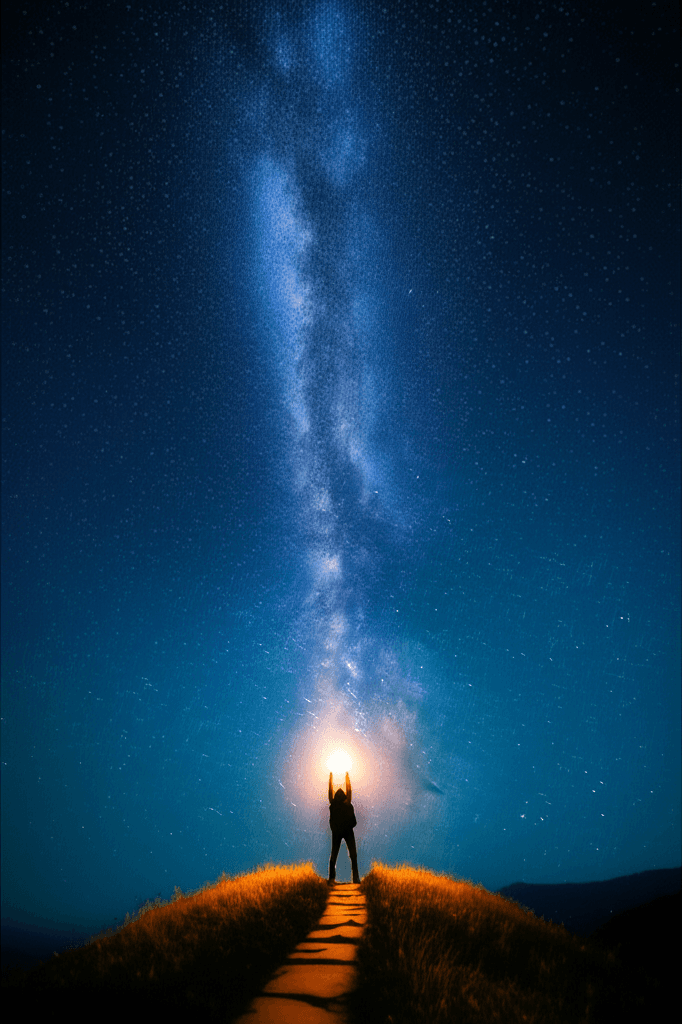
When you look up at the stars, remember they are invitations, not judgments. — Carl Sagan
—What lingers after this line?
From Judgment to Invitation
To begin, this line turns an ancient habit on its head. For millennia, people treated the night sky as a tribunal, reading omens in comets and destinies in constellations. By contrast, calling stars “invitations” reframes them as open doors to wonder and inquiry rather than verdicts to fear. The heavens, in this view, do not condemn; they beckon. This shift moves us from a world of superstition to one of curiosity, where questions replace anxieties and exploration displaces fatalism. It sets the tone for a distinctly modern sensibility: the cosmos is not a judge but a horizon.
Sagan’s Expansive Perspective
Building on that, Carl Sagan consistently urged a welcoming, not punitive, view of the universe. In Cosmos (1980) and Pale Blue Dot (1994), he presented the stars as pathways to perspective, reminding us that we are “star stuff” and “a way for the cosmos to know itself.” The point was not to find celestial reprimands but to accept a humbling invitation—to learn, to test, to wonder. When Voyager 1 turned back to photograph Earth in 1990, the resulting image punctured our pretensions and expanded our empathy. Rather than delivering edicts from above, the distant lights asked us to see ourselves clearly and to keep exploring.
Awe as a Scientific Emotion
Moreover, psychology suggests that awe—often sparked by the night sky—nudges us toward generosity, humility, and curiosity. Studies led by Paul Piff and Dacher Keltner (2015) found that awe can decrease self-focus and increase prosocial behavior, as if the vastness recalibrates our priorities. In this sense, the stars invite a posture of learning rather than a fear of judgment. Standing under a dark, star-laden sky slows our sense of time, making space for questions we usually rush past. The emotion of awe becomes a bridge: it carries us from passive gazing to active inquiry, which is precisely the kind of answer an invitation seeks.
History’s Call to Explore
Following that invitation, humanity has repeatedly used the stars to venture further. Polynesian wayfinders navigated the Pacific by starlight, a tradition celebrated by the Hōkūleʻa’s modern voyages (revived in 1976). Galileo’s Sidereus Nuncius (1610) turned telescopic curiosity into a new cosmos. More recently, the Hubble Ultra Deep Field (2004) revealed swarms of galaxies in what looked like emptiness, Kepler (2009) uncovered thousands of exoplanets, and the James Webb Space Telescope (launched 2021) now probes the atmospheres of distant worlds. Each advance exemplifies the quote’s spirit: the sky does not scold; it summons. Our instruments are, quite literally, RSVP replies to the universe’s invitation.
Science Over Omen
At the same time, interpreting stars as invitations aligns with scientific skepticism. In The Demon-Haunted World (1995), Sagan championed a “baloney detection kit” to test claims and avoid the pitfalls of omen-reading. If the cosmos is neutral, then meaning is our responsibility, forged through evidence and ethics rather than divination. This stance is not cold; it is empowering. Freed from celestial judgments, we can ground our choices in compassion and data. We answer the stars by building reliable knowledge, acknowledging uncertainty, and welcoming revision—habits of mind that keep wonder honest.
The Overview Effect and Shared Fate
Extending this perspective, astronauts often report the “overview effect,” a sudden sense of unity and stewardship when seeing Earth from space. As Frank White described (1987), the experience softens boundaries and sharpens responsibility. The night sky, viewed from orbit or a backyard, invites the same realization: our arguments and ambitions unfold on a small, fragile world. Rather than hearing condemnation from above, we sense a quiet call to care for what we share. That call does not excuse us from judgment; it relocates it within us—our conscience, our communities, our choices.
Answering the Invitation
Ultimately, treating stars as invitations directs us toward action. It can mean learning a constellation, joining a citizen-science project like Galaxy Zoo (launched 2007), or supporting policies that protect dark skies and the climate. It can also mean adopting humility in debate, curiosity in education, and patience in problem-solving. The night sky offers no decrees, only possibilities. When we accept that offer, we trade fear for responsibility, resignation for exploration, and isolation for shared purpose. In doing so, we fulfill the most human of replies: we look up, and then we step forward.
One-minute reflection
What does this quote ask you to notice today?
Related Quotes
6 selectedRaise your gaze; the ordinary sky holds unfamiliar constellations. — Pablo Neruda
Pablo Neruda
Neruda’s line beckons us to tilt the chin and tilt the mind. The ordinary sky, unremarked in its daily blue, becomes a canvas where new patterns can emerge if we allow them.
Read full interpretation →Your heart is an ocean, capable of holding countless stars.
Unknown
This metaphor suggests that the heart has immense emotional depth, akin to the vastness of an ocean. It implies that a person is capable of experiencing and containing a wide range of emotions and feelings.
Read full interpretation →The clearest way into the Universe is through a forest wilderness. - John Muir
John Muir
John Muir suggests that immersing oneself in a natural environment, such as a forest, allows for a deeper and clearer connection with the Universe. Nature serves as a pathway to understanding and experiencing the greater...
Read full interpretation →Every twinkling star tells the story of the universe.
Unknown
This statement suggests that stars are not just celestial bodies but also narrators of the universe's history and events. Each star holds secrets about the cosmos, contributing to the grand tale of space and time.
Read full interpretation →Somewhere, something incredible is waiting to be discovered. - Carl Sagan
Carl Sagan
This quote implies that the universe is filled with endless possibilities and that there are always new and amazing things yet to be found. It encourages a sense of wonder and curiosity about the unknown.
Read full interpretation →Somewhere, something incredible is waiting to be known. - Carl Sagan
Carl Sagan
This quote underscores the endless potential for discovery in the universe. It inspires an enduring sense of curiosity, suggesting that there are numerous marvels yet to be found.
Read full interpretation →More From Author
More from Carl Sagan →A single clear intention can untangle a knot of days. — Carl Sagan
Carl Sagan’s image of a “knot” captures how time can feel when tasks, worries, and obligations twist together into one tight mass. Days stop reading like a sequence and start feeling like a tangle—unfinished conversation...
Read full interpretation →Stand in the clean light of intention and act; regret lives in shadows. — Carl Sagan
Carl Sagan’s line hinges on a simple contrast: “clean light” versus “shadows.” Light suggests visibility, honesty, and the ability to see consequences before you move; shadows imply half-known motives and choices made wi...
Read full interpretation →Share curiosity freely; it grows richer the more it is given. — Carl Sagan
Carl Sagan frames curiosity not as something that diminishes with use, but as a resource that replenishes—甚至 expands—when distributed. Unlike money or fuel, curiosity can multiply because it lives in questions, and quest...
Read full interpretation →Begin with a single curious question; sustained actions reveal the answer. — Carl Sagan
Sagan’s line begins with a deceptively small gesture: asking one curious question. In his framing, the question is not a flourish or a performance—it is the ignition point for inquiry, the moment we admit we do not yet k...
Read full interpretation →