
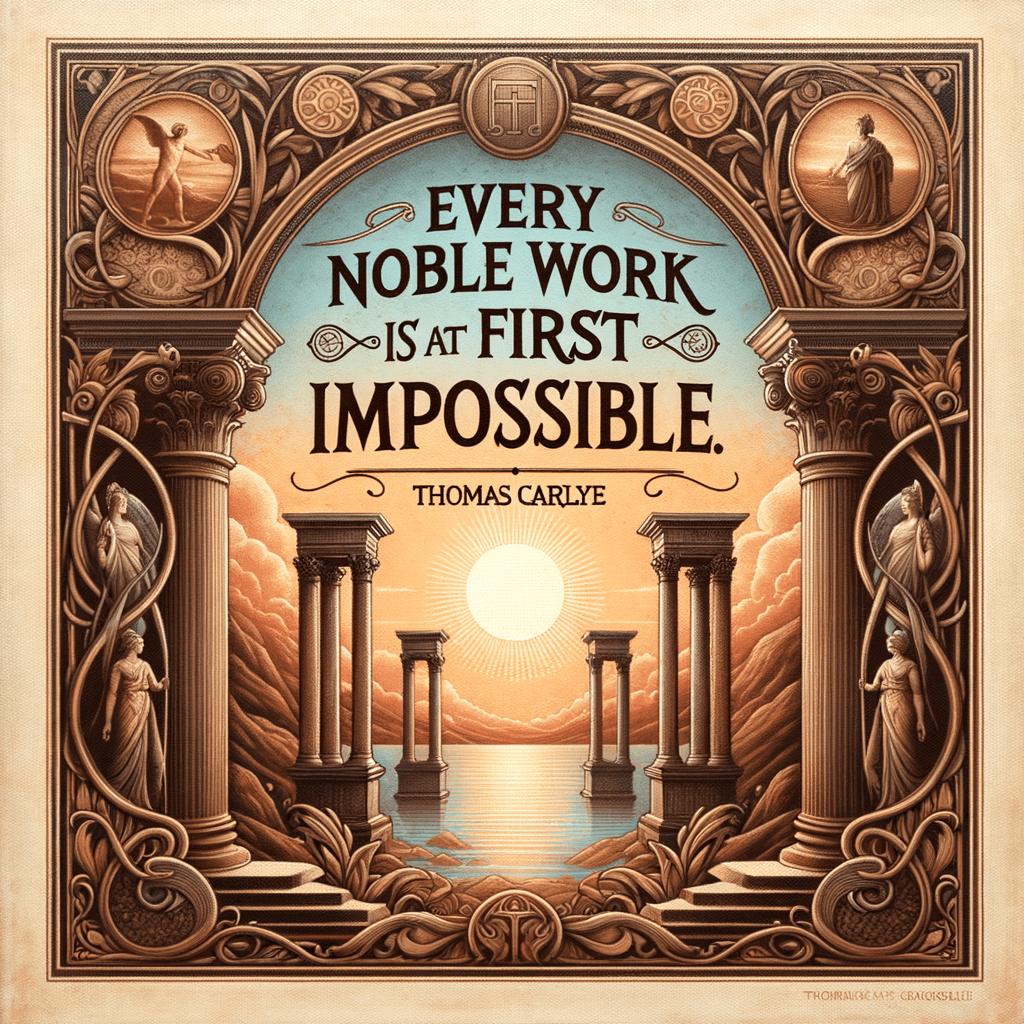
Every noble work is at first impossible. — Thomas Carlyle
—What lingers after this line?
Overcoming Challenges
This quote highlights that significant and honorable achievements often appear unattainable at the outset. It underscores the importance of perseverance and determination in facing initial difficulties and obstacles.
Vision and Ambition
It emphasizes the ambitious nature of noble works. Great accomplishments start as grand visions or aspirations that seem beyond reach, but with effort and persistence, they can be realized.
Growth Through Struggle
The quote suggests that the process of striving to achieve something noble inherently involves struggle. Through this struggle, individuals grow and develop the resilience needed to overcome what once seemed impossible.
Inspirational Perspective
Carlyle’s words serve as a source of inspiration for those embarking on challenging endeavors. They remind individuals that initial impossibilities should not discourage them but rather motivate them to persist and succeed.
Historical Context
Thomas Carlyle was a 19th-century Scottish essayist, historian, and philosopher. His works often addressed themes of heroism, work ethic, and the human spirit, reflecting the Romantic ideals of his time.
Recommended Reading
As an Amazon Associate, we earn from qualifying purchases.
One-minute reflection
What's one small action this suggests?
Related Quotes
6 selectedGo as far as you can see; when you get there, you'll be able to see further. — Thomas Carlyle
Thomas Carlyle
This quote encourages the belief that progress is made incrementally. As you reach your current limits, new opportunities and possibilities will become visible, allowing you to continue growing.
Read full interpretation →Everything seems impossible until it is done. - Nelson Mandela
Nelson Mandela
This quote highlights the notion that difficult tasks often seem insurmountable at first. However, with perseverance and determination, what once seemed impossible can ultimately be achieved.
Read full interpretation →Consistency is not a grand, dramatic act; it is the small, boring choice to show up again even when your internal weather is stormy. — Atomic Habits (James Clear)
Atomic Habits (James Clear
James Clear’s line from Atomic Habits reframes consistency as something far less glamorous than popular culture often suggests. Rather than a heroic burst of motivation, it is the ordinary decision to return to the task,...
Read full interpretation →Anything worth having is worth waiting for, and everything worth doing is worth doing with patience. — Confucius
Confucius
At its core, this saying ties value to delay. Confucius suggests that truly meaningful things do not arrive instantly; instead, they ask us to endure uncertainty, effort, and time.
Read full interpretation →The world belongs to the energetic. — Ralph Waldo Emerson
Ralph Waldo Emerson
Emerson’s line condenses an entire philosophy into a few words: the world tends to yield itself to those who move with vigor, initiative, and persistence. At first glance, “the energetic” may sound like people blessed wi...
Read full interpretation →True craftsmanship is found in the willingness to return to the task, not for perfection, but for the beauty of the work itself. — Ursula K. Le Guin
Ursula K. Le Guin
At its core, Ursula K. Le Guin’s statement shifts attention away from flawless results and toward a deeper kind of dedication.
Read full interpretation →More From Author
More from Thomas Carlyle →Go as far as you can see; when you get there, you'll be able to see further. — Thomas Carlyle
This quote encourages the belief that progress is made incrementally. As you reach your current limits, new opportunities and possibilities will become visible, allowing you to continue growing.
Read full interpretation →No pressure, no diamonds. — Thomas Carlyle
This quote implies that just like diamonds are formed under pressure, true personal growth, achievement, and beauty often come from facing and overcoming challenges.
Read full interpretation →Blessed is the man who has found his work; let him ask no other blessedness. — Thomas Carlyle
Carlyle suggests that true happiness or blessedness comes from finding meaningful work.
Read full interpretation →Adversity is the diamond dust Heaven polishes its jewels with. — Thomas Carlyle
Carlyle likens difficulty to diamond dust, the substance used to polish and perfect gemstones. This metaphor suggests that hardships, rather than diminishing a person's value, actually refine and enhance one's character.
Read full interpretation →