
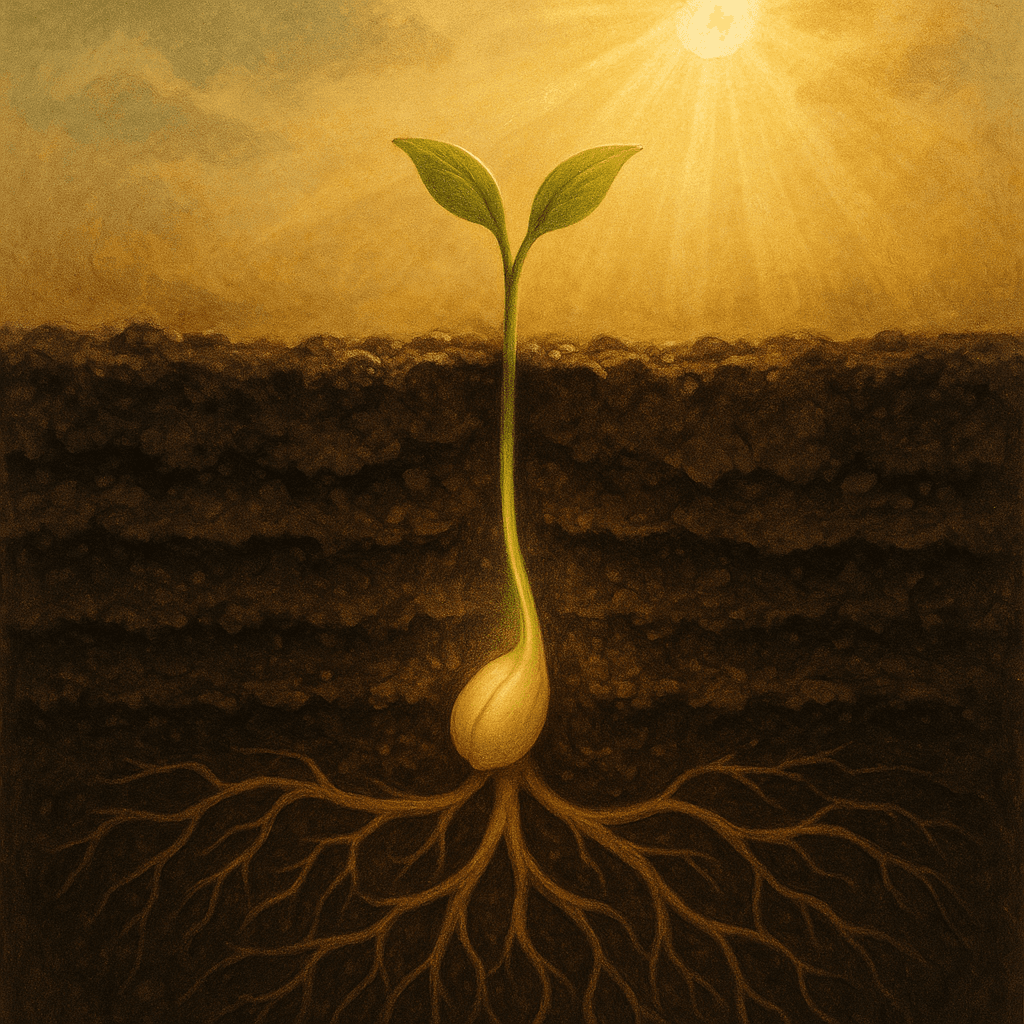
Growth whispers softly in the language of perseverance. — Chimamanda Ngozi Adichie
—What lingers after this line?
Growth as a Gentle Transformation
At the core of Adichie’s observation lies the idea that growth rarely announces itself with fanfare. Instead, progress often occurs in small, almost imperceptible increments. This quiet transformation might be overlooked, yet it accumulates power over time—gradually reshaping an individual’s skills, character, or worldview.
Perseverance as the Unseen Engine
Flowing from this notion is the understanding that perseverance acts as the engine behind enduring change. Rather than grand gestures, it is the patient, repeated effort that moves us forward. As in Maya Angelou’s autobiography, ‘I Know Why the Caged Bird Sings’ (1969), small daily acts of resilience gradually enable transformation, even amid adversity.
Quiet Persistence in Everyday Life
Expanding on this, the language of perseverance is neither loud nor boastful. Its presence can be observed in the student who reviews material one more time, the artist who refines a draft for weeks, or the activist who refuses to abandon a cause despite setbacks. Their steady actions often go unnoticed, but each repetition cements growth more deeply.
Cultural and Personal Resonance
Furthermore, Adichie’s Nigerian heritage and her literary works repeatedly highlight perseverance as a cultural and personal force. In her novel ‘Half of a Yellow Sun’ (2006), characters endure political and personal upheaval through sustained courage. This illustrates how perseverance, though quiet, is a powerful catalyst for both survival and flourishing within communities.
Embracing Subtlety in Self-Development
Ultimately, recognizing growth means embracing its nuanced, subtle nature. In a world that prizes quick results, Adichie’s words remind us that self-improvement often arises from persistence rather than dramatic breakthroughs. By listening for these ‘soft whispers’ of perseverance in our own lives, we learn to appreciate the profound, gentle power of true growth.
One-minute reflection
What's one small action this suggests?
Related Quotes
6 selectedMake today the workshop where your best self is assembled piece by piece. — Chimamanda Ngozi Adichie
Chimamanda Ngozi Adichie
Chimamanda Ngozi Adichie’s line turns “today” from a deadline into a worksite: a place where something is being made. Instead of waiting for a future version of life to begin, she suggests the present is where constructi...
Read full interpretation →We make progress by turning intentions into habits and habits into change. — Chimamanda Ngozi Adichie
Chimamanda Ngozi Adichie
Adichie’s line traces a clear arc: resolve is not enough until it crystallizes into repeatable behavior. This advances a classic problem in psychology—the intention–behavior gap—where good aims stall without structure.
Read full interpretation →Consistency is a superpower. — Ryan Holiday
Ryan Holiday
Ryan Holiday’s line begins with a deceptively simple idea: greatness is rarely built through dramatic gestures. More often, it emerges from repeated actions that seem ordinary in isolation but become extraordinary over t...
Read full interpretation →A good-enough novel violently written now is better than a perfect novel meticulously written never. — Elizabeth Gilbert
Elizabeth Gilbert
Elizabeth Gilbert’s line immediately shifts the argument from artistic purity to artistic existence. A “good-enough” novel, even one “violently written,” has entered the world and can move, provoke, or comfort someone; b...
Read full interpretation →Confidence is silent. Insecurities are loud. — Unknown (Wait—skip/replace with: True nobility is being superior to your former self. — Ernest Hemingway)
Ernest Hemingway
At its core, Hemingway’s line redefines nobility as an inward achievement rather than a social rank. Instead of measuring worth by wealth, pedigree, or dominance over others, it points to a quieter standard: becoming bet...
Read full interpretation →There is no road too long to the man who advances deliberately and without undue haste; there are no honors too distant to the man who prepares himself for them with patience. — Jean de La Bruyère
Jean de La Bruyère
At its core, La Bruyère’s line praises steady movement over restless speed. A long road feels intimidating only when seen all at once; once it is broken into deliberate steps, distance loses much of its power.
Read full interpretation →More From Author
More from Chimamanda Ngozi Adichie →To love is to recognize that another person is a separate universe, and yet to choose, daily, to walk through it beside them. — Chimamanda Ngozi Adichie
At its heart, Adichie’s line defines love not as possession but as perception. To love someone is first to grasp that they are irreducibly distinct: a ‘separate universe’ with their own memories, fears, loyalties, and in...
Read full interpretation →True milestones are not found in our public achievements, but in the quiet, transformative moments of connection we share with those we hold dear. — Chimamanda Ngozi Adichie
At first glance, Adichie’s quote gently overturns a common modern assumption: that the most important markers of a life are public victories, titles, or visible accomplishments. Instead, she redirects our attention towar...
Read full interpretation →Your job is not to be likable. Your job is to be yourself. — Chimamanda Ngozi Adichie
Adichie’s line begins by stripping away a common social bargain: if you act agreeable enough, you’ll be accepted. By saying your job is not to be “likable,” she points to how easily a person can become an employee of oth...
Read full interpretation →Make today the workshop where your best self is assembled piece by piece. — Chimamanda Ngozi Adichie
Chimamanda Ngozi Adichie’s line turns “today” from a deadline into a worksite: a place where something is being made. Instead of waiting for a future version of life to begin, she suggests the present is where constructi...
Read full interpretation →