
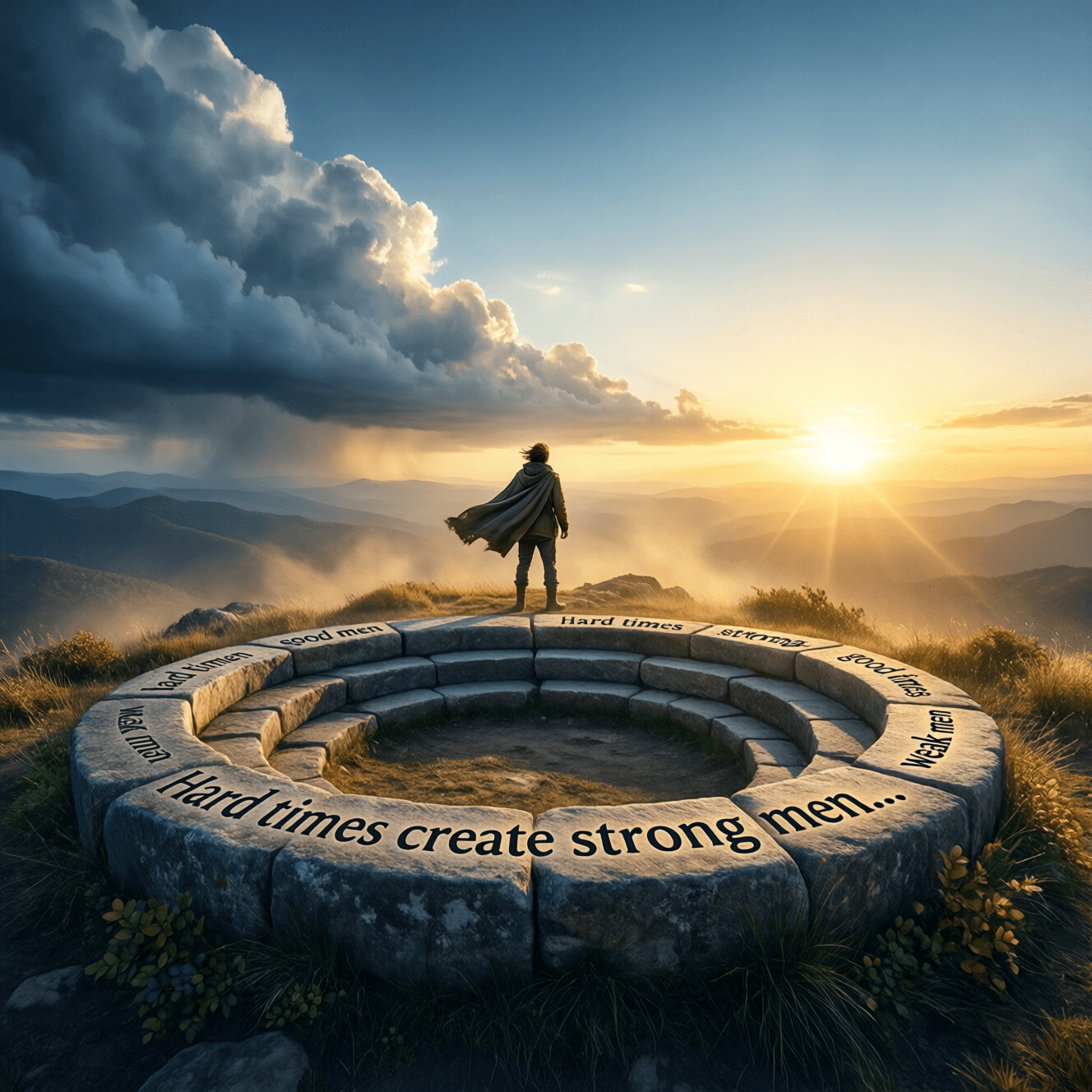
Hard times create strong men. Strong men create good times. Good times create weak men. And, weak men create hard times. — G. Michael Hopf
—What lingers after this line?
A Four-Stage Cycle of Society
Hopf’s quote frames history as a repeating loop in which conditions and character continually remake each other. It begins with hardship forging people who are disciplined, resourceful, and willing to sacrifice; those traits then help build stability and abundance. Yet, as comfort becomes normal, the urgency that once demanded resilience fades, and a softer, less prepared generation emerges. From there, the cycle completes itself: diminished competence and cohesion make societies more vulnerable, inviting new hardship that restarts the process.
Why Hard Times Can Produce Strength
To understand the first turn of the cycle, consider what scarcity forces people to practice: delayed gratification, cooperation, practical skills, and clear priorities. When survival is uncertain, waste becomes costly and responsibility becomes non-negotiable, so habits of self-control and mutual reliance are rewarded. In that sense, “strong” does not only mean physical toughness, but also psychological endurance—the capacity to tolerate stress without collapsing. As the pressure continues, those traits become cultural norms, and that collective hardiness can translate into real social rebuilding.
How Strength Creates Good Times
Once a population values competence and responsibility, institutions often reflect it through higher trust, stronger work ethics, and a willingness to invest in long-term projects. This is where “good times” emerge: security improves, productivity rises, and systems become more efficient because people believe effort matters and corruption is less tolerated. After major upheavals, many societies have experienced bursts of reconstruction that feel like proof of Hopf’s claim—hard-earned habits get converted into stability. However, this transition also plants the seeds of the next stage, because success changes what people expect life to feel like.
When Good Times Breed Complacency
As prosperity persists, the memory of danger becomes abstract and the skills built for survival can start to look unnecessary or even old-fashioned. Comfort allows more room for distraction, entitlement, and risk-blind decision-making, especially when systems seem sturdy enough to absorb mistakes. Moreover, children raised in safety may not internalize the same urgency that shaped their parents; they inherit outcomes without fully inheriting the disciplines that produced them. Gradually, “weakness” appears less as moral failure and more as a predictable byproduct of abundance and distance from hardship.
How Weakness Invites Hard Times Again
The final turn of the cycle suggests that when a society loses resilience—skills, unity, prudence, and trust—it becomes fragile under stress. Then shocks that might once have been manageable, such as economic crises, political polarization, or external threats, can cascade into deeper dysfunction because fewer people are prepared to respond constructively. In this stage, short-term thinking may replace stewardship, and institutions may be strained by cynicism or incompetence. Eventually, hardship returns, and the renewed pressure begins shaping a tougher ethos again—though the cost of relearning can be severe.
Reading the Quote as a Warning, Not a Law
Although the cycle is compelling, it works best as a cautionary narrative rather than a strict historical rule. Not every era fits neatly, and “strength” can curdle into brutality while “good times” can also enable education, innovation, and moral progress that prevent collapse. Still, Hopf’s point retains force as practical guidance: societies that want to keep “good times” must deliberately cultivate resilience—through responsibility, civic virtue, and real preparation—so prosperity doesn’t erase the very qualities that made it possible.
Recommended Reading
As an Amazon Associate, we earn from qualifying purchases.
One-minute reflection
What feeling does this quote bring up for you?
Related Quotes
6 selectedTrue strength is not about never falling—it is about staying composed, learning from challenges, and continuing forward with a calm and focused mind. — Ben Okri
Ben Okri
At first glance, strength is often imagined as invulnerability, the ability to resist every blow without wavering. Ben Okri’s insight gently overturns that assumption by suggesting that real strength appears not in perfe...
Read full interpretation →Recovery isn't linear. You are not behind; you are rebuilding. — Anne Wright
Anne Wright
At its core, Anne Wright’s quote pushes back against a common and damaging assumption: that healing should move neatly upward, without setbacks or pauses. By saying recovery “isn’t linear,” she reframes difficult days no...
Read full interpretation →It does not matter what you bear, but how you bear it. — Seneca
Seneca
At its heart, Seneca’s remark shifts attention away from suffering itself and toward character. Misfortune, pain, and limitation are often beyond human control, yet our response remains a moral choice.
Read full interpretation →Peace is not freedom from the storm, but peace amid the storm. — Martin Luther King Jr.
Martin Luther King Jr.
Martin Luther King Jr.’s words redefine peace as something deeper than comfort or calm surroundings. Rather than imagining peace as the total absence of conflict, pain, or uncertainty, he presents it as an inner steadine...
Read full interpretation →Yield and overcome, bend and be straight. — Lao Tzu
Lao Tzu
At first glance, Lao Tzu’s line seems contradictory: how can yielding lead to overcoming, or bending result in straightness? Yet this paradox lies at the heart of Taoist thought.
Read full interpretation →A blazing fire makes flame and brightness out of everything that is thrown into it. — Marcus Aurelius
Marcus Aurelius
Marcus Aurelius compresses a central Stoic lesson into a vivid image: a strong fire does not merely endure what is cast into it, but transforms it into more flame and light. In that sense, adversity is not just something...
Read full interpretation →More From Author
More from G. Michael Hopf →