
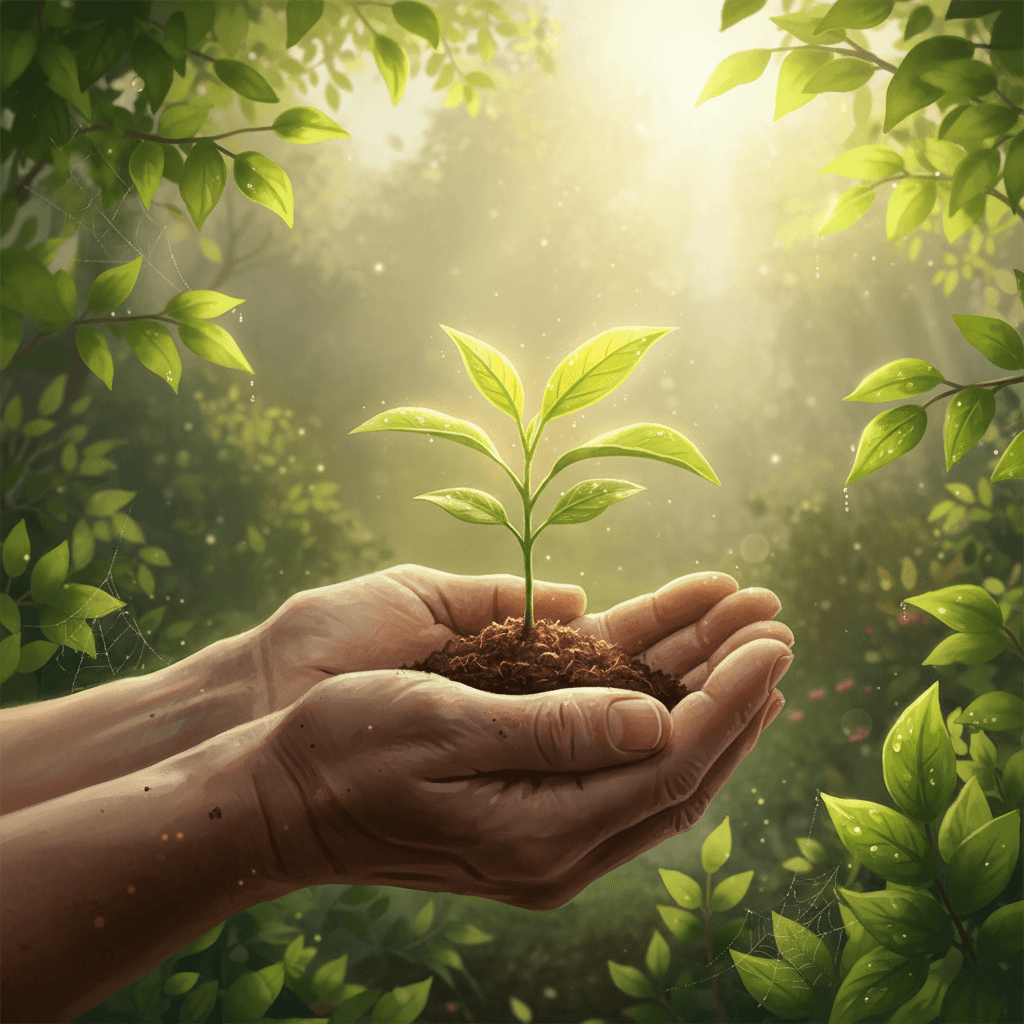
Hold the future gently and tend to it with persistent hands — Anaïs Nin
—What lingers after this line?
A Future That Requires Care, Not Control
Anaïs Nin’s line, “Hold the future gently and tend to it with persistent hands,” invites us to rethink how we relate to what has not yet happened. Instead of gripping the future with anxiety or attempting to dominate it through rigid plans, she suggests an attitude of careful stewardship. Much like cradling a fragile object, holding the future gently implies respect for uncertainty, an openness to surprise, and a refusal to crush possibilities through fear. At the same time, the image of tending with persistent hands rejects passivity, reminding us that tomorrow is not a distant abstraction but something continuously shaped by what we do today.
Gentleness as a Form of Strength
Though often mistaken for weakness, gentleness here becomes a deliberate strength. By holding the future gently, we admit our limits while still choosing to act. This stance echoes the patient, nonviolent strength described by figures like Mahatma Gandhi, whose approach in the 20th century relied on steady, principled action rather than brute force. In everyday life, such gentleness might appear in how we approach new ventures, relationships, or personal changes: we experiment, listen, and learn rather than forcing outcomes. Thus, Nin’s phrase suggests that true resilience lies not in hardening ourselves, but in remaining soft enough to adapt.
Persistence: The Daily Craft of Becoming
Yet, Nin balances gentleness with the call for “persistent hands,” pointing toward steady, almost humble effort. Persistence here is not frantic striving but the daily craft of becoming—small, repeated actions accumulating over time. James Clear’s modern discussion of “atomic habits” (2018) illustrates a similar idea: minor, consistent improvements can produce profound change. By framing our work on the future as tending, like a gardener returning each morning to water and prune, Nin emphasizes that what matters most is not a single heroic act, but an ongoing willingness to show up, try again, and refine our approach.
Stewardship of Self, Others, and the World
From this perspective, the “future” is not just our private fate; it encompasses the lives of others and the planet we share. Holding it gently can mean mentoring younger people without imposing our fears, choosing sustainable practices that protect ecosystems, or building communities rooted in mutual care. Historical movements for social progress—from civil rights campaigns to environmental activism—embody this dual mandate: they insist on persistent effort while cherishing the vulnerable possibilities of a more just world. Nin’s image reminds us that each choice, however small, is a form of tending that either nurtures or neglects what comes next.
Living Today With Tomorrow in Mind
Ultimately, Nin’s statement weaves together presence and foresight, urging us to live today as gardeners of tomorrow. Holding the future gently means accepting that outcomes cannot be fully scripted, which frees us to act with creativity rather than paralysis. Meanwhile, tending with persistent hands means resisting the temptation to disengage when progress feels slow or invisible. By integrating both qualities—softness and stamina—we craft a wiser posture toward time itself. In doing so, we treat the future not as a looming threat or a distant dream, but as a living seed entrusted to our ongoing care.
One-minute reflection
What's one small action this suggests?
Related Quotes
6 selectedIf we are facing in the right direction, all we have to do is keep walking. — Thích Nhất Hạnh
Thich Nhat Hanh
Thích Nhất Hạnh’s words begin with a simple but profound premise: progress depends first on direction, not speed. If a person is turned toward compassion, clarity, healing, or truth, then each modest step becomes meaning...
Read full interpretation →Do the best one can. Do it over again. Then still improve, even if ever so slightly, those retouches. — Marguerite Yourcenar
Marguerite Yourcenar
Yourcenar’s words begin with a simple demand: do the best one can. Yet she immediately refuses to let effort become an excuse for stopping.
Read full interpretation →A good-enough novel violently written now is better than a perfect novel meticulously written never. — Elizabeth Gilbert
Elizabeth Gilbert
Elizabeth Gilbert’s line immediately shifts the argument from artistic purity to artistic existence. A “good-enough” novel, even one “violently written,” has entered the world and can move, provoke, or comfort someone; b...
Read full interpretation →There is no road too long to the man who advances deliberately and without undue haste; there are no honors too distant to the man who prepares himself for them with patience. — Jean de La Bruyère
Jean de La Bruyère
At its core, La Bruyère’s line praises steady movement over restless speed. A long road feels intimidating only when seen all at once; once it is broken into deliberate steps, distance loses much of its power.
Read full interpretation →There are no soft grounds in life. Just places to water and plough. — Athésia
Athésia
At first glance, Athésia’s line dismisses the hope that life might eventually deliver a permanently gentle terrain. There are, in this view, no naturally soft grounds waiting for us—no stage where effort disappears and g...
Read full interpretation →A farmer is helpless to grow grain; all he can do is provide the right conditions for the growing of grain. — Richard J. Foster
Richard J. Foster
At first glance, Foster’s farming metaphor shifts attention away from control and toward humility. A farmer cannot command a seed to sprout, just as a person cannot force true growth—whether spiritual, personal, or relat...
Read full interpretation →More From Author
More from Anaïs Nin →Perfection is static, and I am in full progress. — Anaïs Nin
Anaïs Nin’s line immediately contrasts two ways of being: perfection, which she calls static, and progress, which she embraces as alive and ongoing. In that contrast, she challenges the common fantasy that a flawless sel...
Read full interpretation →Each friend represents a world in us, a world possibly not born until they arrive, and it is only by this meeting that a new world is born. — Anais Nin
Anaïs Nin’s reflection begins with a striking premise: each person contains unrealized possibilities, as though entire inner worlds lie dormant beneath ordinary life. In this view, friendship is not merely companionship...
Read full interpretation →We are the architects of our own perception; the world looks the way we choose to frame it. — Anais Nin
Anaïs Nin’s statement begins with a striking reversal: instead of treating perception as a passive mirror, she presents it as an act of construction. In other words, we do not simply receive the world; we organize, inter...
Read full interpretation →Where people fail is that they wish to elect a state and remain in it. — Anaïs Nin
Anaïs Nin points to a common human temptation: treating life as a set of destinations rather than an unfolding process. We imagine that if we can finally “elect a state”—confidence, happiness, success, certainty—we can s...
Read full interpretation →