
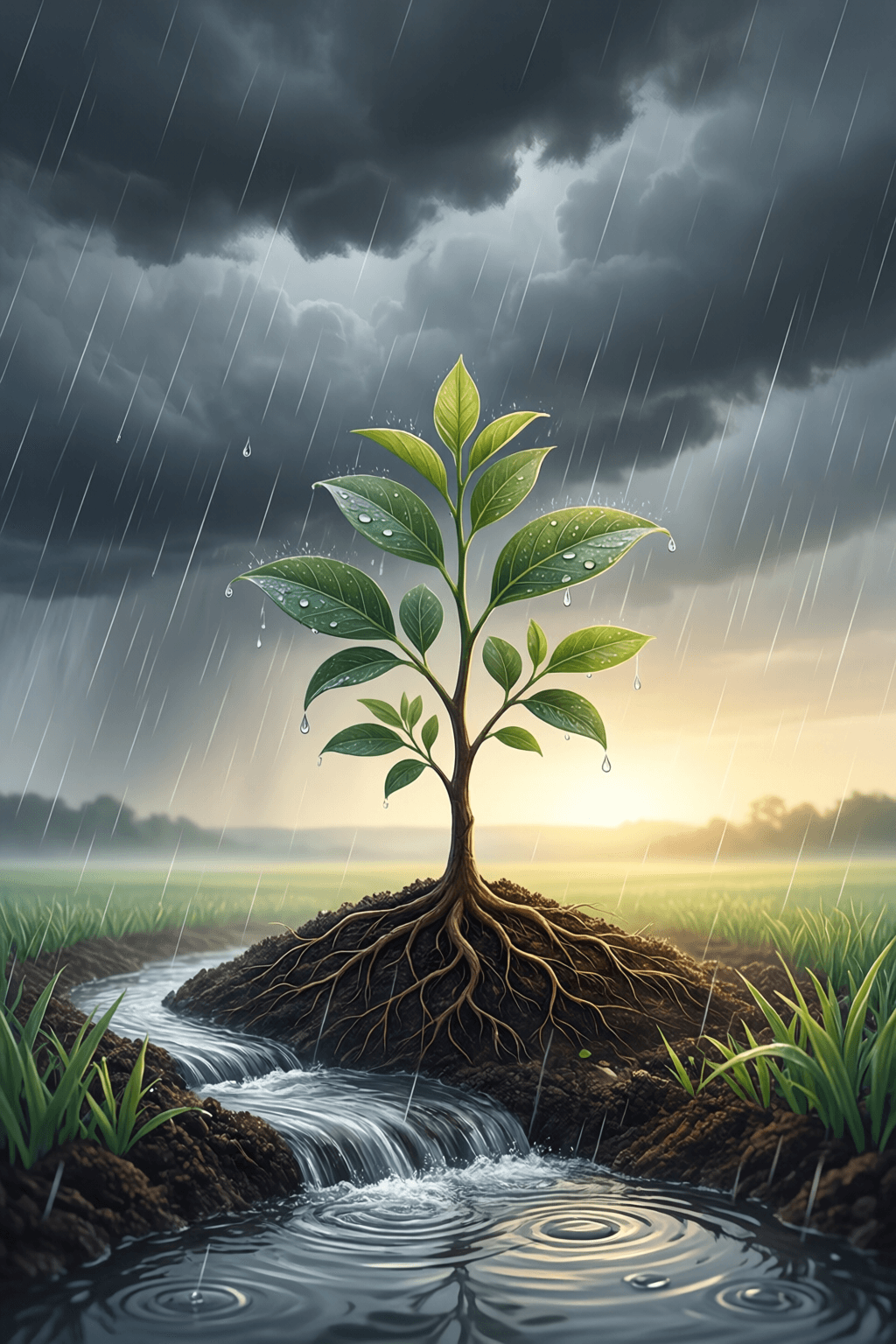
Resilience is not just enduring the storm; it is learning to harvest the rain to nourish the roots you've already planted. — Elizabeth Edwards
—What lingers after this line?
Beyond Mere Survival
At first glance, Elizabeth Edwards rejects the common image of resilience as simple endurance. To ‘endure the storm’ suggests gritting one’s teeth and waiting for suffering to pass, yet her metaphor quickly moves further: true resilience transforms adversity into something useful. In this view, hardship is not only weather to survive but also a source of nourishment, if one learns how to receive it. This shift matters because it changes resilience from passivity into creativity. Rather than being defined by how much pain a person can absorb, resilience becomes the skill of responding meaningfully to disruption. The quote therefore invites us to see strength not as stiffness, but as adaptability rooted in purpose.
The Meaning of Harvesting the Rain
From there, the image of ‘harvesting the rain’ deepens the idea. Rain often arrives with storms, and storms are rarely welcome, yet rain also sustains life. Edwards suggests that painful experiences may carry lessons, perspective, discipline, or compassion that can later feed a stronger self. What first appears destructive may also contain hidden provisions. Similarly, many memoirs of recovery echo this pattern. Viktor Frankl’s Man’s Search for Meaning (1946) argues that even suffering can be shaped into meaning when a person discovers a purpose within it. In that sense, harvesting the rain does not romanticize pain; instead, it means refusing to let pain be wasted.
Roots Already Planted
Just as important, the quote emphasizes ‘the roots you’ve already planted.’ This phrase implies prior labor, values, and commitments established before the storm arrived. Resilience does not begin in crisis alone; it draws from foundations already laid—relationships, habits, beliefs, skills, and long-term hopes that remain alive beneath the surface. Because of this, the metaphor honors preparation as much as recovery. A tree survives heavy weather not only because rain falls, but because roots are deep enough to receive it. In human terms, those roots might be family bonds, spiritual practice, education, or self-knowledge. The storm tests them, but it can also strengthen them.
Growth Through Adversity
Consequently, Edwards’s words align with modern discussions of post-traumatic growth. Psychologists Richard Tedeschi and Lawrence Calhoun, writing in the 1990s, described how some people emerge from crisis with renewed appreciation for life, deeper relationships, and clearer priorities. Their research does not deny trauma’s damage; rather, it shows that growth can coexist with pain. This makes the quote especially powerful because it avoids sentimental optimism. Rain nourishes roots, but only through a difficult process involving disruption, saturation, and patience. In the same way, resilience is rarely neat or immediate. It often appears gradually, as suffering is worked into wisdom.
A Practical Philosophy of Strength
Ultimately, the quote offers a practical philosophy for living. When hardship arrives, the question is not only ‘How do I get through this?’ but also ‘What can this teach, deepen, or redirect in me?’ That change in perspective can turn crisis into cultivation, allowing pain to serve life rather than only threaten it. In everyday experience, people often describe this process after illness, grief, or failure: they would not have chosen the storm, yet they learned patience, tenderness, or courage because of it. Edwards captures that hard-won truth elegantly. Resilience, then, is not the denial of suffering, but the art of making suffering feed what matters most.
One-minute reflection
Where does this idea show up in your life right now?
Related Quotes
6 selectedShe stood in the storm, and when the wind did not blow her way, she adjusted her sails. — Elizabeth Edwards
Elizabeth Edwards
Elizabeth Edwards’ image begins with a person who does not flee difficulty: she “stood in the storm.” Rather than framing hardship as a signal to stop, the line treats adversity as a setting in which character is reveale...
Read full interpretation →We are gardeners of our own resilience, tending to the soil of our minds with the quiet, persistent care that growth requires. — Robin Wall Kimmerer
Robin Wall Kimmerer
Robin Wall Kimmerer’s image begins by turning resilience into something living rather than fixed. Instead of portraying strength as hard armor, she imagines it as a garden that must be tended, suggesting that the mind is...
Read full interpretation →True resilience isn't just about pushing through; it's the intelligent management of your energy so you don't break. — Brené Brown
Brené Brown
At first glance, resilience is often mistaken for sheer endurance—the ability to keep going no matter the cost. Brené Brown’s quote gently corrects that assumption by suggesting that real strength lies not in endless pus...
Read full interpretation →Resilience is accepting your new reality, even if it’s less good than the one you had before. — Elizabeth Edwards
Elizabeth Edwards
This quote defines resilience as the ability to adapt to new circumstances. It emphasizes that true resilience involves acknowledging and accepting changes, even when they are not favorable.
Read full interpretation →Resilience is not a single skill. It is a variety of tools, a way of being, and a choice to adapt your sails when the wind refuses to blow your way. — Jean Chatzky
Jean Chatzky
At first glance, Jean Chatzky’s quote rejects the comforting idea that resilience is a single inborn gift. Instead, it presents resilience as something broader and more practical: a collection of tools, habits, and attit...
Read full interpretation →Mental wellness is not about eliminating difficulty; it is about increasing our capacity to move through it. — Village-Connect
Connect
At first glance, mental wellness is often mistaken for a life free of stress, sadness, or conflict. Yet the Village-Connect quote reframes wellness as something more realistic and empowering: not the absence of difficult...
Read full interpretation →More From Author
More from Elizabeth Edwards →She stood in the storm, and when the wind did not blow her way, she adjusted her sails. — Elizabeth Edwards
Elizabeth Edwards’ image begins with a person who does not flee difficulty: she “stood in the storm.” Rather than framing hardship as a signal to stop, the line treats adversity as a setting in which character is reveale...
Read full interpretation →Resilience is accepting your new reality, even if it’s less good than the one you had before. — Elizabeth Edwards
This quote defines resilience as the ability to adapt to new circumstances. It emphasizes that true resilience involves acknowledging and accepting changes, even when they are not favorable.
Read full interpretation →