
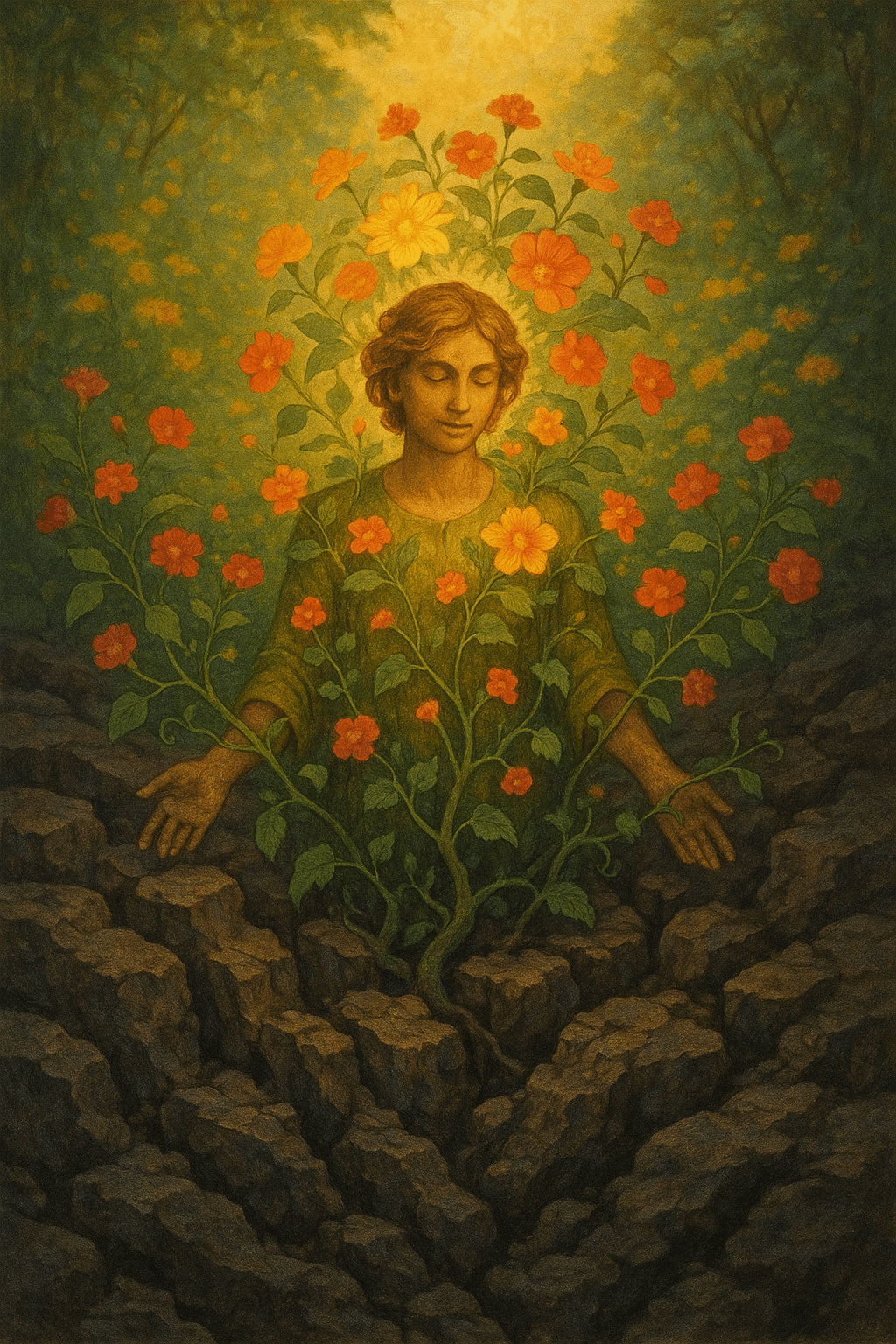
Struggle is the gardener that makes the soul bloom. — Rumi
—What lingers after this line?
Rumi’s Metaphor of Growth Through Hardship
Rumi, the celebrated 13th-century Sufi poet, often explored themes of transformation in his writings. By likening struggle to a gardener, he suggests adversity is not a mere obstacle but a nurturing force. Just as a gardener tends, prunes, and sometimes uproots to encourage healthy blooms, difficulties in life cultivate resilience and beauty within the soul.
Historical Perspectives on Adversity
This idea echoes through philosophical history: in Stoicism, Epictetus (c. 100 AD) argued that hardship is essential for developing virtue. Similarly, Friedrich Nietzsche later wrote, 'What does not kill me, makes me stronger.' Both thinkers, like Rumi, emphasize that genuine strength and character emerge from enduring challenges, rather than avoiding them.
Transformation and Self-Discovery
Building upon this, struggle acts as a catalyst for self-discovery. Psychological research shows that individuals often find deeper meaning and personal growth after facing significant hardships, a phenomenon known as post-traumatic growth (Tedeschi & Calhoun, 1996). Much as a seed breaks open before it sprouts, the soul too may need adversity to reveal its fullest expression.
Spiritual Resonances in Rumi’s Teachings
From a spiritual perspective, Rumi’s metaphor aligns with Sufi concepts of purification and divine love. He believed that suffering strips away the ego, clearing the way for compassion and wisdom to flourish. For example, Rumi’s own heartbreak after Shams of Tabriz’s departure is often credited with inspiring his most profound poetry and spiritual insights.
Embracing Struggle for Personal Renewal
Ultimately, recognizing struggle as a nurturing gardener transforms one’s outlook on difficulties. Rather than dreading challenges, individuals can view them as opportunities for renewal and blossoming. This mindset, championed by Rumi, invites us to embrace our struggles with grace, trusting that each hardship has the potential to cultivate a more resilient and radiant spirit.
One-minute reflection
What's one small action this suggests?
Related Quotes
6 selectedWe are gardeners of our own resilience, tending to the soil of our minds with the quiet, persistent care that growth requires. — Robin Wall Kimmerer
Robin Wall Kimmerer
Robin Wall Kimmerer’s image begins by turning resilience into something living rather than fixed. Instead of portraying strength as hard armor, she imagines it as a garden that must be tended, suggesting that the mind is...
Read full interpretation →Don't fight the challenges. Just find a new way to stand. — Germany Kent
Germany Kent
Germany Kent’s words begin with a quiet reversal of instinct: instead of treating every challenge as an enemy to defeat, she invites us to reconsider our posture toward difficulty. The emphasis is not on surrender, but o...
Read full interpretation →Optimist: someone who figures that taking a step backward after taking a step forward is not a disaster, it's more like a cha-cha. — Robert Brault
Robert Brault
Robert Brault’s line begins with a witty redefinition: an optimist is not someone who denies backward motion, but someone who interprets it differently. Instead of treating a setback as proof of failure, the optimist see...
Read full interpretation →A mind grows by staying with difficulty long enough for the experience to change it. — Mary Catherine Bateson
Mary Catherine Bateson
Mary Catherine Bateson’s observation begins with a quiet but demanding truth: the mind does not grow merely by encountering difficulty, but by remaining with it. Challenge becomes transformative only when we resist the u...
Read full interpretation →When you are friends with your storm, you dance, instead of getting blown away. — Michael Bassey Johnson
Michael Bassey Johnson
Michael Bassey Johnson’s line begins with a striking reversal: the storm is not merely an enemy to survive, but a force one can learn to understand. In this sense, the storm may represent grief, fear, conflict, uncertain...
Read full interpretation →Just because your light flickers does not mean it is about to go out. — Yohancé Salimu
Yohancé Salimu
At first glance, Yohancé Salimu’s line separates appearance from reality. A flicker suggests instability, fatigue, or interruption, yet it does not automatically signal extinction.
Read full interpretation →More From Author
More from Rumi →Everything that happens is a form of instruction if you choose to listen. — Rumi
At its core, Rumi’s line reframes ordinary experience as a living classroom. Nothing is merely random noise if one approaches it with attention; instead, each success, disappointment, encounter, or delay carries the poss...
Read full interpretation →Do not mistake movement for progress; a spinning top stays in one place, while a seed grows by staying rooted in the dark. — Rumi
Rumi’s image draws an immediate contrast between busyness and true development. A spinning top dazzles with speed and motion, yet it remains fixed in essentially the same place.
Read full interpretation →You don't need to escape the chaos to find peace—it's already inside you, waiting to be remembered. — Rumi
At first glance, Rumi’s line overturns a common assumption: that peace must be found by fleeing noise, conflict, or uncertainty. Instead, he suggests that peace is not an external destination but an inner condition alrea...
Read full interpretation →Confidence is silent. Insecurities are loud. Do not feel the need to broadcast your worth to a world that doesn't understand your path. — Rumi
At its core, this saying contrasts two very different emotional states: confidence, which rests quietly within, and insecurity, which seeks constant outward expression. The point is not that confident people never speak,...
Read full interpretation →