
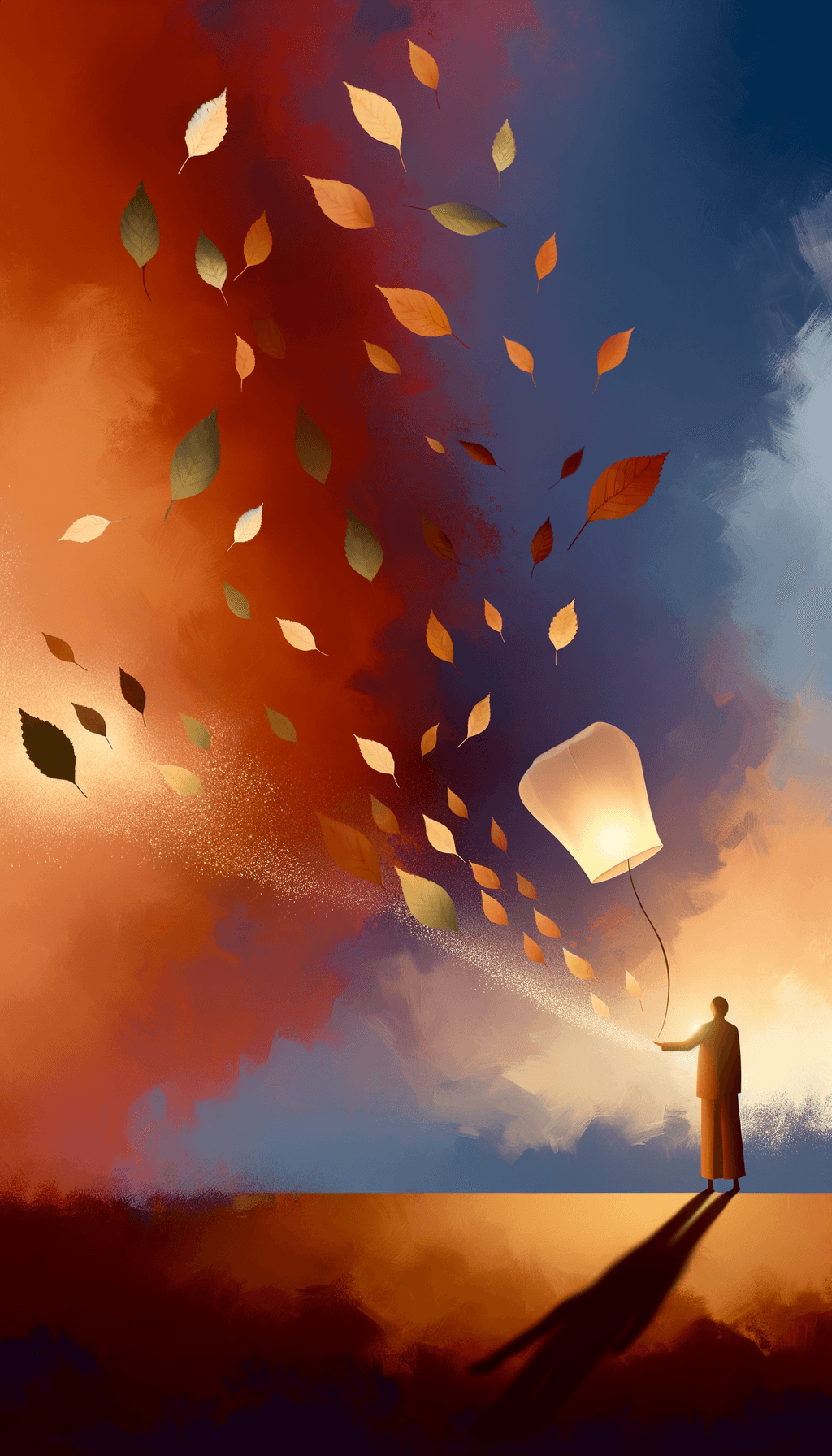
The art of living lies in a fine mingling of letting go and holding on. — Henry Havelock Ellis
—What lingers after this line?
Balance in Life
This quote highlights the importance of balance in life. It suggests that true wisdom comes from knowing when to relinquish control and when to persist, finding harmony in both actions.
Personal Growth
Letting go allows for new opportunities and self-discovery, while holding on provides stability and continuity. A successful life is shaped by understanding when to embrace change and when to remain steadfast.
Emotional Resilience
Navigating life effectively requires emotional resilience. Letting go of past burdens while holding onto meaningful relationships and values helps maintain emotional well-being.
Adaptability and Strength
This quote suggests that adaptability is key to success. Being too rigid or too passive can hinder progress, so a blend of persistence and flexibility is necessary for overcoming challenges.
Philosophical Outlook
Henry Havelock Ellis, a British psychologist and writer, often explored themes of human development and emotional well-being. His perspective encourages a balanced approach to life, combining acceptance with determination.
One-minute reflection
What feeling does this quote bring up for you?
Related Quotes
6 selectedSelf-mastery rarely looks impressive. It simply holds. — James Clear
James Clear
James Clear’s observation begins by stripping self-mastery of glamour. It is not usually a heroic moment, a public triumph, or a dramatic display of willpower.
Read full interpretation →When I hear somebody sigh, 'Life is hard,' I am always tempted to ask, 'Compared to what?' — Sydney J. Harris
Sydney J. Harris
Sydney J. Harris’s remark begins with an ordinary expression of fatigue: “Life is hard.” Yet his response, “Compared to what?” quietly turns complaint into inquiry.
Read full interpretation →Don't fight the challenges. Just find a new way to stand. — Germany Kent
Germany Kent
Germany Kent’s words begin with a quiet reversal of instinct: instead of treating every challenge as an enemy to defeat, she invites us to reconsider our posture toward difficulty. The emphasis is not on surrender, but o...
Read full interpretation →Optimist: someone who figures that taking a step backward after taking a step forward is not a disaster, it's more like a cha-cha. — Robert Brault
Robert Brault
Robert Brault’s line begins with a witty redefinition: an optimist is not someone who denies backward motion, but someone who interprets it differently. Instead of treating a setback as proof of failure, the optimist see...
Read full interpretation →A mind grows by staying with difficulty long enough for the experience to change it. — Mary Catherine Bateson
Mary Catherine Bateson
Mary Catherine Bateson’s observation begins with a quiet but demanding truth: the mind does not grow merely by encountering difficulty, but by remaining with it. Challenge becomes transformative only when we resist the u...
Read full interpretation →When you are friends with your storm, you dance, instead of getting blown away. — Michael Bassey Johnson
Michael Bassey Johnson
Michael Bassey Johnson’s line begins with a striking reversal: the storm is not merely an enemy to survive, but a force one can learn to understand. In this sense, the storm may represent grief, fear, conflict, uncertain...
Read full interpretation →More From Author
More from Henry Havelock Ellis →