
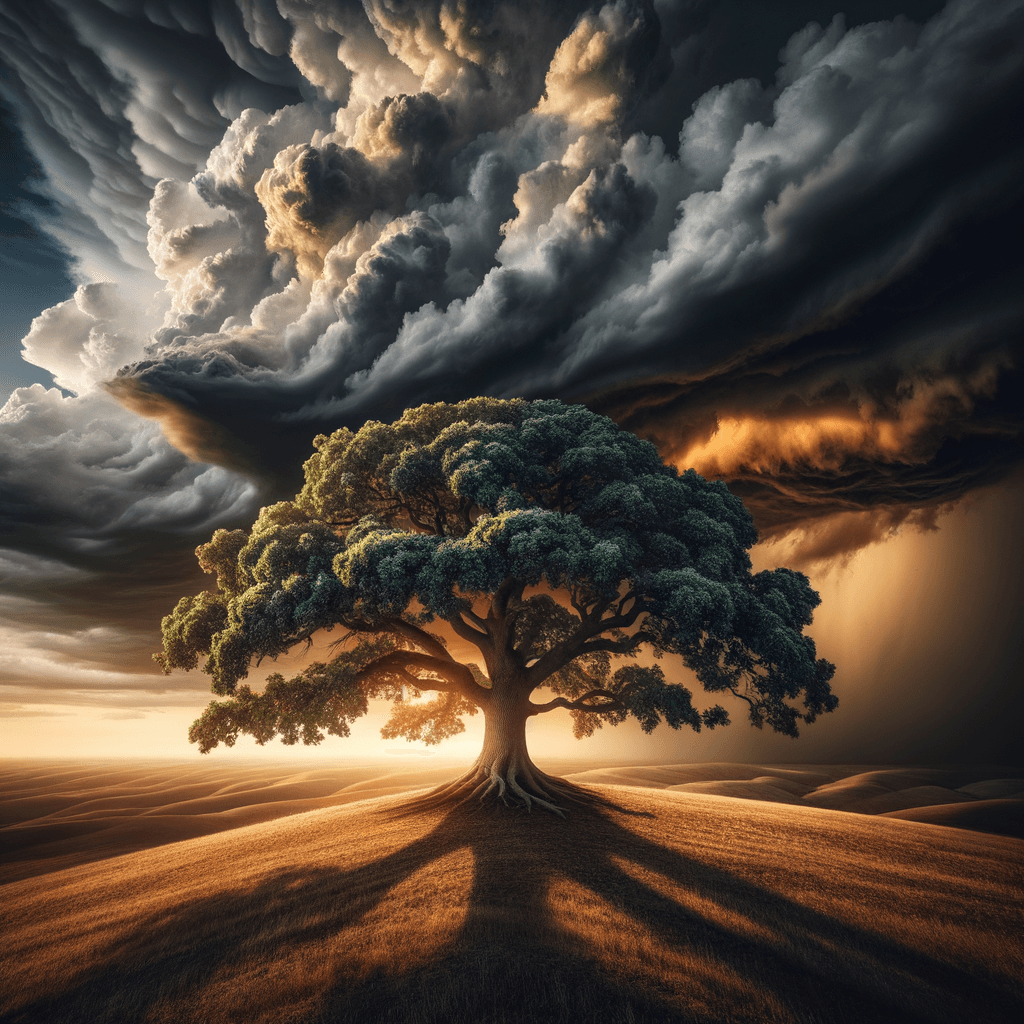
The strongest oak of the forest is not the one that is protected from the storm, but rather, it is the one that stands in the open, exposed to all the winds of heaven. — Napoleon Hill
—What lingers after this line?
Resilience and Growth
This quote highlights the notion that true strength and resilience come from facing challenges and adversities. The oak, exposed to storms, symbolizes growth that results from overcoming difficulties.
Embracing Challenges
Hill suggests that being sheltered or protected from struggles does not foster true strength. Instead, embracing and enduring hardships can lead to greater fortitude and character.
The Nature of True Strength
The idea conveyed is that true strength is not merely the absence of challenges but rather the ability to withstand and thrive despite them. The oak thrives because it faces the winds head-on.
Life's Lessons
This quote serves as a metaphor for life, where facing challenges can lead to personal development and a deeper understanding of one's own capabilities.
Napoleon Hill's Philosophy
Napoleon Hill was a prominent self-help author known for his works on personal success and achievement. His ideas often emphasize the importance of mindset and the benefits of overcoming adversity.
One-minute reflection
Where does this idea show up in your life right now?
Related Quotes
6 selectedDon't fight the challenges. Just find a new way to stand. — Germany Kent
Germany Kent
Germany Kent’s words begin with a quiet reversal of instinct: instead of treating every challenge as an enemy to defeat, she invites us to reconsider our posture toward difficulty. The emphasis is not on surrender, but o...
Read full interpretation →Optimist: someone who figures that taking a step backward after taking a step forward is not a disaster, it's more like a cha-cha. — Robert Brault
Robert Brault
Robert Brault’s line begins with a witty redefinition: an optimist is not someone who denies backward motion, but someone who interprets it differently. Instead of treating a setback as proof of failure, the optimist see...
Read full interpretation →A mind grows by staying with difficulty long enough for the experience to change it. — Mary Catherine Bateson
Mary Catherine Bateson
Mary Catherine Bateson’s observation begins with a quiet but demanding truth: the mind does not grow merely by encountering difficulty, but by remaining with it. Challenge becomes transformative only when we resist the u...
Read full interpretation →When you are friends with your storm, you dance, instead of getting blown away. — Michael Bassey Johnson
Michael Bassey Johnson
Michael Bassey Johnson’s line begins with a striking reversal: the storm is not merely an enemy to survive, but a force one can learn to understand. In this sense, the storm may represent grief, fear, conflict, uncertain...
Read full interpretation →Just because your light flickers does not mean it is about to go out. — Yohancé Salimu
Yohancé Salimu
At first glance, Yohancé Salimu’s line separates appearance from reality. A flicker suggests instability, fatigue, or interruption, yet it does not automatically signal extinction.
Read full interpretation →When something in your life dies—whether it be a job, a hobby, or a dream—I encourage you not to focus on what could have been but instead to look for the new life and the new opportunities that result. — Ryan Hall
Ryan Hall
Ryan Hall frames loss as a kind of death, and that metaphor immediately broadens the quote beyond grief in the literal sense. A job can end, a cherished hobby can fade, and a long-held dream can collapse; yet in each cas...
Read full interpretation →More From Author
More from Napoleon Hill →If you don't control what you think, you can't control what you do. Simply, self-discipline enables you to think first and act afterward. — Napoleon Hill
Napoleon Hill’s statement begins with a simple but demanding premise: behavior does not appear out of nowhere, but grows from thought. If the mind is scattered, impulsive, or ruled by fear, then action will likely follow...
Read full interpretation →Everything that is created in the world is first created in the mind, then brought into reality through persistent care. — Napoleon Hill
Napoleon Hill’s statement begins with a bold premise: every created thing exists first as an idea before it becomes an object, achievement, or institution. In this view, the mind is not merely a place of private reflecti...
Read full interpretation →If you do not conquer self, you will be conquered by self. — Napoleon Hill
Napoleon Hill’s statement turns the self into both battlefield and opponent. At first glance, it sounds severe, yet its logic is simple: if we do not govern our impulses, fears, and habits, those inner forces will quietl...
Read full interpretation →The flame doesn't appear before the match. It is always action that creates the fire. — Napoleon Hill
Napoleon Hill’s image is simple but forceful: a flame does not mysteriously appear on its own; it requires the friction of a struck match. In the same way, desire, talent, and intention remain dormant until they are tran...
Read full interpretation →