
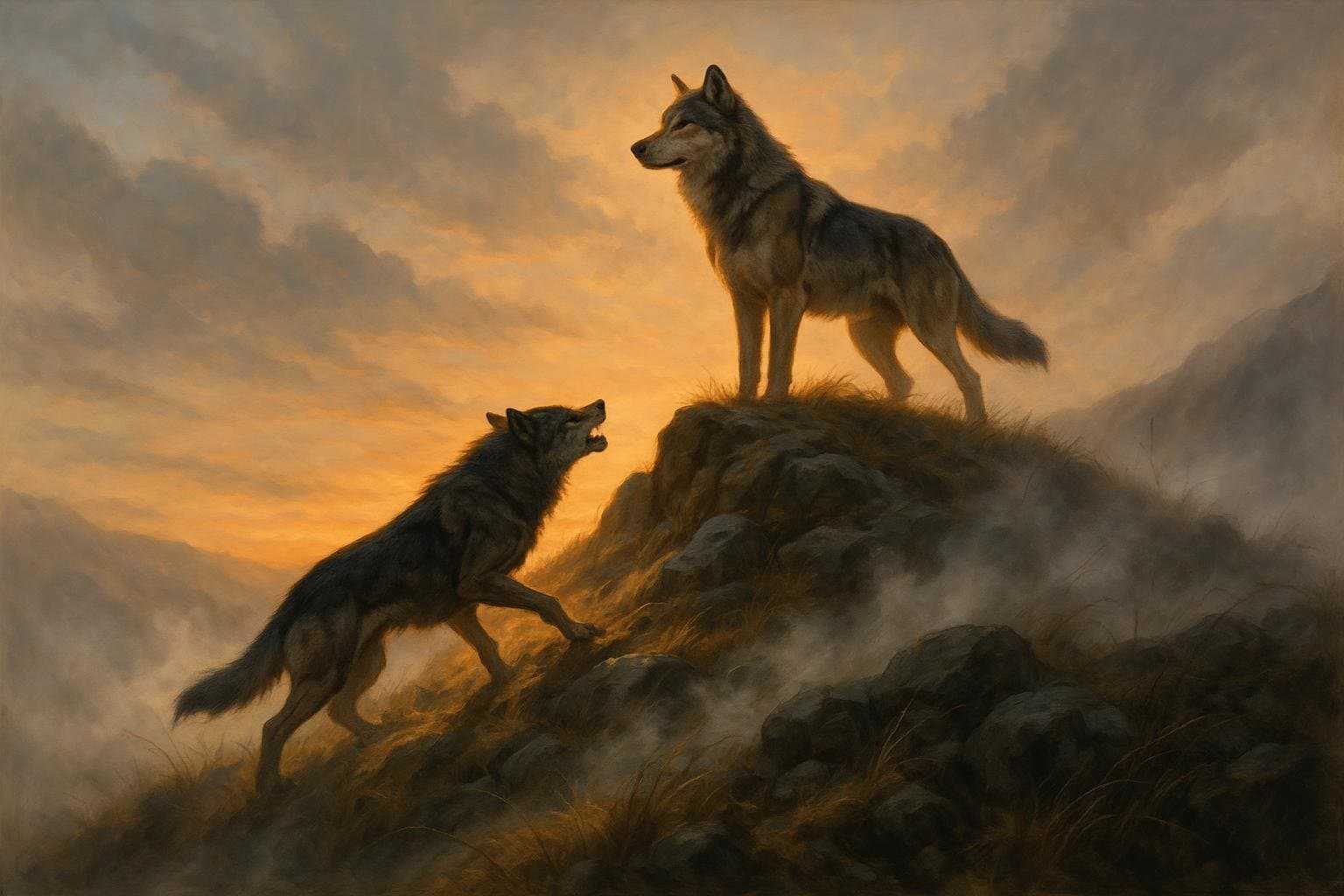
The wolf on the hill is not as hungry as the wolf climbing the hill. — Arnold Schwarzenegger
—What lingers after this line?
The Power of Ambition
Arnold Schwarzenegger’s quote draws a powerful distinction between the contentment of those who have achieved their goals and the relentless drive of those still aspiring. The ‘wolf climbing the hill’ symbolizes ambition—the energy that propels individuals to strive for more. This hunger for progress has been a driving force behind countless historical achievements, as seen in the tireless inventors of the Industrial Revolution who pushed boundaries, never fully satisfied with what already existed.
Complacency at the Summit
In contrast, the ‘wolf on the hill’ embodies a sense of accomplishment followed by potential complacency. Once success is attained, the urgency that accompanies striving can give way to comfort and even stagnation. The sports world offers countless examples: championship teams often struggle to maintain the same hunger after winning a title, a challenge described in Michael Jordan’s reflections on continuous motivation even after repeated victories.
Perpetual Growth and Challenge
Yet, the analogy reminds us that growth is less about arrival and more about the journey. Like Sisyphus in Greek mythology, whose punishment was to forever push a boulder uphill, it is the act of striving that keeps individuals engaged and alive. This concept extends to creative professions, where artists and writers often find their greatest work emerges not after recognition, but while still seeking it—motivated by the fierce hunger that uncertainty and ambition provide.
Modern Motivation and Self-Improvement
Transitioning to contemporary life, the idea resonates with today’s emphasis on self-improvement and the ‘growth mindset’ popularized by psychologist Carol Dweck. Her research shows that individuals who embrace challenges and persist through setbacks (the wolves climbing) are more likely to achieve excellence than those resting on prior successes. This perspective reframes obstacles not as threats, but as opportunities to fuel ambition and resilience.
Sustaining Hunger After Success
Ultimately, Schwarzenegger’s words invite us to reflect on how to maintain hunger even after we’ve achieved our goals. Many successful figures consciously set new objectives to avoid stagnation; for example, after dominating bodybuilding, Schwarzenegger transitioned to a stellar film career, and then into politics. This cycle of resetting and re-engaging with new hills ensures that the hunger to climb never fades, keeping drive and fulfillment alive throughout one’s journey.
One-minute reflection
What does this quote ask you to notice today?
Related Quotes
6 selectedIf we are facing in the right direction, all we have to do is keep walking. — Thích Nhất Hạnh
Thich Nhat Hanh
Thích Nhất Hạnh’s words begin with a simple but profound premise: progress depends first on direction, not speed. If a person is turned toward compassion, clarity, healing, or truth, then each modest step becomes meaning...
Read full interpretation →Learn to be thankful for what you already have, while you pursue all that you want. — Jim Rohn
Jim Rohn
Jim Rohn’s advice begins with a delicate balance: appreciation for the present should not cancel ambition for the future. Instead, gratitude and aspiration can move together, like two steps in the same journey.
Read full interpretation →Do the best one can. Do it over again. Then still improve, even if ever so slightly, those retouches. — Marguerite Yourcenar
Marguerite Yourcenar
Yourcenar’s words begin with a simple demand: do the best one can. Yet she immediately refuses to let effort become an excuse for stopping.
Read full interpretation →A good-enough novel violently written now is better than a perfect novel meticulously written never. — Elizabeth Gilbert
Elizabeth Gilbert
Elizabeth Gilbert’s line immediately shifts the argument from artistic purity to artistic existence. A “good-enough” novel, even one “violently written,” has entered the world and can move, provoke, or comfort someone; b...
Read full interpretation →There is no road too long to the man who advances deliberately and without undue haste; there are no honors too distant to the man who prepares himself for them with patience. — Jean de La Bruyère
Jean de La Bruyère
At its core, La Bruyère’s line praises steady movement over restless speed. A long road feels intimidating only when seen all at once; once it is broken into deliberate steps, distance loses much of its power.
Read full interpretation →If you are not failing from time to time, you are not aiming high enough. — Soichiro Honda
Soichiro Honda
At its core, Soichiro Honda’s remark reframes failure from a mark of inadequacy into proof of aspiration. If every attempt succeeds smoothly, the goal may be too safe, too familiar, or too small to stretch one’s abilitie...
Read full interpretation →More From Author
More from Arnold Schwarzenegger →The pain you feel today will be the strength you feel tomorrow. — Arnold Schwarzenegger
This quote highlights the idea that enduring pain and challenges can lead to personal strength and resilience. It suggests that hardship is a necessary part of growth.
Read full interpretation →You can’t climb the ladder of success with your hands in your pockets. — Arnold Schwarzenegger
This quote highlights that success requires active effort and work. You cannot expect to achieve success by being passive or uninvolved; you must take deliberate actions towards your goals.
Read full interpretation →Strength does not come from winning. Your struggles develop your strength. — Arnold Schwarzenegger
This quote highlights the idea that true strength is developed through overcoming difficulties. It is the struggles and obstacles that help build resilience and fortitude, rather than the act of winning itself.
Read full interpretation →Courage is like a muscle; it needs to be exercised. — Arnold Schwarzenegger
Just like physical muscles, courage grows stronger when put to use regularly.
Read full interpretation →