
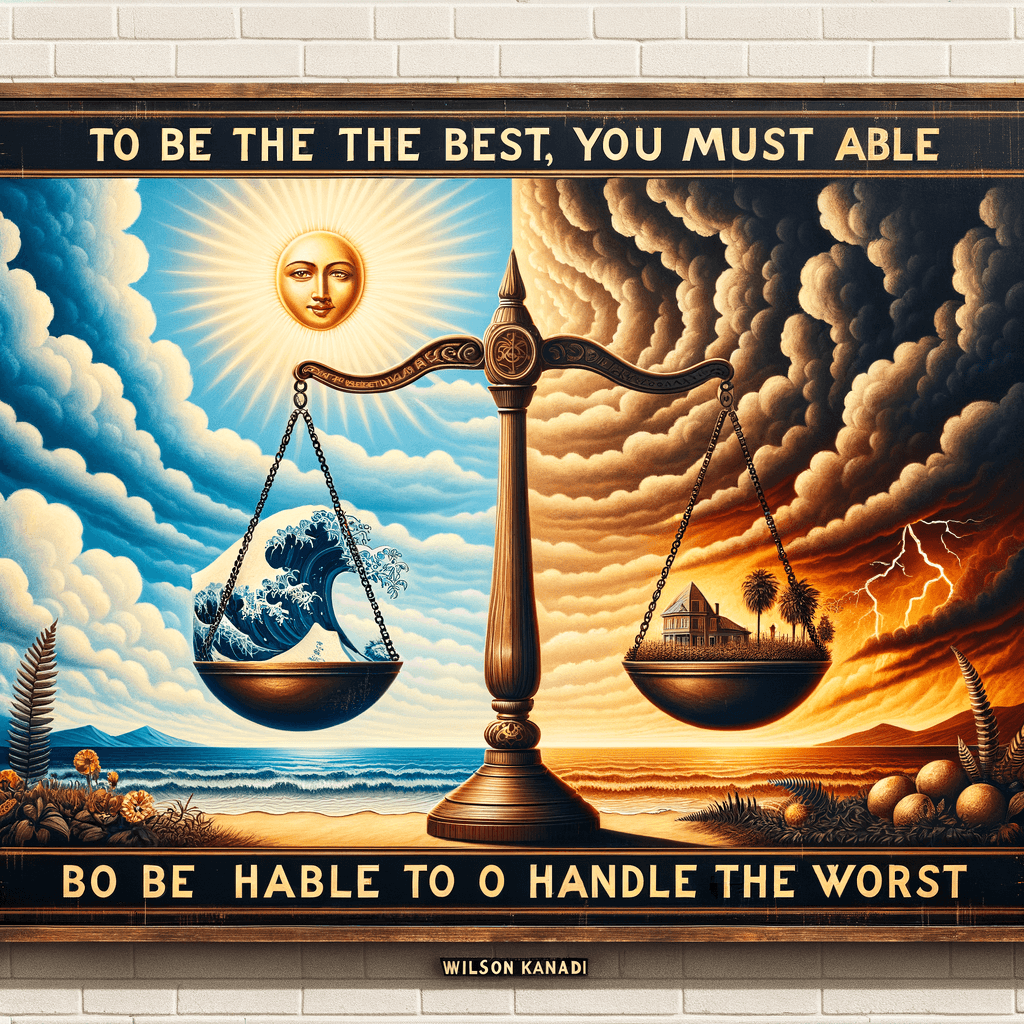
To be the best, you must be able to handle the worst. — Wilson Kanadi
—What lingers after this line?
Resilience in Adversity
This quote emphasizes the importance of resilience. To achieve greatness, one must learn to navigate and overcome challenges and setbacks, viewing them as essential experiences on the path to success.
Preparation for Challenges
It suggests that being prepared for tough situations is crucial. The journey to becoming the best is often fraught with difficulties, and those who can withstand these trials are more likely to excel.
Growth Through Struggle
Kanadi's assertion highlights that personal growth often comes from facing and dealing with hardships. The ability to confront the worst situations fosters strength and character, which are vital attributes of the best individuals.
Mental Fortitude
Handling the worst requires mental toughness and grit. This quote reinforces the idea that to compete at the highest level and achieve success, one must cultivate a strong mindset capable of enduring pressure and challenges.
Competitive Spirit
The quote reflects the competitive nature of various fields, whether in sports, business, or personal achievements. It serves as a reminder that excellence is not just about talent but also about the ability to face and overcome adversity effectively.
Recommended Reading
As an Amazon Associate, we earn from qualifying purchases.
One-minute reflection
What does this quote ask you to notice today?
Related Quotes
6 selectedIf you have passed through life without an opponent, no one can ever know what you are capable of, not even you. — Seneca
Seneca
At its core, Seneca’s remark argues that ability remains largely invisible until it meets resistance. A life without opponents may feel peaceful, yet it offers few occasions to prove courage, discipline, or endurance.
Read full interpretation →It does not matter what you bear, but how you bear it. — Seneca
Seneca
At its heart, Seneca’s remark shifts attention away from suffering itself and toward character. Misfortune, pain, and limitation are often beyond human control, yet our response remains a moral choice.
Read full interpretation →Peace is not freedom from the storm, but peace amid the storm. — Martin Luther King Jr.
Martin Luther King Jr.
Martin Luther King Jr.’s words redefine peace as something deeper than comfort or calm surroundings. Rather than imagining peace as the total absence of conflict, pain, or uncertainty, he presents it as an inner steadine...
Read full interpretation →Yield and overcome, bend and be straight. — Lao Tzu
Lao Tzu
At first glance, Lao Tzu’s line seems contradictory: how can yielding lead to overcoming, or bending result in straightness? Yet this paradox lies at the heart of Taoist thought.
Read full interpretation →A blazing fire makes flame and brightness out of everything that is thrown into it. — Marcus Aurelius
Marcus Aurelius
Marcus Aurelius compresses a central Stoic lesson into a vivid image: a strong fire does not merely endure what is cast into it, but transforms it into more flame and light. In that sense, adversity is not just something...
Read full interpretation →The creative process is often fraught with setbacks, criticism, and rejection. Focus on what you can control and let go of what you cannot. — Seneca
Seneca
At its core, this thought reflects Seneca’s Stoic distinction between what belongs to us and what does not. In the creative process, effort, discipline, and integrity remain within an artist’s control, while public taste...
Read full interpretation →More From Author
More from Wilson Kanadi →