
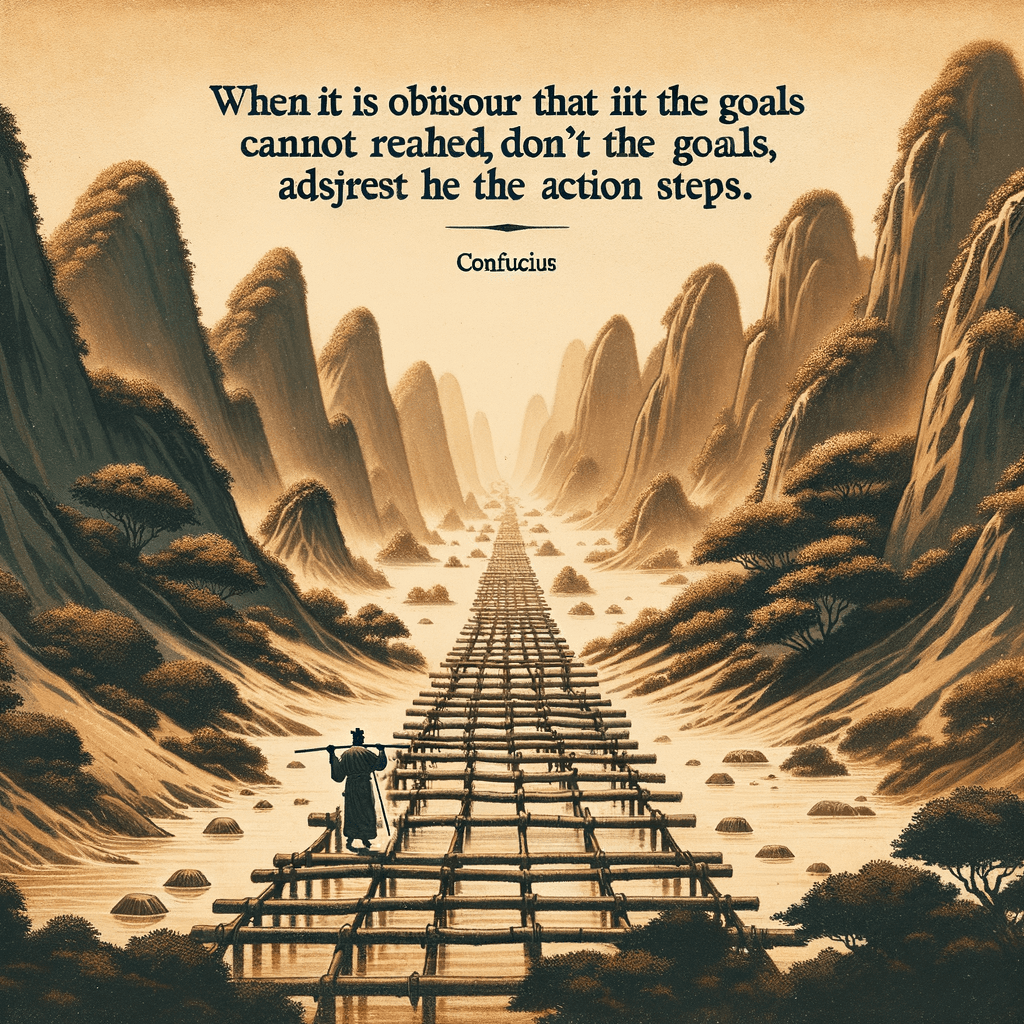
When it is obvious that the goals cannot be reached, don't adjust the goals, adjust the action steps. — Confucius
—What lingers after this line?
Perseverance and Adaptability
This quote emphasizes the importance of perseverance and adaptability. When faced with challenges, the key is to find alternative approaches rather than giving up on the goals.
Goal Commitment
It highlights the importance of staying committed to one’s goals. Rather than altering the goals themselves, one should change the methods or strategies to achieve them.
Strategic Flexibility
The quote suggests the idea of strategic flexibility. Being open to changing one’s approach can lead to discovering more effective ways to reach the desired objectives.
Problem-Solving Mindset
Confucius advocates for a problem-solving mindset. When confronted with obstacles, adjusting the plan of action helps overcome hindrances and move forward.
Resilience
It reinforces the concept of resilience. By modifying actions, one demonstrates resilience and the ability to bounce back from setbacks while still pursuing their aspirations.
Historical and Philosophical Context
Confucius, an ancient Chinese philosopher, focused on moral integrity and practical wisdom. This quote reflects his teachings on continuous improvement and proactive behavior.
One-minute reflection
What does this quote ask you to notice today?
Related Quotes
6 selectedThe discipline of writing something down is the first step toward making it happen. — Lee Iacocca
Lee Iacocca
Lee Iacocca’s remark begins with a simple but powerful observation: ideas remain fragile while they stay in the mind. The moment a goal is written down, however, it gains shape, boundaries, and a sense of seriousness.
Read full interpretation →The discipline you learn and character you build from setting and achieving a goal can be more valuable than the achievement of the goal itself. — Bo Bennett
Bo Bennett
Bo Bennett’s quote shifts attention away from the trophy at the end and toward the person formed along the way. At first glance, goals seem valuable because they promise concrete results—money, status, fitness, or recogn...
Read full interpretation →If you want to gain momentum, begin by setting goals that are worthwhile but highly achievable. Master the basics. Then practice them every day without fail. — John C. Maxwell
John C. Maxwell
John C. Maxwell’s quote begins with a practical insight: momentum rarely appears out of nowhere.
Read full interpretation →Discipline is remembering what you want. — David Campbell
David Campbell
David Campbell’s line reframes discipline in a strikingly humane way. Rather than presenting it as grim self-denial, he suggests that discipline begins with memory: the active recollection of a deeper aim.
Read full interpretation →Clarity about the destination makes everything else negotiable. — Doran Gao
Doran Gao
Doran Gao’s line begins with a simple but powerful claim: once the destination is clear, many other decisions lose their rigidity. In other words, certainty about where one wants to go creates freedom in how to get there...
Read full interpretation →Set a clear aim and whittle it with daily craft until it stands complete. — Johann Wolfgang von Goethe
Johann Wolfgang von Goethe
Goethe’s sentence begins by insisting on a “clear aim,” because effort without direction tends to scatter into busywork. An aim is more than a wish; it’s a defined outcome that can guide decisions about what to practice...
Read full interpretation →More From Author
More from Confucius →Learning is a lifelong process of unlearning the need for immediate results. Patience is the discipline of trusting the slow, quiet compounding of your efforts. — Confucius
At its core, this saying presents learning not as a race toward instant achievement, but as a gradual reshaping of expectation. The phrase “unlearning the need for immediate results” suggests that education is not only a...
Read full interpretation →Anything worth having is worth waiting for, and everything worth doing is worth doing with patience. — Confucius
At its core, this saying ties value to delay. Confucius suggests that truly meaningful things do not arrive instantly; instead, they ask us to endure uncertainty, effort, and time.
Read full interpretation →A common man marvels at uncommon things. A wise man marvels at the commonplace. — Confucius
Confucius draws a quiet but profound distinction between two kinds of attention. The common man, in this saying, is captivated by what appears exceptional—spectacle, rarity, or public greatness.
Read full interpretation →To learn is to admit you do not know. The moment you stop being a student is the moment your growth ends. — Confucius
Confucius frames learning not as the display of knowledge but as the honest recognition of its limits. In that sense, to learn is to begin with humility: one must first admit, without shame, that there is something missi...
Read full interpretation →