
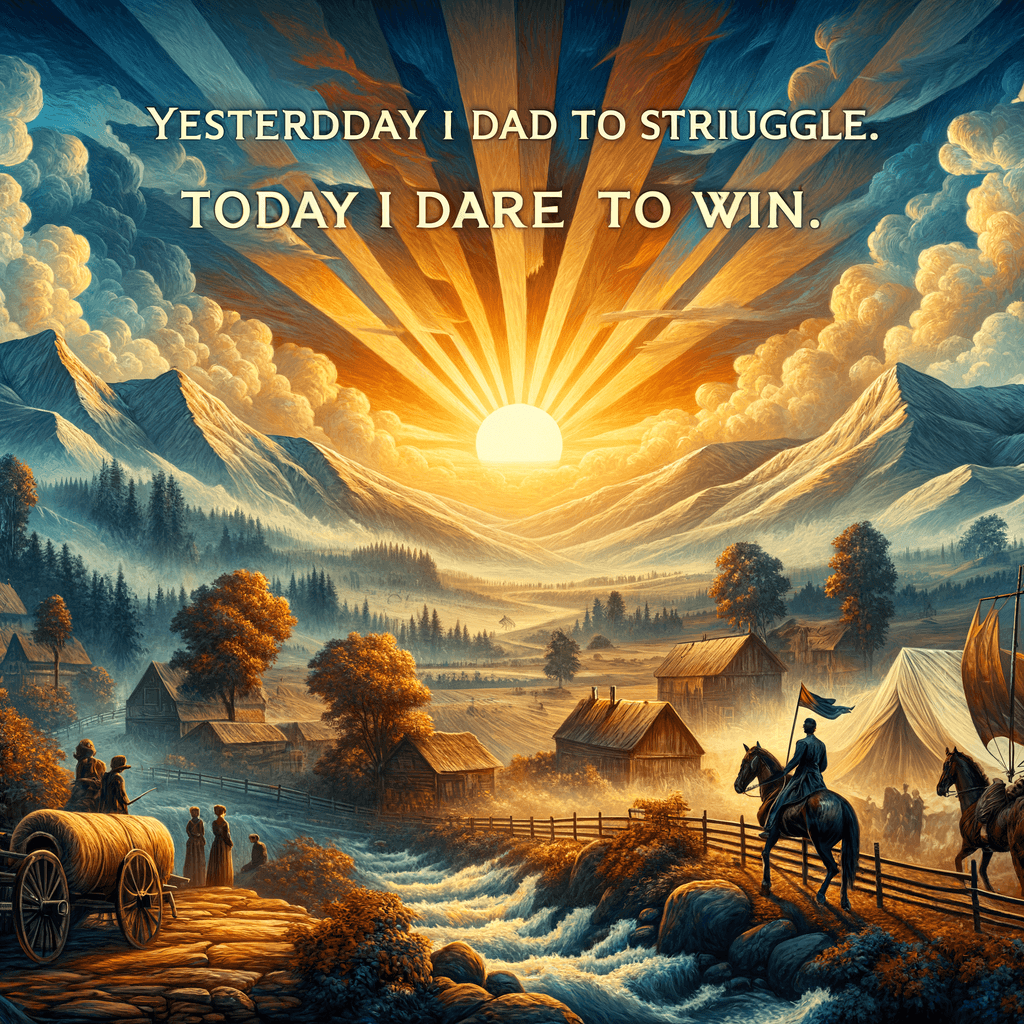
Yesterday I dared to struggle. Today I dare to win. — Bernadette Devlin
—What lingers after this line?
Overcoming Challenges
This quote highlights the progression from facing difficulties to achieving success. It emphasizes that the effort put into confronting challenges eventually leads to victory.
Persistence and Resilience
The quote underscores the importance of persistence and resilience. It suggests that daring to struggle in the past builds the strength and courage needed to win in the present.
Empowerment and Confidence
It illustrates a journey of empowerment where initially one finds the bravery to face struggles, and subsequently, this bravery transforms into the confidence to achieve goals.
Personal Growth
Devlin's words indicate that personal growth comes through challenging oneself. The struggles of yesterday contribute to the capabilities and readiness to win today.
Historical Context
Bernadette Devlin is an Irish civil rights leader and former politician known for her activism during the late 20th century. Her quote reflects the ethos of the civil rights movements and the fight for justice and equality.
One-minute reflection
What feeling does this quote bring up for you?
Related Quotes
6 selectedIf we are facing in the right direction, all we have to do is keep walking. — Thích Nhất Hạnh
Thich Nhat Hanh
Thích Nhất Hạnh’s words begin with a simple but profound premise: progress depends first on direction, not speed. If a person is turned toward compassion, clarity, healing, or truth, then each modest step becomes meaning...
Read full interpretation →Do the best one can. Do it over again. Then still improve, even if ever so slightly, those retouches. — Marguerite Yourcenar
Marguerite Yourcenar
Yourcenar’s words begin with a simple demand: do the best one can. Yet she immediately refuses to let effort become an excuse for stopping.
Read full interpretation →A good-enough novel violently written now is better than a perfect novel meticulously written never. — Elizabeth Gilbert
Elizabeth Gilbert
Elizabeth Gilbert’s line immediately shifts the argument from artistic purity to artistic existence. A “good-enough” novel, even one “violently written,” has entered the world and can move, provoke, or comfort someone; b...
Read full interpretation →There is no road too long to the man who advances deliberately and without undue haste; there are no honors too distant to the man who prepares himself for them with patience. — Jean de La Bruyère
Jean de La Bruyère
At its core, La Bruyère’s line praises steady movement over restless speed. A long road feels intimidating only when seen all at once; once it is broken into deliberate steps, distance loses much of its power.
Read full interpretation →There are no soft grounds in life. Just places to water and plough. — Athésia
Athésia
At first glance, Athésia’s line dismisses the hope that life might eventually deliver a permanently gentle terrain. There are, in this view, no naturally soft grounds waiting for us—no stage where effort disappears and g...
Read full interpretation →The greatest victory is the battle fought against your own desire to quit when things get quiet. — Epictetus
Epictetus
At first glance, this saying shifts the meaning of victory away from public triumph and toward an inward contest. The hardest battle, it suggests, is not fought in dramatic moments but in silence—when excitement fades, r...
Read full interpretation →More From Author
More from Bernadette Devlin →