
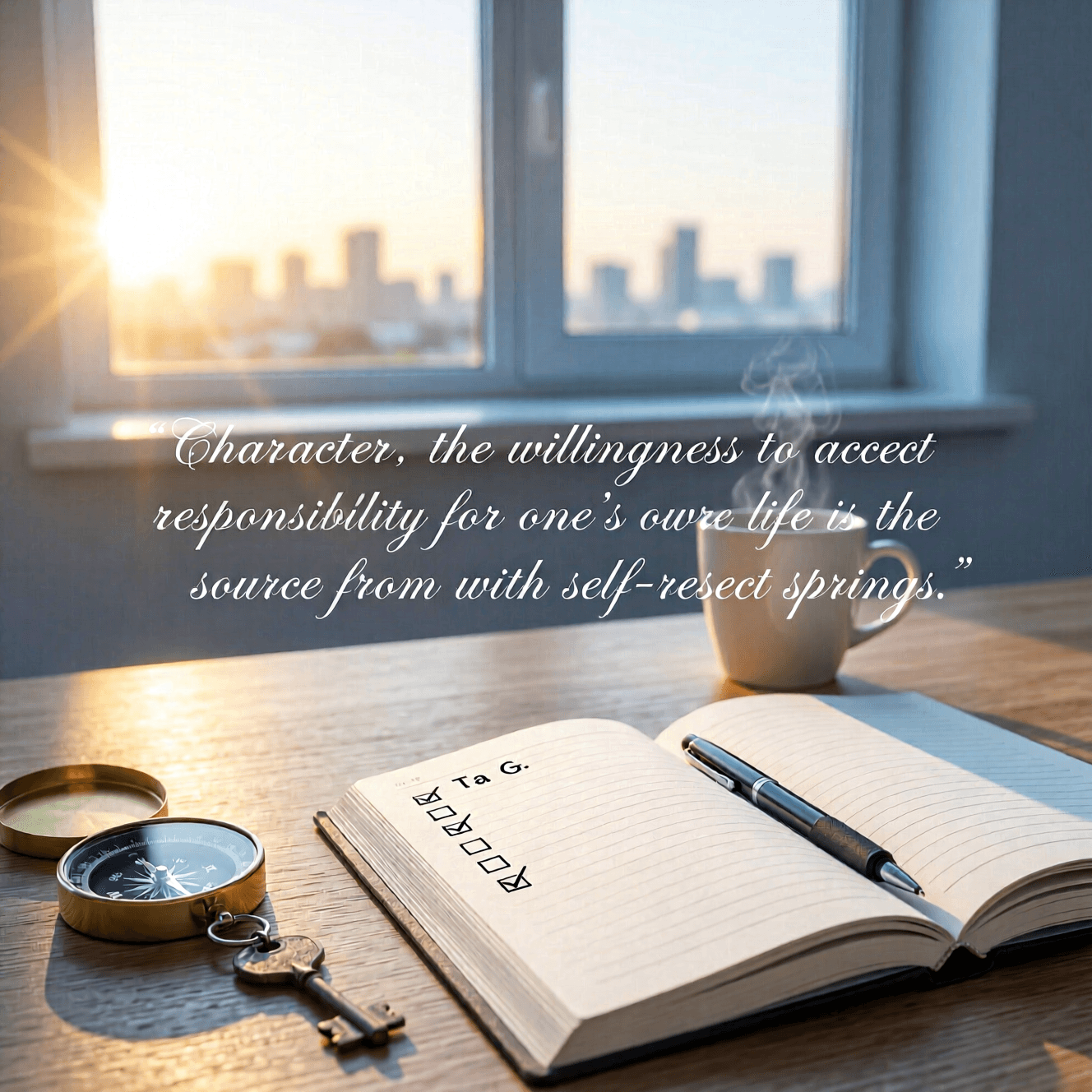
Character—the willingness to accept responsibility for one's own life—is the source from which self-respect springs. — Joan Didion
—What lingers after this line?
Didion’s Compact Definition of Character
Joan Didion frames character not as charm, talent, or reputation, but as a willingness to accept responsibility for one’s own life. The word “willingness” matters: it suggests an ongoing choice rather than a fixed trait, and it implies that character appears most clearly when avoidance would be easier. From the start, Didion ties inner strength to agency—an orientation that shifts the focus from what happens to us to what we decide to do with what happens. This definition sets up her second claim: self-respect is not something we declare into existence; it springs from a source. In other words, self-respect is portrayed as a consequence of lived alignment—built when our actions match our stated values and when we can look at our choices without flinching.
Agency Versus the Comfort of Blame
Moving from definition to implication, Didion’s line challenges one of the most tempting refuges in difficult times: the comfort of blaming circumstances, other people, or fate. While many setbacks are genuinely unfair, the habit of outsourcing responsibility can quietly erode dignity, because it trains the mind to see the self as mostly powerless. By contrast, accepting responsibility does not mean pretending we control everything; it means acknowledging the part that is ours—our responses, boundaries, work, and next steps. That shift can be small but decisive: it turns a life story from something narrated by accidents into something shaped by choices, and the resulting coherence is what begins to feel like self-respect.
How Responsibility Produces Self-Respect
From there, the “source” metaphor becomes clearer: self-respect grows when we can trust ourselves. Trust is built through repeated evidence—keeping promises, correcting mistakes, and facing consequences rather than hiding from them. Each time we own a decision and follow through, we add another plank to a private foundation that does not depend on external applause. Conversely, when we habitually dodge ownership—minimizing harms, rationalizing procrastination, or waiting for rescue—self-respect has little to draw on. It’s not punishment; it’s physics: without actions that demonstrate integrity, the feeling of self-respect has nothing solid to rest upon.
Responsibility Without Self-Blame
However, Didion’s idea can be misunderstood as harsh self-accusation, so it helps to separate responsibility from shame. Responsibility is forward-looking: it asks, “What is mine to do now?” Shame is identity-destroying: it insists, “I am the problem.” The first strengthens agency; the second often paralyzes it. This distinction matters in real life. Someone raised in chaos, for example, may not be responsible for early wounds, yet they can still responsibly seek support, learn healthier patterns, and stop repeating harm. Accepting responsibility becomes an act of care rather than cruelty—a way of steering, not sentencing.
Character Revealed in Ordinary Commitments
Next, Didion’s statement implies that character isn’t primarily proven in dramatic moments but in ordinary decisions that accumulate. Returning a missed call, admitting an error at work, sticking to a budget, apologizing without excuses—these small acts may feel mundane, yet they are where responsibility becomes a habit. Over time, the habit changes how a person stands in the world. Even when outcomes aren’t perfect, the knowledge that you showed up, told the truth, and did what you could creates a quiet steadiness. That steadiness is recognizably self-respect: not swagger, but the ability to meet your own eyes.
A Practical Path to Earning Self-Respect
Finally, Didion’s insight offers a practical path: if self-respect springs from responsibility, then cultivating it is less about affirmations and more about commitments you can keep. Start with one clear domain—health, relationships, work—and choose a responsibility that is measurable: “I will tell the truth about what I can deliver,” or “I will repair what I damage.” As those choices repeat, self-respect becomes less fragile because it’s anchored in evidence. And when you inevitably fall short, the same principle applies: own it, learn from it, and act again. In Didion’s sense, that ongoing willingness is what character looks like—and why self-respect can genuinely grow.
One-minute reflection
Why might this line matter today, not tomorrow?
Related Quotes
6 selectedI care for myself. The more solitary, the more friendless, the more unsustained I am, the more I will respect myself. — Charlotte Brontë
Charlotte Brontë
Charlotte Brontë’s words begin as a quiet but forceful act of self-possession. Rather than treating loneliness as proof of failure, the speaker transforms it into evidence of resilience.
Read full interpretation →We can secure other people's approval if we do right and try hard; but our own is worth a hundred of it. — Mark Twain
Mark Twain
At its heart, Mark Twain argues that external approval is attainable through good conduct and honest effort, yet it remains secondary to a deeper judgment: our own. Praise from others can reassure us, but it is often cha...
Read full interpretation →To have that sense of one's intrinsic worth which constitutes self-respect is potentially to have everything. — Joan Didion
Joan Didion
Joan Didion’s line hinges on a bold equivalence: self-respect is not merely one virtue among others but a potentially complete storehouse of inner resources. When she calls it “that sense of one’s intrinsic worth,” she p...
Read full interpretation →It is not true belonging if you have to betray yourself in order to stay. — Anthon St. Maarten
Anthon St. Maarten
At its heart, Anthon St. Maarten’s line draws a firm boundary between acceptance and self-erasure.
Read full interpretation →We are not victims of our impulses or emotions; we have the power to control them. It is time to relinquish the excuses. — Allie Brosh
Allie Brosh
At its core, Allie Brosh’s quote rejects the comforting idea that emotions and impulses are irresistible forces. Instead, it insists that human beings possess agency: the ability to pause, choose, and act deliberately ev...
Read full interpretation →Respect yourself enough to say no to what does not serve you. — Marianne Williamson
Marianne Williamson
Marianne Williamson’s quote begins with a quiet but powerful premise: self-respect is not merely a feeling but a standard for action. To respect yourself enough to say no means recognizing that your time, energy, and dig...
Read full interpretation →More From Author
More from Joan Didion →Do not whine. Do not complain. Work harder. — Joan Didion
At first glance, Joan Didion’s line reads like a blunt command, stripped of comfort or qualification. “Do not whine.
Read full interpretation →I think we are well-advised to keep on nodding terms with the people we used to be. — Joan Didion
Joan Didion’s line frames personal history as a relationship—one that can be tended, neglected, or openly severed. To be on “nodding terms” is not to embrace every past decision with pride, but to acknowledge that the pe...
Read full interpretation →To have that sense of one's intrinsic worth which constitutes self-respect is potentially to have everything. — Joan Didion
Joan Didion’s line hinges on a bold equivalence: self-respect is not merely one virtue among others but a potentially complete storehouse of inner resources. When she calls it “that sense of one’s intrinsic worth,” she p...
Read full interpretation →What matters most is how well we have lived. — Joan Didion
This quote emphasizes that the value of life is not measured by its length or external achievements but by the quality of experiences, relationships, and the fulfillment we have found.
Read full interpretation →