
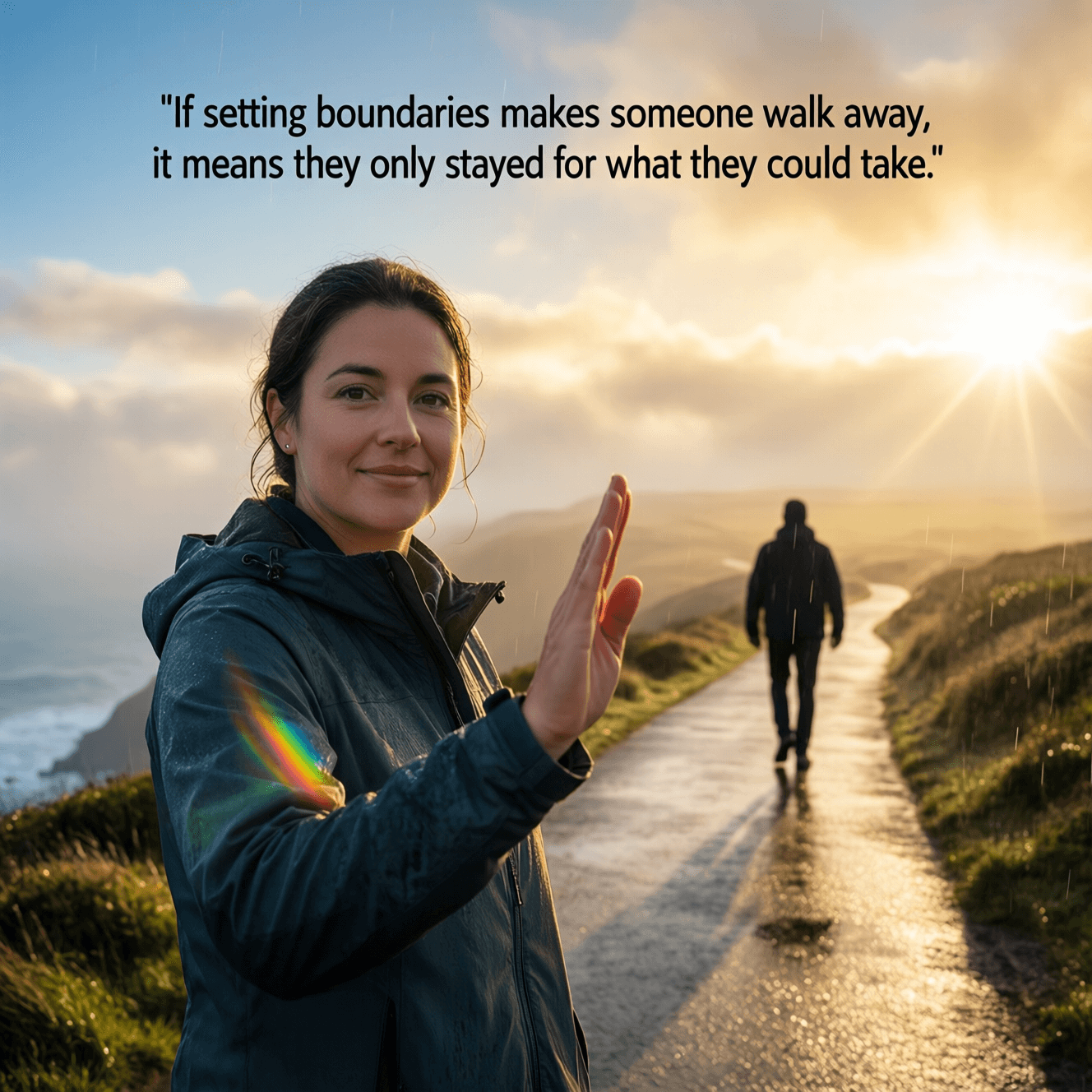
If setting boundaries makes someone walk away, it means they only stayed for what they could take. — Lisa Nichols
—What lingers after this line?
The Quote’s Core Test
Lisa Nichols frames boundaries as a kind of truth serum in relationships: once you name what you will and won’t accept, the relationship’s real motive becomes visible. If someone leaves the moment limits appear, the departure isn’t caused by the boundary itself so much as by what the boundary interrupts—access, control, convenience, or emotional supply. In that sense, the quote argues that boundaries don’t create selfishness in others; they simply expose it.
Boundaries Versus Control
To understand the claim, it helps to distinguish boundaries from attempts to control. A boundary is about your behavior and your participation—“I won’t stay in conversations where I’m insulted; I’ll leave the room if it happens.” Control is about forcing another person’s behavior—“You’re not allowed to be angry” or “You can’t see your friends.” Because boundaries are self-directed, someone who respects you can disagree, negotiate, or even feel disappointed while still honoring your autonomy. By contrast, someone invested in entitlement often experiences boundaries as an obstacle to their preferred extraction.
What Walking Away Can Signal
When a person exits as soon as limits are stated, it can suggest the relationship was organized around what they could obtain rather than what they could build. The “take” might be tangible (money, favors, housing) or intangible (attention, caretaking, status, sexual access, constant availability). An everyday example is the friend who only calls when they need a ride: the first time you say, “I can’t do late-night pickups anymore,” they vanish. The sudden silence doesn’t prove you were unkind; it often indicates the connection was transactional in practice, even if it sounded affectionate in words.
Why Boundaries Trigger Pushback
Nichols’ insight also reflects a common psychological dynamic: people accustomed to unearned access tend to interpret limits as rejection. As boundaries shift the balance of power, those who benefited from the old arrangement may protest, guilt-trip, or retreat to regain leverage. Meanwhile, people who genuinely care may still need time to adjust, yet they typically remain present and curious—asking what changed and how to adapt. The key transition here is from “Do they like me?” to “Do they respect my needs when it costs them something?”
The Grief and Relief of Enforcement
Even when a boundary is healthy, the outcome can feel painful because it reveals reality you hoped wasn’t true. There’s grief in realizing a bond may have depended on over-giving, people-pleasing, or silence. Yet there is also relief: walking away becomes information, not just abandonment. In practice, enforcing boundaries often narrows your circle at first, but it can increase the quality of what remains—relationships that survive limits tend to have sturdier foundations like reciprocity, consent, and emotional safety.
Using the Lesson Constructively
The quote ultimately invites a practical stance: treat boundaries as a filter, not a weapon. State them clearly, follow through consistently, and watch for patterns—respect, negotiation, and accountability versus contempt, punishment, or disappearance. If someone leaves, you can still reflect on tone and timing, but you don’t need to bargain away your self-respect to keep them. Over time, this approach shifts relationships from extraction to exchange, making space for connections that stay not for what they can take, but for who you are.
One-minute reflection
Why might this line matter today, not tomorrow?
Related Quotes
6 selectedIf someone throws a fit over your boundaries, it's just loud, colorful confirmation of exactly why you needed them. — Unknown
Unknown
The quote frames boundaries as a kind of relational truth serum: the moment you name a limit, you learn who benefits from you having none. Rather than treating a boundary as an act of hostility, it presents it as a pract...
Read full interpretation →I care for myself. The more solitary, the more friendless, the more unsustained I am, the more I will respect myself. — Charlotte Brontë
Charlotte Brontë
Charlotte Brontë’s words begin as a quiet but forceful act of self-possession. Rather than treating loneliness as proof of failure, the speaker transforms it into evidence of resilience.
Read full interpretation →If it costs my peace, it's outside my boundary. — Adam J. Jackson
Adam J. Jackson
At its core, Adam J. Jackson’s line reframes boundaries as more than rules we impose on others; they become protections for our inner life.
Read full interpretation →We can secure other people's approval if we do right and try hard; but our own is worth a hundred of it. — Mark Twain
Mark Twain
At its heart, Mark Twain argues that external approval is attainable through good conduct and honest effort, yet it remains secondary to a deeper judgment: our own. Praise from others can reassure us, but it is often cha...
Read full interpretation →It is not true belonging if you have to betray yourself in order to stay. — Anthon St. Maarten
Anthon St. Maarten
At its heart, Anthon St. Maarten’s line draws a firm boundary between acceptance and self-erasure.
Read full interpretation →Respect yourself enough to say no to what does not serve you. — Marianne Williamson
Marianne Williamson
Marianne Williamson’s quote begins with a quiet but powerful premise: self-respect is not merely a feeling but a standard for action. To respect yourself enough to say no means recognizing that your time, energy, and dig...
Read full interpretation →More From Author
More from Lisa Nichols →