
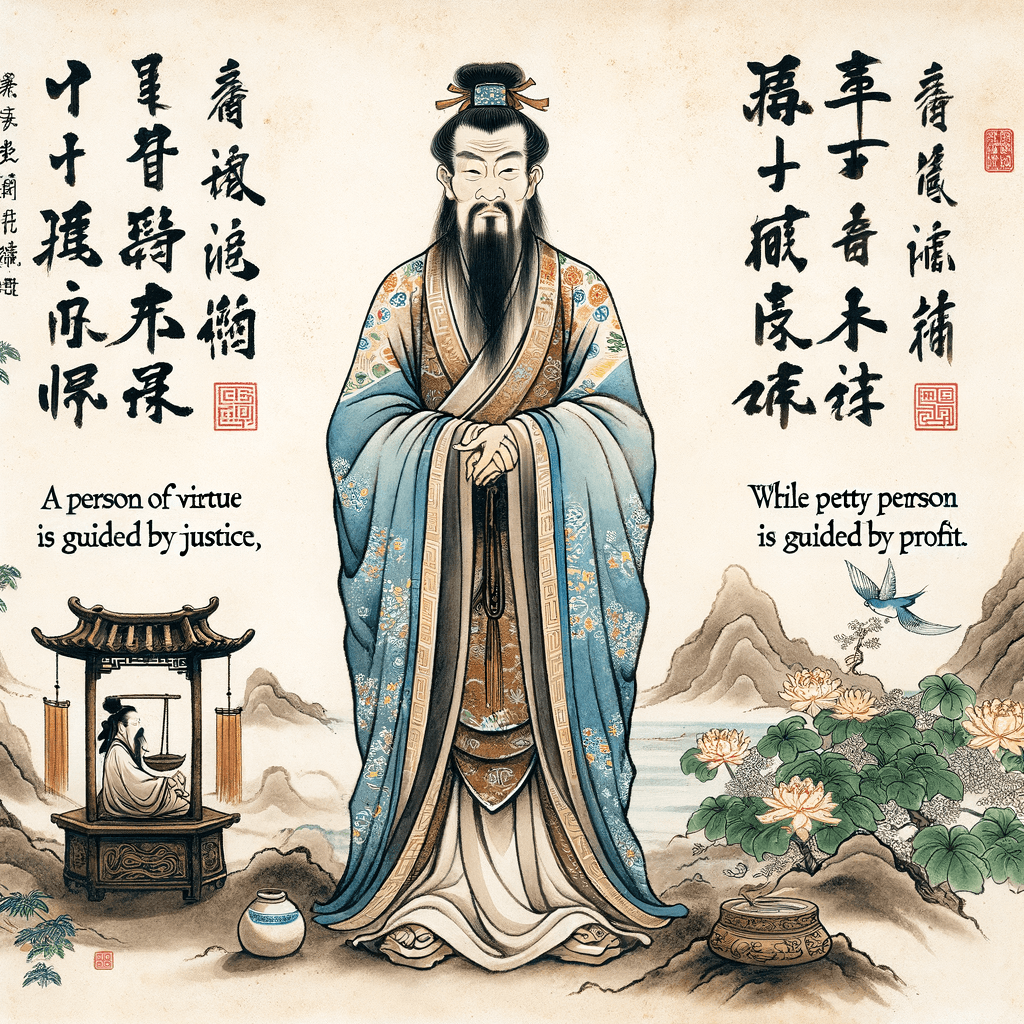
A gentleman understands what is right, while a petty person understands what is profitable. — Confucius
—What lingers after this line?
Moral Integrity
Confucius emphasizes the importance of moral integrity. A gentleman, or a virtuous person, prioritizes doing what is ethically right over personal gain.
Ethical Judgment vs. Self-Interest
This quote contrasts the ethical judgment of a gentleman with the self-interest of a petty person. While the gentleman seeks virtue, the petty person focuses on what benefits them materially or financially.
Character and Virtue
Confucius suggests that the true measure of a person's character is their ability to discern and act upon what is morally right, rather than what is merely advantageous.
Confucian Philosophy
In Confucian philosophy, being a 'gentleman' or 'junzi' means embodying virtues like righteousness, benevolence, and integrity. This quote reflects Confucius' teaching that moral excellence is far more important than material success.
Social Harmony
The emphasis on righteousness over profitability also highlights Confucius' belief in maintaining social harmony. When people prioritize ethical behavior, it contributes to a more just and harmonious society.
Timeless Guidance
Although Confucius lived over 2,500 years ago, his teachings remain relevant. This quote provides timeless guidance on the value of prioritizing ethical considerations over personal gain.
One-minute reflection
Where does this idea show up in your life right now?
Related Quotes
6 selectedWhen we see men of a contrary character, we should turn inwards and examine ourselves. — Confucius
Confucius
Confucius, the revered Chinese philosopher, believed that our encounters with people different from ourselves offer a unique opportunity for self-examination. His statement urges us not to rush to judgment when confronte...
Read full interpretation →Polish your character until it shines; others will come to admire the light. — Confucius
Confucius
To begin, the line evokes a central Confucian conviction: character refined from within radiates outward as moral light. Confucius calls this inner power de—virtue as a kind of quiet magnetism—and holds up the junzi, the...
Read full interpretation →The family is a place where principles are hammered and honed on the anvil of everyday living. — Charles R. Swindoll
Charles R. Swindoll
Charles R. Swindoll’s image of the family as an anvil immediately turns abstract morality into something tangible.
Read full interpretation →Intelligence plus character—that is the goal of true education. — Martin Luther King Jr., United States.
Martin Luther King Jr., United States.
This quote emphasizes the importance of a well-rounded education that goes beyond intellectual achievement. True education should cultivate both knowledge and moral character.
Read full interpretation →Character is destiny. — Heraclitus
Heraclitus
This quote implies that a person's character fundamentally shapes their life experiences and future. The qualities one possesses can determine success, relationships, and overall happiness.
Read full interpretation →What we leave behind is not as important as how we've lived. — Jimmy Stewart
Jimmy Stewart
This quote suggests that the true measure of a person's life is not the material or physical legacy they leave behind, but rather the way they lived their life and the values they upheld.
Read full interpretation →More From Author
More from Confucius →Learning is a lifelong process of unlearning the need for immediate results. Patience is the discipline of trusting the slow, quiet compounding of your efforts. — Confucius
At its core, this saying presents learning not as a race toward instant achievement, but as a gradual reshaping of expectation. The phrase “unlearning the need for immediate results” suggests that education is not only a...
Read full interpretation →Anything worth having is worth waiting for, and everything worth doing is worth doing with patience. — Confucius
At its core, this saying ties value to delay. Confucius suggests that truly meaningful things do not arrive instantly; instead, they ask us to endure uncertainty, effort, and time.
Read full interpretation →A common man marvels at uncommon things. A wise man marvels at the commonplace. — Confucius
Confucius draws a quiet but profound distinction between two kinds of attention. The common man, in this saying, is captivated by what appears exceptional—spectacle, rarity, or public greatness.
Read full interpretation →To learn is to admit you do not know. The moment you stop being a student is the moment your growth ends. — Confucius
Confucius frames learning not as the display of knowledge but as the honest recognition of its limits. In that sense, to learn is to begin with humility: one must first admit, without shame, that there is something missi...
Read full interpretation →