
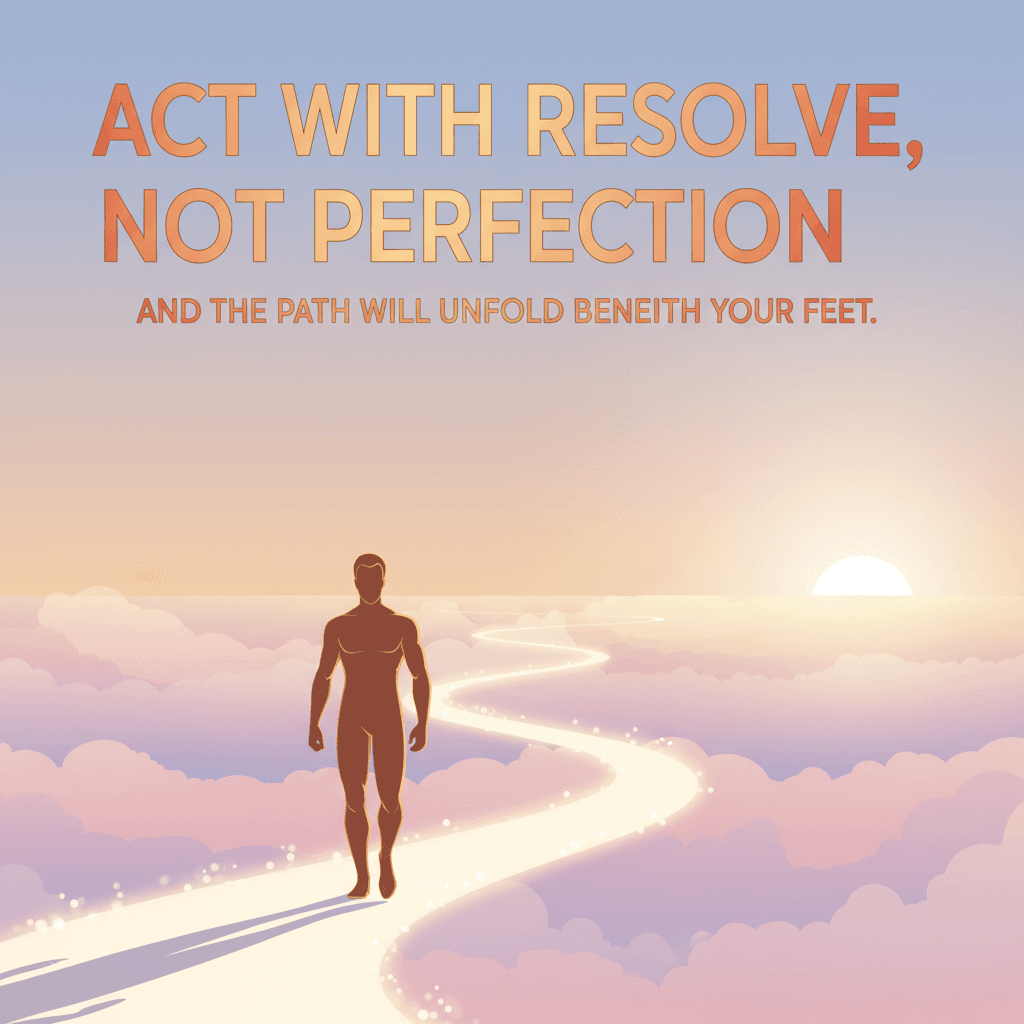
Act with resolve, not perfection, and the path will unfold beneath your feet. — Mary Anne Radmacher
—What lingers after this line?
The Core Message of the Quote
Mary Anne Radmacher’s line, “Act with resolve, not perfection, and the path will unfold beneath your feet,” captures a shift from overthinking to committed doing. Rather than waiting for flawless conditions or a foolproof plan, she urges us to choose decisive, value‑driven action. In this view, clarity about the journey does not precede movement; instead, it emerges as a consequence of moving. Much like a trail that only becomes visible with each step taken, our life direction sharpens only when we act. Thus, the quote invites us to trade the illusion of perfect readiness for the reality of imperfect progress.
Resolve as Commitment in Motion
To understand this shift, it helps to see resolve as commitment in motion rather than mere determination in thought. Resolve means choosing a direction and taking the next concrete step, even while uncertainties remain. Viktor Frankl, in *Man’s Search for Meaning* (1946), noted that meaning often appears when people commit themselves to a task or cause, not before. In the same spirit, Radmacher suggests that we do not need complete confidence or comprehensive answers to proceed. Instead, by anchoring ourselves in core values—such as integrity, curiosity, or service—we create a steady internal compass that guides each imperfect action forward.
The Trap and Cost of Perfectionism
By contrast, the pursuit of perfection can quietly paralyze us. Perfectionism demands certainty, exhaustive preparation, and an absence of visible mistakes before we begin. Psychologist Brené Brown, in *The Gifts of Imperfection* (2010), describes perfectionism as a shield against shame and judgment rather than a genuine drive for excellence. Under its influence, people delay important projects, avoid risks, or abandon ideas that do not promise guaranteed success. Radmacher’s quote counters this trap by implying that the imagined “perfect” path only exists in hindsight. From where we stand, the only real path is the one created by our willingness to act, learn, and adjust.
How Action Reveals the Hidden Path
Radmacher’s image of the path unfolding beneath our feet points to a practical truth: feedback arrives only after we move. An entrepreneur launches a small pilot, then discovers what customers actually need. A writer shares a draft, then learns which parts resonate. In both cases, the next steps become clear only because the first one was taken. Philosopher John Dewey argued in *Human Nature and Conduct* (1922) that experience is fundamentally experimental—we test, see what happens, and refine our course. Therefore, each resolute action, however modest, turns the unknown into the known. The path is not found fully mapped; it is co‑created through our ongoing engagement with reality.
Practicing Courageous, Imperfect Steps
Putting this wisdom into practice means favoring small, courageous experiments over grand, flawless plans. A person wanting a career change might conduct one informational interview each week rather than waiting for the ideal opportunity. Someone considering a creative project might commit to ten minutes a day instead of designing the perfect schedule. Over time, these modest acts accumulate into momentum, revealing options that were invisible from the starting line. By continually choosing resolve—clear intentions plus the next doable step—we gradually build confidence and direction. In this way, Radmacher’s counsel becomes a lived reality: as we step forward, the path we once hoped to see finally appears beneath us.
One-minute reflection
What's one small action this suggests?
Related Quotes
6 selectedA tiger does not proclaim his tigritude, he pounces. — Wole Soyinka
Wole Soyinka
Wole Soyinka’s line compresses a whole ethic into a single image: a tiger doesn’t narrate its identity; it embodies it. By contrasting “proclaiming” with “pouncing,” he treats competence as something proved in motion, no...
Read full interpretation →One clear action dissolves a thousand excuses. — Emily Dickinson
Emily Dickinson
Dickinson’s line hinges on a striking contrast: a single, concrete act can outweigh an entire inventory of explanations. Excuses multiply because they are easy to generate and hard to disprove, yet they remain weightless...
Read full interpretation →When doubt crowds in, make one clear choice and move your feet. — Helen Keller
Helen Keller
Helen Keller frames doubt as something that “crowds in,” suggesting a pressure that can shrink our sense of options and make thinking feel claustrophobic. Instead of treating that sensation as proof we should pause indef...
Read full interpretation →Turn hesitation into a single deliberate step, and mountains start to look like stones. — Haruki Murakami
Haruki Murakami
Murakami’s line hinges on a simple conversion: hesitation becomes action. Hesitation is not just waiting; it is often a form of self-protection that keeps desire and risk safely separated.
Read full interpretation →When doubt knocks, answer with a single focused action. — Toni Morrison
Toni Morrison
Toni Morrison frames doubt as something that “knocks,” suggesting it arrives from outside our plans like an unexpected caller at the door. This image matters because it implies doubt is not proof of incapacity; it is an...
Read full interpretation →Decide with depth, then act with urgency born of conviction. — Søren Kierkegaard
Søren Kierkegaard
Kierkegaard’s line begins by honoring depth: “Decide with depth” implies more than gathering facts or optimizing outcomes. It calls for wrestling with what truly matters—values, responsibilities, and the self you are bec...
Read full interpretation →More From Author
More from Mary Anne Radmacher →Dare to be different, to set your own trends, and to make your own mark. — Mary Anne Radmacher
This quote encourages individuals to embrace their uniqueness and not shy away from being different. It highlights the importance of expressing one's true self, even if it stands out from the crowd.
Read full interpretation →The hardest choice is to choose to act. — Mary Anne Radmacher
This quote highlights the difficulty of stepping out of one's comfort zone to take action, emphasizing that choosing to act often requires immense courage and determination.
Read full interpretation →Step boldly into your dreams; they are waiting for you. — Mary Anne Radmacher
This quote encourages individuals to take bold and confident steps toward their dreams, rather than hesitating or fearing failure.
Read full interpretation →Life is a challenge, it’s not a game. — Mary Anne Radmacher
This quote emphasizes that life should be approached with sincerity and seriousness rather than being treated frivolously or playfully like a game.
Read full interpretation →